Drone Warfare Dynamics and Urban Flooding Challenges
Source:Indian Express ↗
Why It Matters
This article perfectly captures two high-probability UPSC themes: the evolving nature of warfare (drones/UAVs) which is critical for GS3 Security, and the persistent issue of urban flooding linked to concretisation, which bridges GS1 Geography/Urbanization and GS3 Disaster Management.
Summary
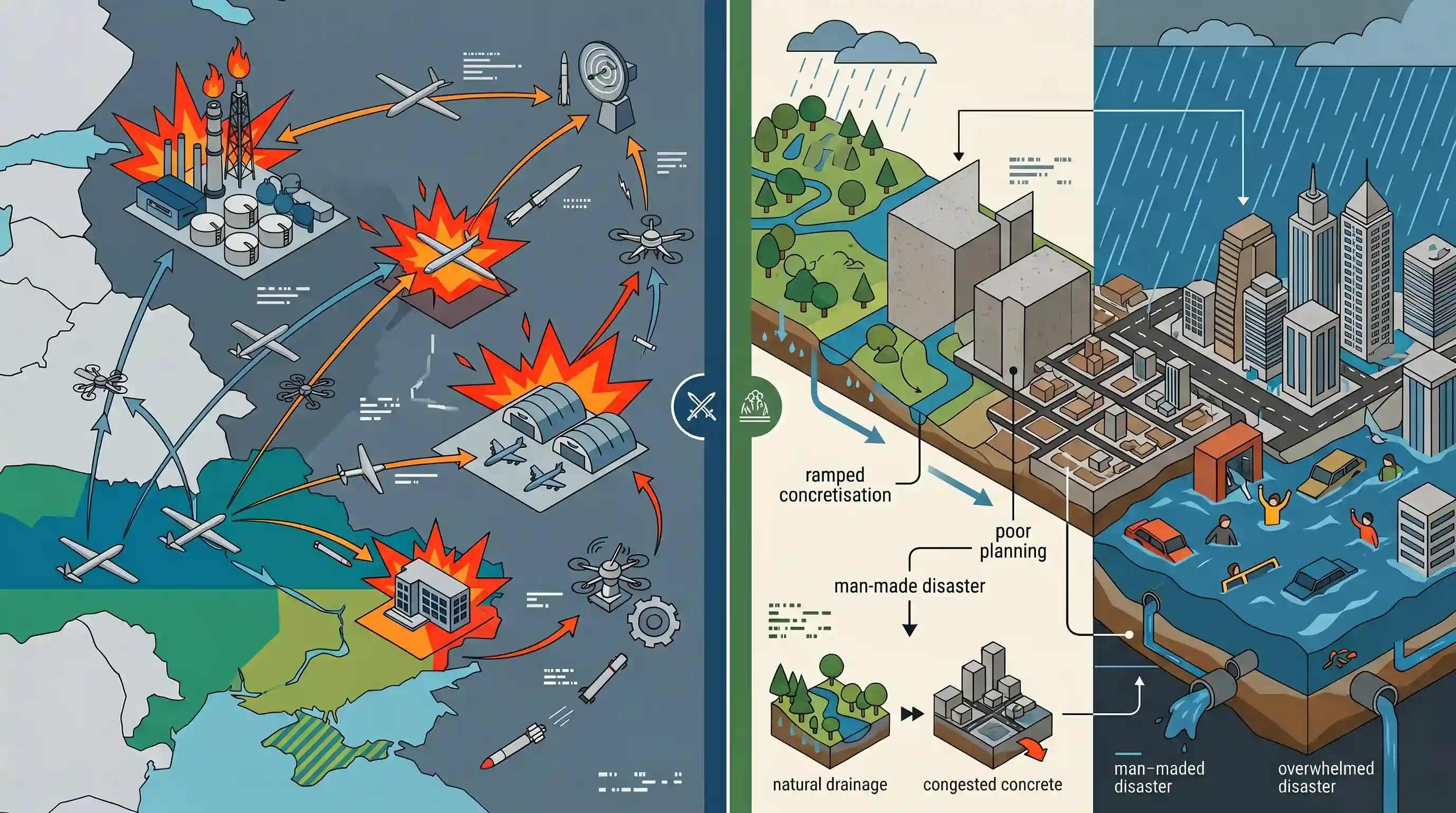
The article examines two distinct but critical contemporary issues: the strategic use of drones by Ukraine to execute deep strikes within Russia, highlighting the transformative role of UAVs in asymmetric warfare, and the escalating crisis of urban flooding in Indian cities. The latter is largely attributed to rampant concretisation and poor urban planning, which obliterate natural drainage systems and turn heavy rainfall into devastating man-made disasters.
Key Points
- Drones have emerged as a cost-effective, versatile tool in modern warfare, as demonstrated by Ukraine's deep strikes into Russia, fundamentally altering asymmetric conflict dynamics.
- The increasing reliance on UAVs necessitates rapid advancements in anti-drone systems and comprehensive air defense networks to safeguard critical infrastructure.
- Urban flooding in Indian metropolitan areas is increasingly a man-made disaster driven by rapid concretisation, unplanned urbanization, and the encroachment on natural drainage systems.
- The systematic destruction of natural water sinks—such as wetlands, lakes, and permeable soil—drastically increases surface runoff, which easily overwhelms outdated municipal drainage networks.
- Effective mitigation requires transitioning towards 'sponge city' concepts, restoring ecological infrastructure, and strictly regulating land-use changes to manage climate-induced extreme rainfall.
Important Terms
National Disaster Management Authority (NDMA)

The apex statutory body for disaster management in India, chaired by the Prime Minister. It issued separate guidelines for Urban Flooding (2010), emphasizing it as a distinct hazard from riverine floods.
UPSC context
GS-III: Disaster Management; crucial for understanding India's institutional framework for managing urban and man-made disasters.
Asymmetric Warfare
A conflict where a weaker adversary uses unconventional, low-cost tactics—such as drone strikes—to exploit the vulnerabilities of a technologically or numerically superior military power.
UPSC context
GS-III: Internal Security and Defense Technology; focuses on the changing nature of modern conflict and non-linear threats.
Unmanned Aerial Vehicles (UAVs)
Commonly known as drones, these are aircraft operated remotely or autonomously. They are pivotal in modern warfare for intelligence, surveillance, reconnaissance (ISR), and executing high-precision deep strikes.
UPSC context
GS-III: Science and Technology; Defense; essential for questions on indigenization of technology and battlefield transformation.
AMRUT (Atal Mission for Rejuvenation and Urban Transformation)
A flagship mission launched in 2015 (now AMRUT 2.0) focusing on universal water supply and improving sewerage and stormwater drainage systems to enhance urban flood resilience.
UPSC context
GS-II: Government Policies; GS-III: Urbanization; relevant for infrastructure-led solutions to urban flooding and water management.
Smart Cities Mission
An urban renewal mission aiming to develop 100 sustainable cities. It utilizes Integrated Command and Control Centres (ICCCs) as 'war rooms' for real-time disaster monitoring and emergency response.
UPSC context
GS-I/III: Urbanization; Disaster Management; highlights the role of technology in building climate-resilient and smart urban infrastructure.
Urban Concretisation
The replacement of natural, permeable green cover with impermeable surfaces like concrete and asphalt. This prevents rainwater percolation, leading to increased runoff and "man-made" urban flooding.
UPSC context
GS-III: Environment and Disaster Management; tests understanding of developmental causes behind increasing urban flood frequency.
Prelims Trap
Soft-kill anti-drone systems use directed energy weapons (lasers) to physically destroy incoming UAVs.
Soft-kill relies on electronic warfare (jamming RF/GPS or spoofing). Directed energy weapons (lasers, microwaves) that physically damage or burn the drone are classified as Hard-kill systems.
Static Concepts Connected
What are the core principles of a 'Sponge City'?
- Natural absorption: Using permeable pavements, rain gardens, and green roofs to naturally absorb and filter surface runoff.
- Ecological restoration: Rejuvenating urban wetlands, floodplains, and lakes to act as natural water reservoirs during heavy rainfall.
- Sustainable drainage: Transitioning from traditional grey infrastructure (pipes) to blue-green infrastructure to delay and manage peak water flow.
How do anti-drone systems (C-UAS) neutralize threats?
- Soft-kill: Disrupts the drone non-kinetically by jamming GPS/radio frequencies or spoofing communication links to force a landing.
- Hard-kill: Physically destroys or disables the drone using kinetic projectiles, directed energy weapons (lasers), or capturing nets.
- DRDO D4 System: India's indigenous anti-drone system features both soft-kill jamming and hard-kill laser-based destruction capabilities.
Cross-Topic Patterns
Asymmetric warfare & Indigenisation
Cheap drone strikes in Ukraine show how asymmetric tech challenges conventional forces, elevating the GS3 relevance of India's indigenous drone swarms and DRDO anti-drone projects.
Micro-climate & Urban Flooding
Concretisation not only prevents groundwater recharge but exacerbates the Urban Heat Island effect, which alters micro-climates and triggers the localized high-intensity rainfall that causes flooding.

Urban flooding as an anthropogenic hazard (GS3) and the technical mechanisms of C-UAS (soft vs hard kill) are highly probable for 2026.
Linked PYQs · 5
Linked PYQs · 5
- 2024MainsGS3
Flooding in urban areas is an emerging climate-induced disaster. Discuss the causes of this disaster. Mention the features of two such major floods in the last two decades in India. Describe the policies and frameworks in India that aim at tackling such floods.
- 2020MainsGS1
Account for the huge flooding of million cities in India including the smart ones like Hyderabad and Pune. Suggest lasting remedial measures.
- 2021MainsGS1
What are the environmental implications of the reclamation of water bodies into urban land use ? Explain with examples.
- 2023MainsGS3
The use of unmanned aerial vehicles (UAVs) by our adversaries across the borders to ferry arms/ammunitions, drugs, etc., is a serious threat to the internal security. Comment on the measures being taken to tackle this threat.
- 2025PrelimsGS1
With reference to Unmanned Aerial Vehicles (UAVs), consider the following statements : I. All types of UAVs can do vertical landing. II. All types of UAVs can do automated hovering. III. All types of UAVs can use battery only as a source of power supply. How many of the statements given above are correct?
