Marine Turtles Conservation and Examination Governance Challenges
Source:Indian Express ↗
Why It Matters
The topics span multiple UPSC domains: marine conservation is a frequent GS1/GS3 environment topic, exam paper leaks touch upon GS2 governance and GS4 ethics (probity and corruption), while carbon tax is a core GS3 topic combining economy and environmental mitigation.
Summary
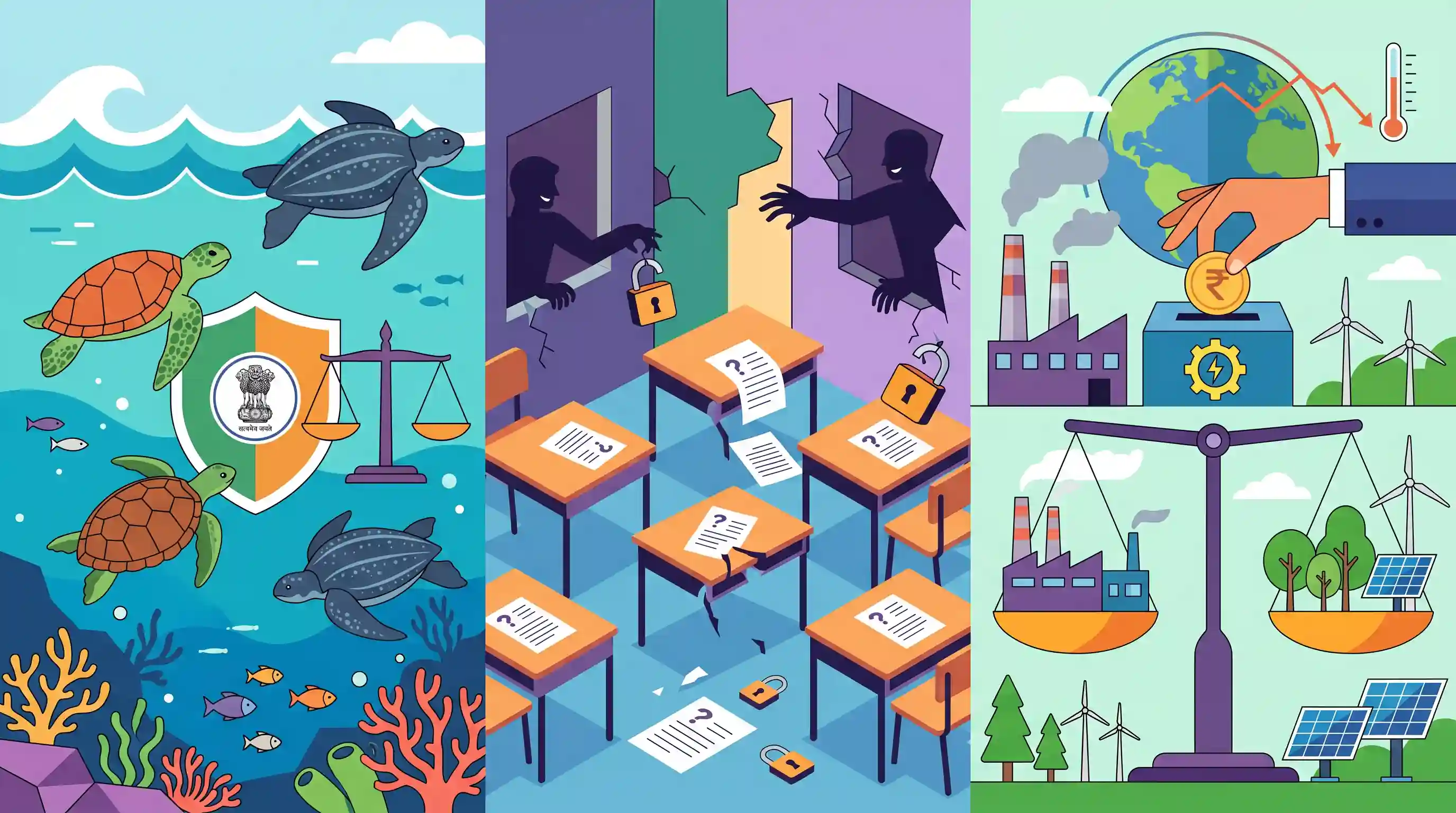
The article discusses three distinct contemporary issues of significance to the UPSC syllabus. First, it reviews the conservation status of protected marine turtles, emphasizing their ecological role and legal backing under environmental laws. Second, it analyzes the Maharashtra Teacher Eligibility Test (TET) paper leak, underscoring the severe governance deficits and ethical breaches in public examination systems that demand strict legislative action. Lastly, it explores the economic rationale and environmental necessity of implementing a carbon tax to mitigate climate change and align with global greenhouse gas reduction targets.
Key Points
- Legal protection and conservation efforts for marine turtles are critical for maintaining coastal and marine biodiversity under the Wildlife Protection Act.
- The Maharashtra TET paper leak highlights severe administrative loopholes and the urgent need for robust governance and anti-cheating frameworks in public examinations.
- Implementing a carbon tax is a key economic and environmental strategy to penalize high greenhouse gas emissions and drive the transition toward a low-carbon economy.
Important Terms
Wildlife (Protection) Act, 1972

A landmark 1972 Indian law providing a legal framework for protecting wild animals, birds, and plants. Marine turtles are listed under Schedule I, granting them absolute protection and the highest penalties for hunting.
UPSC context
GS III (Environment). Essential for questions on conservation, legal safeguards for biodiversity, and the powers of the National Board for Wildlife.
Public Examination (Prevention of Unfair Means) Act, 2024
A central legislation enacted to curb malpractices like paper leaks and organized cheating in recruitment/entrance exams. It specifies offences as cognizable, non-bailable, and prescribes imprisonment up to 10 years.
UPSC context
GS II (Governance & Ethics). Tests knowledge of administrative reforms, transparency in public services, and legislative deterrence against corruption.
Carbon tax
A market-based instrument that sets a direct price on greenhouse gas emissions (per tonne of CO2). It internalizes environmental costs to incentivize industries to transition toward cleaner energy sources.
UPSC context
GS III (Economics & Environment). Relevant for fiscal measures to meet NDCs, climate finance, and comparing carbon taxes vs. carbon credits.
Kyoto Protocol
A 1997 international treaty under the UNFCCC that committed industrialized nations to binding emission reduction targets. It introduced mechanisms like the Clean Development Mechanism (CDM) before being largely replaced by the Paris Agreement.
UPSC context
GS III (Environment). Important for tracing the evolution of global climate governance and principles like Common But Differentiated Responsibilities (CBDR).
Maharashtra State Council of Examination
The state-level statutory body responsible for conducting various school-level examinations in Maharashtra, including the Teacher Eligibility Test (TET). It oversees exam integrity and certification for school teachers.
UPSC context
GS II (Governance). A case study for institutional integrity, state-level administrative challenges, and the impact of examination scams on public trust.
European Union
A 27-member political and economic union. In climate policy, it is notable for the European Green Deal and the Carbon Border Adjustment Mechanism (CBAM), affecting global trade via carbon pricing.
UPSC context
GS III (Economy/International Relations). Crucial for understanding global trade-climate links and the impact of external carbon regulations on Indian exports.
Prelims Trap
A carbon tax guarantees a definite, measurable reduction in the total quantity of greenhouse gas emissions.
This confuses a carbon tax with cap-and-trade. A carbon tax provides price certainty but uncertain emission quantities, whereas cap-and-trade guarantees fixed emission reductions.
Static Concepts Connected
What are the key conservation facts about marine turtles in India?
- Species diversity: India hosts five species: Olive Ridley, Green, Hawksbill, Loggerhead, and Leatherback.
- Legal protection: All five species receive the highest legal protection under Schedule I of the Wildlife (Protection) Act, 1972.
- Dietary trait: UPSC often tests species diets; uniquely among marine turtles, the Green Turtle is primarily herbivorous.
- Conservation tools: Protected via 'Operation Olivia' by the Coast Guard and mandatory Turtle Excluder Devices (TEDs) for trawlers.
How does a Carbon Tax economically differ from a Cap-and-Trade system?
- Pigovian Tax: A tax levied on a market activity that generates negative externalities (like pollution) to correct market failures.
- Carbon Tax: Fixes a specific price on carbon emissions but leaves the total quantity of emission reduction uncertain.
- Cap-and-Trade: Fixes the maximum allowable emissions (guaranteeing reduction quantity) but leaves the market price of carbon uncertain.
Cross-Topic Patterns
Carbon Pricing & EU's CBAM
Domestic carbon taxes or emission trading schemes in India serve as crucial buffers against incoming external climate-trade barriers, most notably the EU's Carbon Border Adjustment Mechanism (CBAM).
Governance Deficits & GS4 Ethics
The Public Examinations Act, 2024 links GS2 legislation with GS4 probity, addressing systemic institutional corruption, trust deficits in state recruitment, and a breakdown of administrative ethics.

Expect a Prelims question comparing Carbon Tax (Pigovian) with Emission Trading Systems, linked to India's Carbon Credit Trading Scheme.
Linked PYQs · 3
Linked PYQs · 3
- 2019PrelimsGS1
Consider the following statements: 1. Some species of turtles are herbivores. 2. Some species of fish are herbivores. 3. Some species of marine mammals are herbivores. 4. Some species of snakes are viviparous. Which of the statements given above are correct?
- 2022MainsGS3
Discuss global warming and mention its effects on the global climate. Explain the control measures to bring down the level of greenhouse gases which cause global warming, in the light of the Kyoto Protocol, 1997.
- 2019MainsGS4
"Non-performance of duty by a public servant is a form of corruption". Do you agree with this view? Justify your answer.
