Tulu Language Recognition and State Reorganization Article 3
Source:Indian Express ↗
આ શા માટે મહત્વનું છે
The topics covered directly correspond to core syllabus areas in Indian Polity (Centre-State relations, state creation, language rights) and Economy/Environment (drought management), which frequently appear in both Prelims and Mains.
સારાંશ
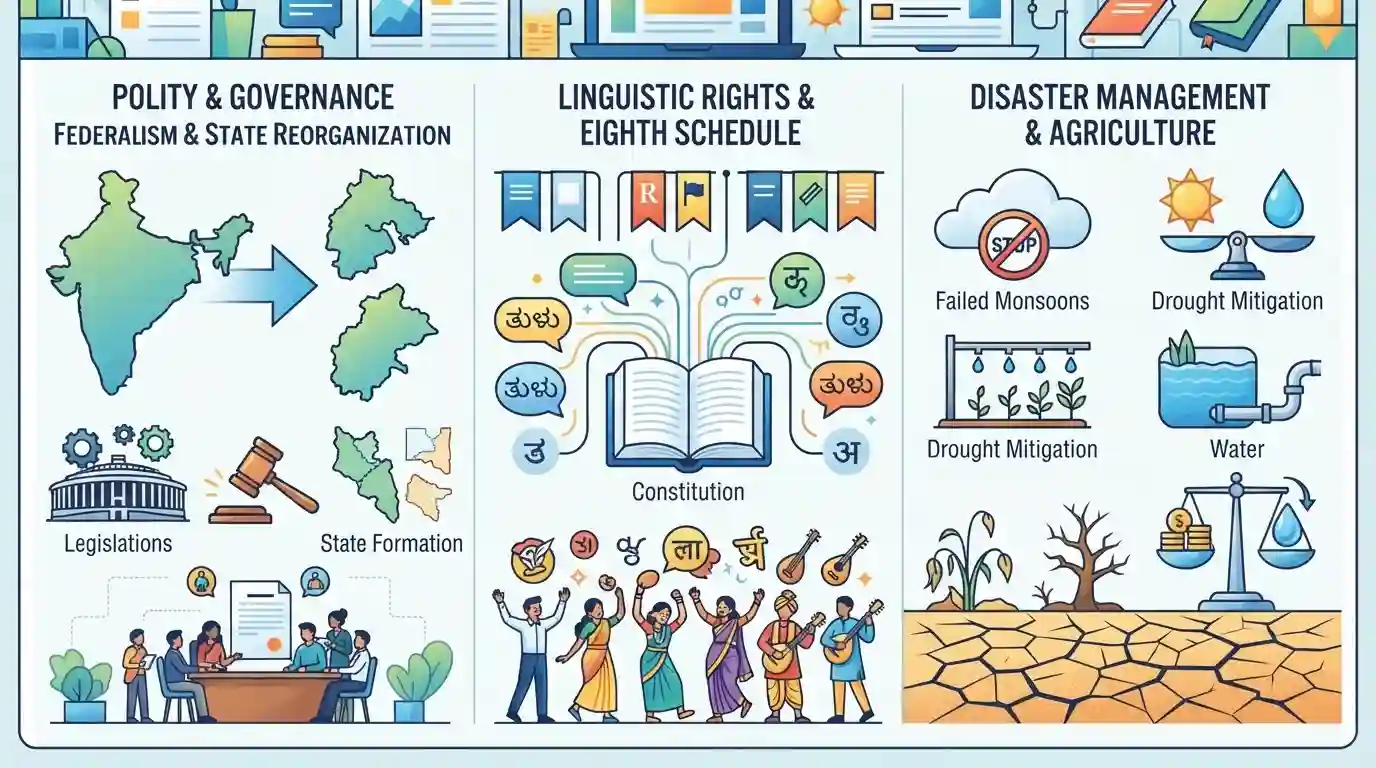
An overview of key UPSC-relevant topics featured in the Indian Express 'UPSC Key', covering the demand for inclusion of the Tulu language in the Eighth Schedule, the constitutional process of forming new states under Article 3, and the economic-environmental implications of droughts in India.
મુખ્ય મુદ્દા
- The article discusses key contemporary and historical topics useful for UPSC preparation, focusing on linguistic demands like Tulu, the geographical and administrative procedures for the formation of new states under Article 3, and agricultural/environmental challenges such as droughts.
- Tulu language advocates seek official recognition and inclusion under the Eighth Schedule of the Indian Constitution.
- The formation and reorganization of states in India are governed by Article 3, which grants Parliament the power to alter boundaries or create new states through a simple majority.
- Drought management remains a critical theme in Indian agriculture, highlighting vulnerability to climate change, water scarcity, and institutional responses.
મહત્વપૂર્ણ શબ્દો
Article 3 of the Constitution

Empowers Parliament to form new states, alter areas, boundaries, or names of existing states by ordinary legislation, requiring a simple majority without triggering Article 368.
UPSC context
GS Paper II (Polity and Governance - Federalism, State Reorganization). Evaluates the Union's legislative supremacy in redrawing internal political boundaries.
Eighth Schedule of the Constitution
A constitutional provision listing recognized languages of India. Inclusion requires a parliamentary amendment and grants benefits like official patronage and academic support.
UPSC context
GS Paper II (Indian Polity - Linguistic Minorities, Federal Rights). Tests knowledge of cultural rights and criteria for language recognition.
Parliament
The supreme legislative body of India comprising the President, Lok Sabha, and Rajya Sabha, vested with powers of lawmaking, constitutional amendment, and state reorganization.
UPSC context
GS Paper II (Parliament and State Legislatures - Structure, Functioning, and Conduct of Business). Essential for questions on legislative power and federal dynamics.
સંલગ્ન સ્થિર ખ્યાલો
What are the constitutional provisions governing official languages and Eighth Schedule inclusion in India?
- Eighth Schedule:: Eighth Schedule currently lists 22 languages; inclusion does not automatically make a language an official national language but grants it representation on official committees and literary recognition.
- Union Language:: Article 343 designates Hindi in Devanagari script as the official language of the Union, while Parliament may by law authorize the use of English for official purposes.
- State Powers:: Article 345 empowers state legislatures to adopt any language used in the state or Hindi for official administrative purposes within that state.
What is the constitutional procedure for the formation of new states under Article 3?
- Prior Recommendation:: Presidential Recommendation: A bill for the purpose can be introduced in Parliament only on the recommendation of the President.
- State Views:: State Legislature Reference: Before recommendation, the President must refer the bill to the concerned state legislature to express its views within a specified timeframe.
- Advisory Views:: Non-Binding Nature: The views expressed by the state legislature are strictly advisory; Parliament is not bound to accept them or wait indefinitely.
- Majority Required:: Simple Majority: Parliament can pass the legislation to alter boundaries, names, or create new states through a simple majority (ordinary legislative process).
આંતર-વિષય પેટર્ન
Linguistic Demands vs. State Official Languages
While the Centre decides on Eighth Schedule additions, states can independently adopt regional tongues for official use under Article 345, bridging cultural aspirations and administrative federalism.
Article 3 Reorganisation and Cooperative Federalism
Article 3 reorganisations highlight how India's asymmetric federalism balances regional aspirations with parliamentary supremacy, keeping state views strictly advisory during boundary alterations.

Expect a conceptual question combining Article 3's non-binding state legislature reference rule with Eighth Schedule inclusion criteria.
સંલગ્ન PYQ · 3
સંલગ્ન PYQ · 3
- 2024MainsGS2
What changes has the Union Government recently introduced in the domain of Centre-State relations ? Suggest measures to be adopted to build the trust between the Centre and the States and for strengthening federalism.
- 2024PrelimsGS1
The Constitution (71st Amendment) Act, 1992 amends the Eighth Schedule to the Constitution to include which of the following languages? 1. Konkani 2. Manipuri 3. Nepali 4. Maithili Select the correct answer using the code given below:
- 2024MainsGS3
What are the major challenges faced by Indian irrigation system in recent times? State the measures taken by the government for efficient irrigation management.
