US Reciprocal Tariffs and Strategic Geopolitics of Arctic Region
Source:Indian Express ↗
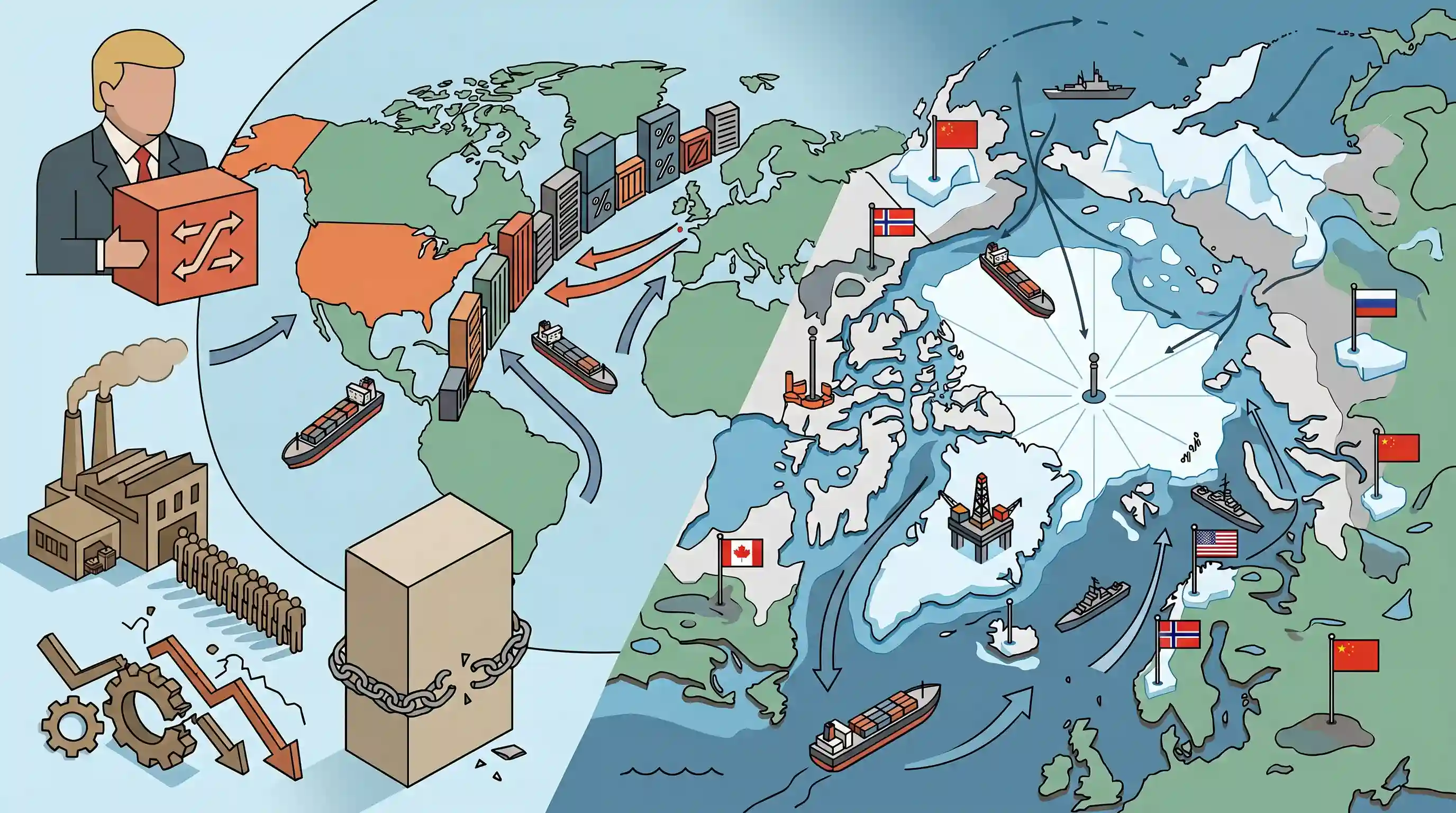
Why It Matters
Understanding the historical consequences of the Smoot-Hawley Act provides critical context for the current global shift towards protectionism and its impact on the Indian economy. Furthermore, the strategic dynamics of the melting Arctic are increasingly important for global maritime trade and India's long-term environmental and energy security interests.
Summary
The article discusses the resurgence of protectionist trade policies under Trump's reciprocal tariffs, drawing historical parallels with the disastrous 1930 Smoot-Hawley Tariff Act that deepened the Great Depression. It also explores the shifting geopolitics of the Arctic region, where climate-induced ice melting is creating new economic opportunities and strategic competition over resources and shipping routes.
Key Points
- The Smoot-Hawley Tariff Act of 1930 significantly raised US import duties, triggering a global trade war that exacerbated the Great Depression.
- Trump's proposed 'Reciprocal Tariffs' represent a modern return to protectionist trade policies, shifting away from multilateralism towards aggressive bilateral trade barriers.
- The Arctic region is gaining immense geopolitical and economic significance as global warming melts polar ice, opening up new maritime shipping routes (like the Northern Sea Route) and access to vast untapped natural resources.
- India maintains a strategic interest in the Arctic region's resources and the environmental impact of its melting ice, highlighting the importance of the Arctic Council and the Polar Code.
Important Terms
Smoot-Hawley Tariff Act

A 1930 US law that raised import duties on over 20,000 goods. It triggered global retaliations, causing international trade to collapse and deepening the Great Depression.
UPSC context
GS-1 (World History) and GS-3 (Economy); tests knowledge of protectionism’s historical consequences and its impact on global trade stability.
Reciprocal Tariffs
A trade policy where a nation imposes import duties equal to the rates charged on its exports by a trading partner, aiming to achieve parity and counter perceived unfair barriers.
UPSC context
GS-3 (Economy); tests understanding of shift from multilateralism to bilateralism and challenges to WTO’s non-discrimination principles.
Arctic Council
The leading intergovernmental forum promoting cooperation among Arctic states and indigenous communities on sustainable development and environmental protection. India has held Observer status since 2013.
UPSC context
GS-2 (International Relations); essential for understanding Arctic geopolitics, India’s strategic interests, and climate change governance.
World Trade Organization (WTO)
An international body regulating global trade rules and ensuring non-discriminatory treatment (MFN principle) among member nations to promote a predictable, rules-based trading system.
UPSC context
GS-3 (Economy); central to discussions on multilateralism, trade disputes, and the erosion of global trade norms.
Polar Code
A mandatory International Maritime Organization (IMO) framework for ships in polar waters, setting safety and environmental standards for vessel design and operations in inhospitable environments.
UPSC context
GS-3 (Environment/Infrastructure); relevant for Arctic shipping route regulations, maritime safety, and environmental protection in sensitive zones.
Prelims Trap
"The Arctic Council mediates territorial and maritime security disputes among Arctic states."
The 1996 Ottawa Declaration explicitly excludes military and security matters from the Arctic Council's mandate. It is strictly a forum for environmental protection and sustainable development.
Static Concepts Connected
What is the Arctic Council's mandate and India's status?
- Core Members: Comprises 8 Arctic States (Canada, Denmark, Finland, Iceland, Norway, Russia, Sweden, US); governed by the 1996 Ottawa Declaration.
- Mandate: Promotes cooperation on sustainable development and environmental protection. It holds no legal enforcement power.
- India's Role: Holds 'Observer' status since 2013. India operates the 'Himadri' research station in Svalbard, Norway, to study climate impacts.
How do Reciprocal Tariffs violate core WTO principles?
- MFN Principle: The WTO's Most-Favored-Nation (MFN) rule requires a country to treat all member nations equally regarding baseline tariffs and trade barriers.
- Protectionist Shift: Imposing bilateral, tit-for-tat tariffs without WTO authorization directly violates the non-discrimination principle of MFN, undermining the multilateral trading system.
Cross-Topic Patterns
Northern Sea Route + INSTC
The opening of the Northern Sea Route complements India's push for the INSTC and Chennai-Vladivostok corridor to bypass traditional chokepoints like the Suez Canal, reshaping global maritime geography.
Deglobalisation + WTO Paralysis
The resurgence of Smoot-Hawley style protectionism connects directly to modern supply chain regionalization, 'friend-shoring', and the ongoing paralysis of the WTO's dispute settlement Appellate Body.

Expect a multi-statement question combining the IMO’s Polar Code, the Arctic Council's mandate, and India's Observer status in 2026.
Linked PYQs · 4
Linked PYQs · 4
- 2025MainsGS3
What are the challenges before the Indian economy when the world is moving away from free trade and multilateralism to protectionism and bilateralism? How can these challenges be met?
- 2021MainsGS1
How do the melting of the Arctic ice and glaciers of the Antarctic differently affect the weather patterns and human activities on the Earth? Explain.
- 2018MainsGS1
Why is India taking keen interest in resources of Arctic Region?
- 2022PrelimsGS1
Which one of the following statements best describes the 'Polar Code'?
