Middle East Peace Framework Payments Board and Bhutan Rail Link
Source:Indian Express ↗
Why It Matters
Understanding the Middle East's evolving geopolitics is vital for evaluating India's foreign policy and energy security. The India-Bhutan rail link demonstrates practical implementation of the 'Neighbourhood First' policy and Northeast integration. Meanwhile, the PRB debate touches upon the crucial regulatory architecture needed to sustainably manage India's booming fintech and digital payments sector.
Summary
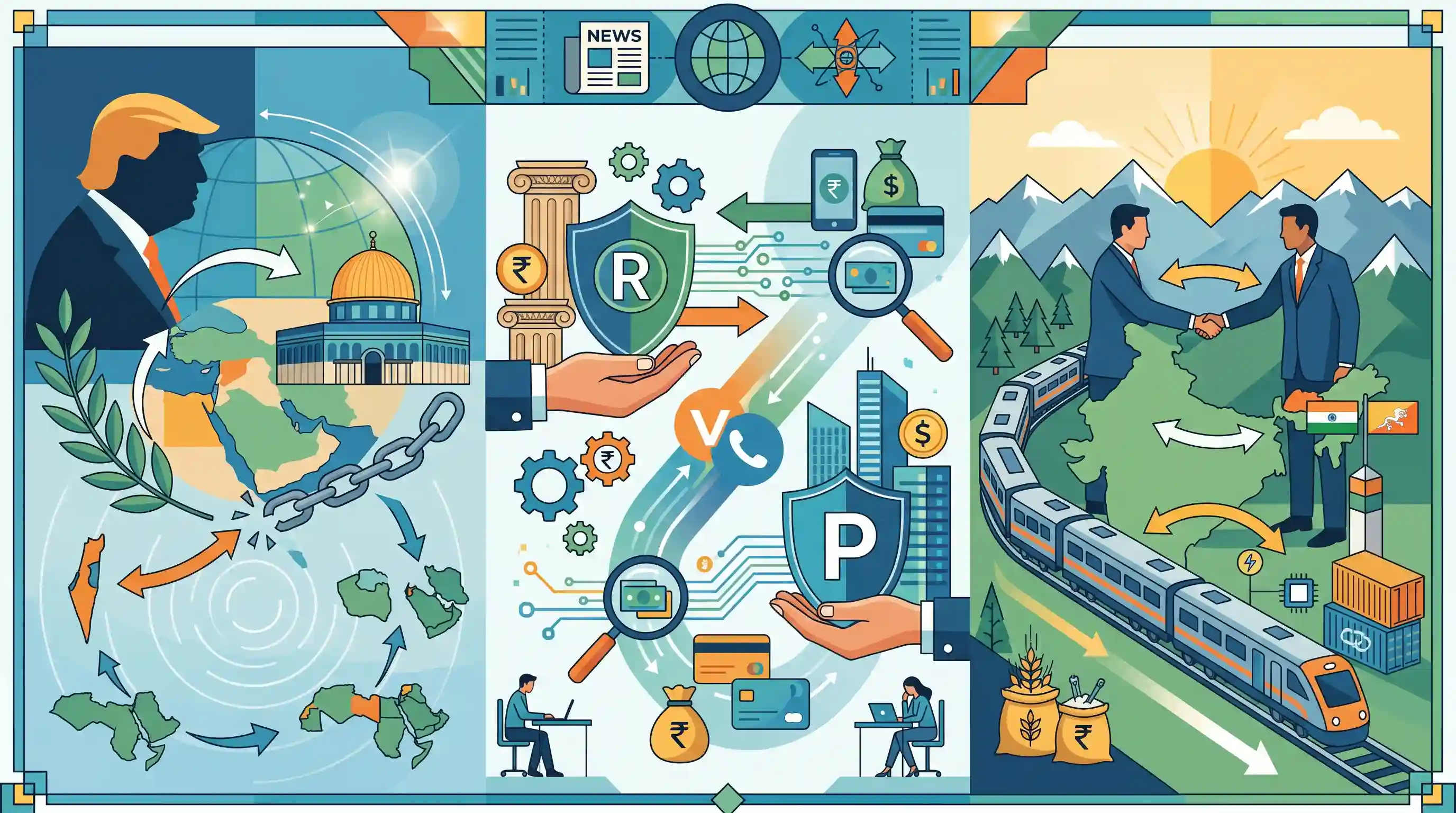
The article highlights three significant topics for UPSC preparation: Donald Trump's prospective Gaza peace plan and its geopolitical implications for the Middle East; the ongoing regulatory debate surrounding the Payments Regulatory Board (PRB) and the RBI's jurisdiction over India's digital payment ecosystem; and the strategic India-Bhutan railway link connecting Kokrajhar to Gelephu, which bolsters India's 'Neighbourhood First' policy and enhances cross-border trade.
Key Points
- Trump's Gaza peace plan strategies indicate a potential shift in US involvement in the Middle East, impacting the broader Israel-Palestine resolution process and regional stability.
- The proposed Payments Regulatory Board (PRB) sparks a debate over the governance of digital payments, focusing on whether it should be an independent regulator or function under the RBI.
- The planned 58-km railway line between Kokrajhar (Assam) and Gelephu (Bhutan) will mark the first-ever rail connectivity between India and Bhutan.
- This cross-border infrastructure project is a critical component of India's 'Neighbourhood First' policy, aimed at enhancing bilateral trade and regional integration.
Important Terms
Neighbourhood First Policy

India's diplomatic strategy prioritizing relations with immediate neighbors (like Bhutan and Nepal) to foster regional stability, physical connectivity, and economic prosperity through non-reciprocal and consultative engagement.
UPSC context
GS Paper II (International Relations); essential for topics on regional integration, bilateral ties, and countering external influences in South Asia.
Payments Regulatory Board (PRB)
A statutory body under the PSS Act, 2007, replacing the BPSS to regulate and supervise India's payment systems. It includes members from both the RBI and Central Government.
UPSC context
GS Paper III (Indian Economy); tests knowledge of financial regulatory reforms and digital payment governance frameworks.
Payment and Settlement Systems Act, 2007
The primary legislation providing the legal framework for the RBI to regulate, supervise, and authorize all payment and settlement systems in India, including digital platforms like UPI.
UPSC context
GS Paper III (Indian Economy); crucial for questions on digital infrastructure, financial stability, and the legal basis of electronic transactions.
Watal Committee
A 2016 panel that proposed a roadmap for digital payments, recommending an independent regulator, interoperability between banks and non-banks, and a reduction in India's cash-to-GDP ratio.
UPSC context
GS Paper III (Economy); provides historical and structural context for India's digital payment revolution and subsequent regulatory shifts.
Reserve Bank of India (RBI)
India's central bank and the apex authority responsible for monetary policy, banking supervision, and the regulation of payment systems to ensure financial stability.
UPSC context
GS Paper III (Economy); fundamental institution for monetary policy, resource mobilization, and financial sector regulation.
Kokrajhar-Gelephu Rail Link
A 57.5 km cross-border rail project connecting Assam to Bhutan's southern industrial hub. Designated as a 'Special Railway Project,' it is Bhutan's first-ever railway link.
UPSC context
GS Paper II (International Relations); vital for questions on India-Bhutan connectivity, strategic infrastructure in the Northeast, and the 'Act East' synergy.
Prelims Trap
The Payments Regulatory Board (PRB) is an independent statutory body established outside the RBI to regulate digital payments.
An independent PRB is merely a proposal (Watal Committee). Currently, payment systems are firmly regulated by the RBI through the BPSS under the Payment and Settlement Systems Act, 2007.
Static Concepts Connected
How are payment and settlement systems currently regulated in India?
- PSS Act 2007: Empowers the Reserve Bank of India as the apex authority to regulate and oversee all payment and settlement systems in the country.
- BPSS: The Board for Regulation and Supervision of Payment and Settlement Systems (BPSS) is a sub-committee of the RBI Central Board that executes this oversight.
- Watal Committee: Recommended establishing an independent Payments Regulatory Board (PRB) to promote digital payments, sparking debates over fintech regulation versus systemic monetary risk.
What is the strategic significance of the Kokrajhar-Gelephu railway project?
- First Rail Link: It is a broad-gauge line marking the first-ever railway connectivity between India and Bhutan, running from Kokrajhar (Assam) to the Bhutanese border.
- Gelephu Mindfulness City: Integrates India's logistics with Bhutan's planned 2,500 sq km Special Administrative Region (GMC), boosting bilateral trade and reducing Bhutan's transit dependency.
Cross-Topic Patterns
Neighbourhood First & Border Infrastructure
The Kokrajhar-Gelephu project mirrors connectivity pushes like the Agartala-Akhaura rail link, highlighting India's shift from treating borders as defensive buffers to viewing them as integrated economic corridors.
Fintech Innovation vs Monetary Stability
The RBI-PRB debate echoes discussions surrounding the FSDC and crypto regulation, where the need for agile tech governance directly clashes with a central bank's mandate to prevent systemic financial risks.

Expect a 2026 Prelims matching question pairing cross-border infrastructure projects (Gelephu, Agartala, Kaladan) with their Indian states.
Linked PYQs · 3
Linked PYQs · 3
- 2018MainsGS2
“India’s relations with Israel have, of late, acquired a depth and diversity, which cannot be rolled back.” Discuss.
- 2023MainsGS3
What is the status of digitalization in the Indian economy? Examine the problems faced in this regard and suggest improvements.
- 2024PrelimsGS1
Consider the following statements in respect of the digital rupee : 1. It is a sovereign currency issued by the Reserve Bank of India (RBI) in alignment with its monetary policy. 2. It appears as a liability on the RBI's balance sheet. 3. It is insured against inflation by its very design. 4. It is freely convertible against commercial bank money and cash. Which of the statements given above are correct?
