ASEAN Summit Diplomacy and Consumer Price Index Revisions in India
Source:Indian Express ↗
Why It Matters
Understanding these topics is crucial for UPSC aspirants as they overlap heavily with India's foreign policy objectives (GS2) and core macroeconomic concepts related to inflation targeting (GS3). Questions frequently test the strategic implications of regional groupings and the technical nuances of economic indices.
Summary
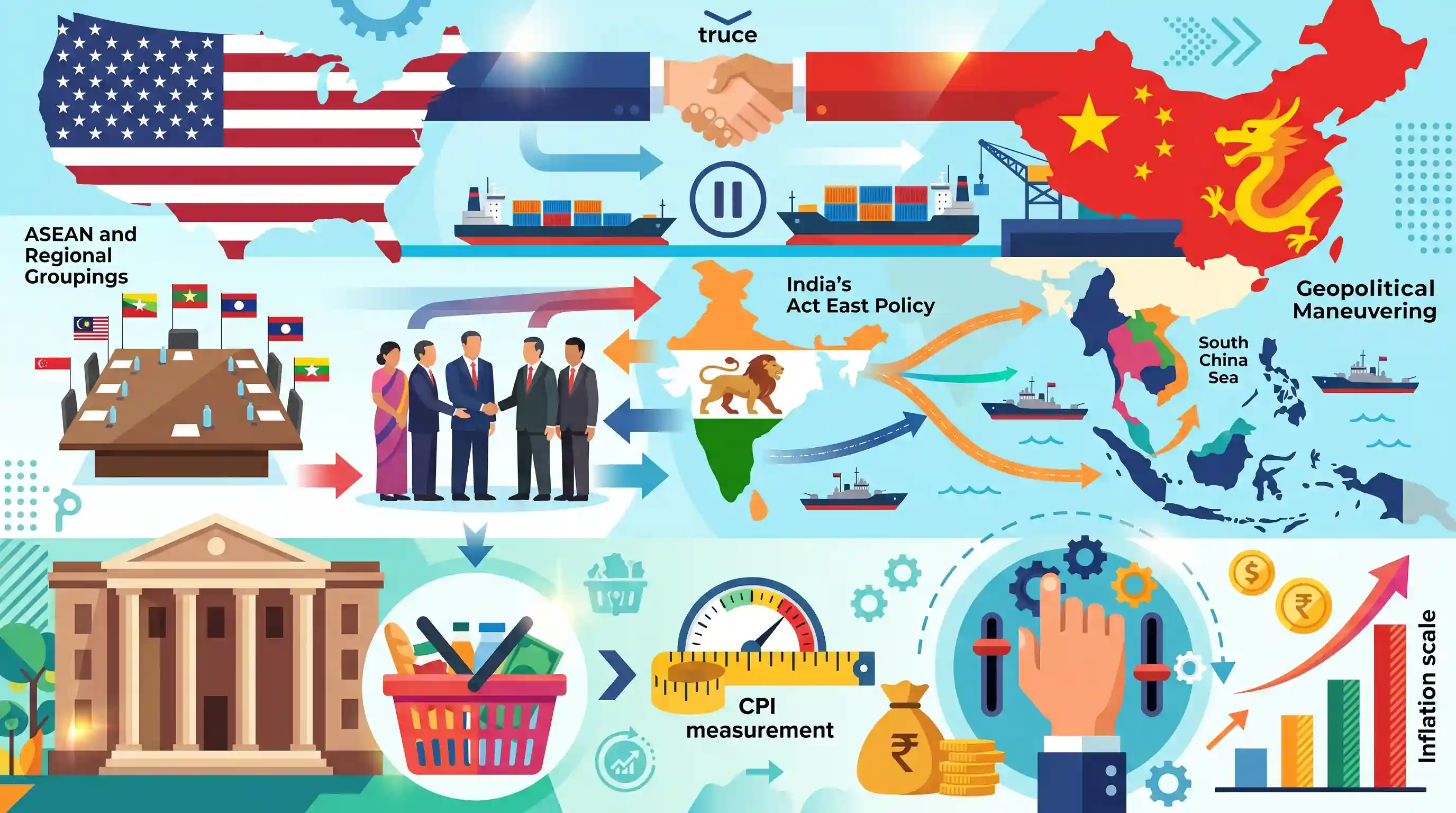
The article navigates three critical developments impacting both international relations and the domestic economy: the pause in the US-China trade war, the geopolitical maneuvering at the ASEAN Summit, and changes to India's Consumer Price Index (CPI). The US-China truce offers a reprieve for global supply chains and trade dynamics. Concurrently, the ASEAN Summit underscores the continuing relevance of India's Act East Policy amidst broader Indo-Pacific and South China Sea tensions. On the domestic front, a revised CPI reflects updated consumption patterns, which is vital for the Reserve Bank of India (RBI) to accurately target inflation and formulate responsive monetary policy.
Key Points
- The pause in the US-China trade war temporarily reduces global economic uncertainty, easing pressures on supply chains and international trade mechanisms.
- The ASEAN Summit reinforces the strategic importance of India's Act East Policy for ensuring regional stability and economic integration in the Indo-Pacific.
- Updates to the Consumer Price Index (CPI), including base year or basket weight revisions, more accurately capture current household consumption patterns.
- A modernized CPI is crucial for the RBI's Monetary Policy Committee to effectively mandate its inflation targeting framework and adjust key policy rates.
Important Terms
Act East Policy

India’s proactive diplomatic strategy launched in 2014 to deepen economic, strategic, and cultural ties with Southeast Asia and the wider Indo-Pacific, upgrading the 1991 Look East Policy.
UPSC context
GS Paper II (International Relations); tests India's regional diplomacy, maritime security, and connectivity-led development through the Northeast.
ASEAN
A regional intergovernmental organization of Southeast Asian nations promoting economic growth and regional stability; it serves as the central pillar of India's Act East Policy.
UPSC context
GS Paper II; crucial for understanding regional groupings, India's neighborhood policy, and Indo-Pacific strategic balance.
Monetary Policy Committee (MPC)
A six-member statutory body (three from RBI, three government-nominated) empowered by the RBI Act, 1934, to determine the benchmark interest rate for meeting inflation targets.
UPSC context
GS Paper III (Indian Economy); tests knowledge of inflation targeting, monetary policy instruments, and institutional autonomy.
Reserve Bank of India (RBI)
India’s central bank, established in 1935, responsible for regulating the monetary system, issuing currency, managing foreign exchange, and maintaining financial stability.
UPSC context
GS Paper III; core topic for banking, financial regulation, and macroeconomic management questions.
World Trade Organization (WTO)
The only global international organization dealing with the rules of trade between nations, providing a forum for negotiations and resolving trade disputes.
UPSC context
GS Paper II & III; tests global trade governance, multilateralism, and India’s stance on trade disputes and protectionism.
Look East Policy
A predecessor to the Act East Policy, launched in 1991 to pivot India's strategic and economic focus toward Southeast Asian markets following the Cold War.
UPSC context
GS Paper II; important for tracing the evolution of India's foreign policy and post-1991 economic reforms.
Prelims Trap
The RBI decides the base year and commodity weights for the Consumer Price Index to align with inflation targeting.
MoSPI (NSO) determines the base year and commodity basket weights for CPI. The RBI only uses the published CPI-Combined data for its inflation-targeting framework.
Static Concepts Connected
How does the Consumer Price Index (CPI) differ from the Wholesale Price Index (WPI)?
- Publishing Authority: CPI-Combined is published by NSO (MoSPI), whereas WPI is published by the Office of the Economic Adviser under the Ministry of Commerce and Industry.
- Coverage Scope: CPI tracks the retail prices of both goods and services, while WPI only tracks the wholesale-level prices of goods.
- Food Weightage: Food and beverages command a significantly higher weight in the CPI basket compared to their relatively lower weight in the WPI basket.
What are the foundational elements of India's Act East Policy?
- Policy Evolution: Upgraded from the 1992 Look East Policy in 2014, shifting the focus from purely economic relations to broader strategic and security engagements.
- The 4 Cs: The policy is built on four core pillars: Culture, Commerce, Connectivity, and Capacity Building with ASEAN and Indo-Pacific partners.
- Security Dimension: It formally integrates a defense dimension, emphasizing freedom of navigation, maritime security, and a rules-based order in the Indo-Pacific.
Cross-Topic Patterns
CPI weights & agricultural shifts
The shifting weightage in the newly revised CPI basket mirrors changing domestic consumption habits, directly connecting inflation metrics to GS3 topics like agricultural diversification, changing cropping patterns, and farm policy.
Trade Wars & 'China Plus One'
Pauses in US-China trade friction highlight global supply chain vulnerabilities, reinforcing the strategic urgency behind ASEAN's regional integration and India's PLI schemes under the 'China Plus One' strategy.

A 2026 Prelims question will likely test the exact weightage shifts (e.g., food vs. housing/services) in the new CPI 2024 base year.
Linked PYQs · 5
Linked PYQs · 5
- 2020PrelimsGS1
Consider the following statements: 1. The weightage of food in Consumer Price Index (CPI) is higher than that in Wholesale Price Index (WPI). 2. The WPI does not capture changes in the prices of services, which CPI does. 3. Reserve Bank of India has now adopted WPI as its key measure of inflation and to decide on changing the key policy rates. Which of the statements given above is/are correct?
- 2022PrelimsGS1
In India, which one of the following is responsible for maintaining price stability by controlling inflation?
- 2024MainsGS3
What are the causes of persistent high food inflation in India? Comment on the effectiveness of the monetary policy of the RBI to control this type of inflation.
- 2021MainsGS2
“The USA is facing an existential threat in the form of a China, that is much more challenging than the erstwhile Soviet Union.” Explain.
- 2016MainsGS2
Evaluate the economic and strategic dimensions of India's Look East Policy in the context of the post Cold War international scenario.
