Assisted Reproductive Technology Regulations and Cancer Burden
Source:Indian Express ↗
Why It Matters
This compilation touches upon multidimensional UPSC themes: India's strategic push for FTAs is crucial for economic growth (GS2/GS3); ART regulations reflect the intersection of medical ethics and governance (GS2); and the cancer epidemic presents a core public health and social justice challenge (GS2).
Summary
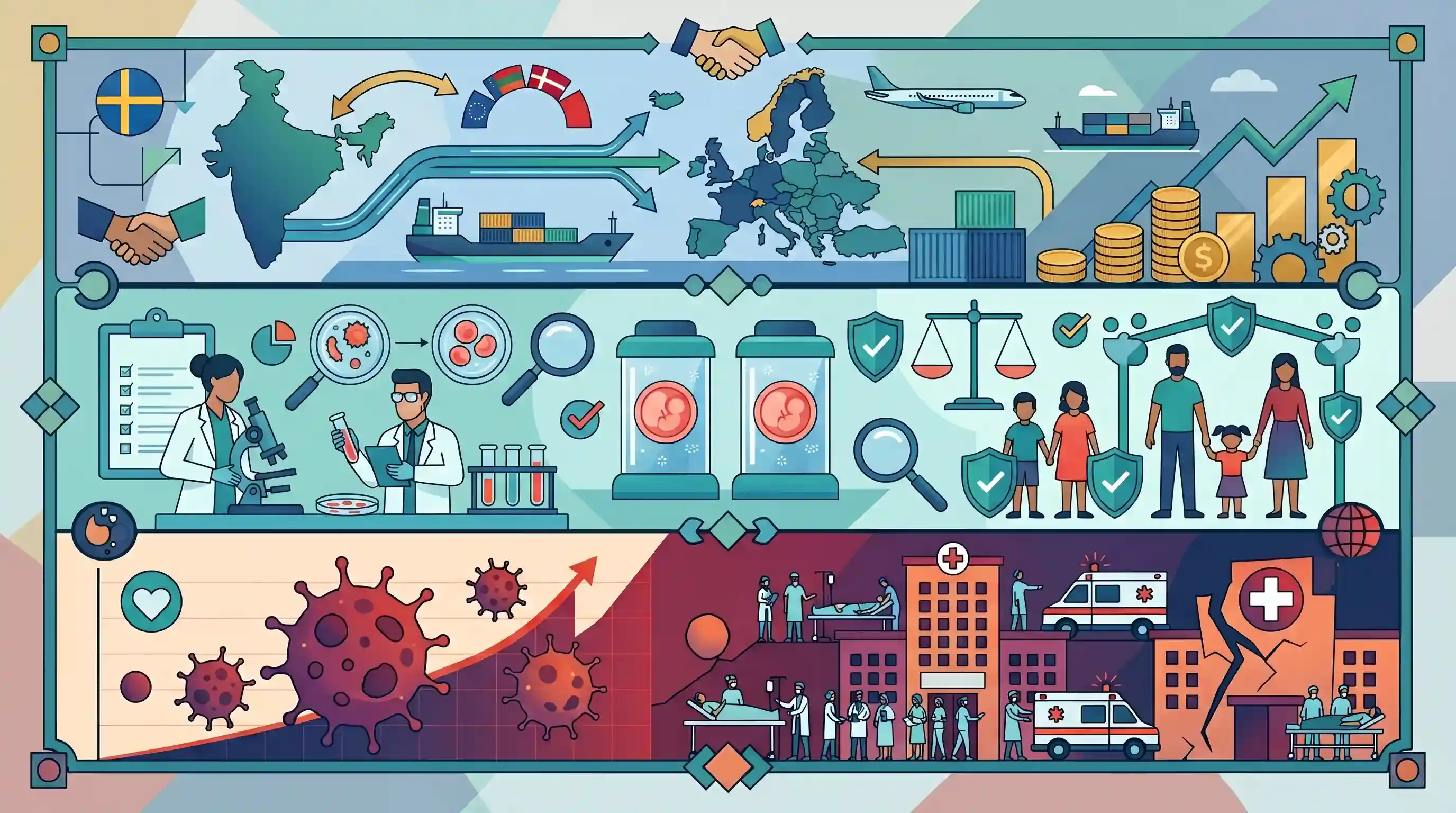
The article highlights three significant developments across India's economic, regulatory, and health landscapes. First, it underscores India's advancing economic diplomacy through recent Free Trade Agreements, notably the pact with the European Free Trade Association (EFTA). Second, it covers the Health Ministry's newly notified regulations under the Assisted Reproductive Technology (ART) Act, which set strict guidelines for the donation and storage of frozen embryos to ensure ethical practices. Finally, it addresses the escalating public health crisis of rising cancer cases, which reflects a broader surge in non-communicable diseases and strains the nation's healthcare infrastructure.
Key Points
- Economic Diplomacy: India's recent successes in negotiating Free Trade Agreements (FTAs) like the TEPA with the EFTA bloc highlight a strategic shift towards attracting Foreign Direct Investment (FDI) and expanding export markets.
- Medical Regulations: The Union Health Ministry has notified updated rules under the ART Act to govern the ethical donation, duration of storage, and usage of frozen embryos, clamping down on unregulated commercial practices.
- Healthcare Challenge: The rising incidence of cancer underscores the growing burden of non-communicable diseases (NCDs) in India, revealing critical gaps in grassroots healthcare infrastructure, preventative screening, and affordability of treatment.
Important Terms
Trade and Economic Partnership Agreement (TEPA)

A comprehensive free trade agreement between India and the four EFTA nations. It features a unique $100 billion investment commitment over 15 years and aims to create one million jobs.
UPSC context
GS Paper 2: Bilateral agreements. GS Paper 3: Indian Economy (Investment/Trade). Tests knowledge of India's recent strategic economic diplomacy.
European Free Trade Association (EFTA)
An intergovernmental organization consisting of Iceland, Liechtenstein, Norway, and Switzerland. It promotes free trade and economic integration independently of the European Union.
UPSC context
GS Paper 2: Regional and global groupings involving India. Tests understanding of non-EU European economic partnerships.
Assisted Reproductive Technology (Regulation) Act
Legislation passed in 2021 to regulate and supervise fertility clinics and banks. It ensures ethical practices, prevents misuse, and protects the rights of donors and patients.
UPSC context
GS Paper 2: Health, Government policies and interventions. GS Paper 3: Science and Technology. Tests bioethics and health governance.
Frozen Embryo Donation
Under current rules, embryos can be stored for 10 years, after which they must be destroyed or donated for research; donation to other couples for reproduction is currently prohibited.
UPSC context
GS Paper 2: Issues related to health and women. Tests knowledge of regulatory challenges and ethical debates in reproductive rights.
National Cancer Registry Programme (NCRP)
A surveillance system under the ICMR that tracks cancer incidence and mortality. It provides data for evidence-based policy making and planning cancer control activities.
UPSC context
GS Paper 2: Issues relating to development and management of Social Sector/Services relating to Health. Tests awareness of disease surveillance infrastructure.
NPCDCS
A flagship program under the National Health Mission aimed at strengthening infrastructure, early diagnosis, and management for major non-communicable diseases including cancer.
UPSC context
GS Paper 2: Government schemes and health management. Tests understanding of India's public health response to non-communicable diseases.
Prelims Trap
"Couples can legally donate their surplus frozen embryos to other infertile couples under the ART Act."
The ART Act strictly prohibits the donation of surplus frozen embryos to other couples. They can only be stored for 10 years, after which they must be destroyed or donated for research.
Static Concepts Connected
What are the key regulatory mechanisms of the Assisted Reproductive Technology (ART) Act?
- National Board: Establishes the National Assisted Reproductive Technology and Surrogacy Board to advise the government on policy matters.
- Clinics Registry: Mandates the mandatory registration of all ART clinics and banks under a centralized National Registry.
- Offences and Penalties: Strictly prohibits commercial sex selection, sale of embryos, and exploitation of donors, prescribing severe penalties.
How does the European Free Trade Association (EFTA) differ from the European Union (EU)?
- Membership: EFTA comprises four non-EU states: Iceland, Liechtenstein, Norway, and Switzerland.
- Customs Union: Unlike the EU, EFTA is not a customs union; member states maintain their own external customs tariffs and independent trade policies.
- Market Access: EFTA nations participate in the EU's single market (via the EEA), except Switzerland, which relies on bilateral agreements.
Cross-Topic Patterns
Trade Deals with FDI Mandates
India's TEPA with EFTA shifts the traditional FTA paradigm by legally tying market access and tariff concessions to a binding $100 billion FDI and employment generation target over 15 years.
Epidemiological Transition and NCD Burden
The surge in cancer cases highlights India’s epidemiological transition, linking directly to GS2 health governance questions about the rising economic burden of Non-Communicable Diseases (NCDs) on grassroots infrastructure.

Expect a 2026 Prelims MCQ on the ART Act, specifically testing the tricky distinction between legal gamete and banned embryo donation.
Linked PYQs · 3
Linked PYQs · 3
- 2024MainsGS2
In a crucial domain like the public healthcare system the Indian State should play a vital role to contain the adverse impact of marketisation of the system. Suggest some measures through which the State can enhance the reach of public healthcare at the grassroots level.
- 2012MainsGS2
In the context of Assisted Reproductive Technologies, India has emerged as a hub of commercial surrogacy. What key biological, legal and ethical issues merit consideration while framing the regulation to govern surrogacy in India?
- 2018PrelimsGS1
Consider the following countries: 1. Australia 2. Canada 3. China 4. India 5. Japan 6. USA Which of the above are among the 'free-trade partners' of ASEAN?
