Assisted Reproductive Technology Rules and Public Health Burden
Source:Indian Express ↗
Why It Matters
These topics intersect governance, international relations, and public health. Understanding FTAs is crucial for GS2 IR and GS3 Economy. The ART regulations touch upon GS2 Social Justice and GS4 Ethics, while the rising cancer burden relates directly to GS2 Public Health and Human Resource Development.
Summary
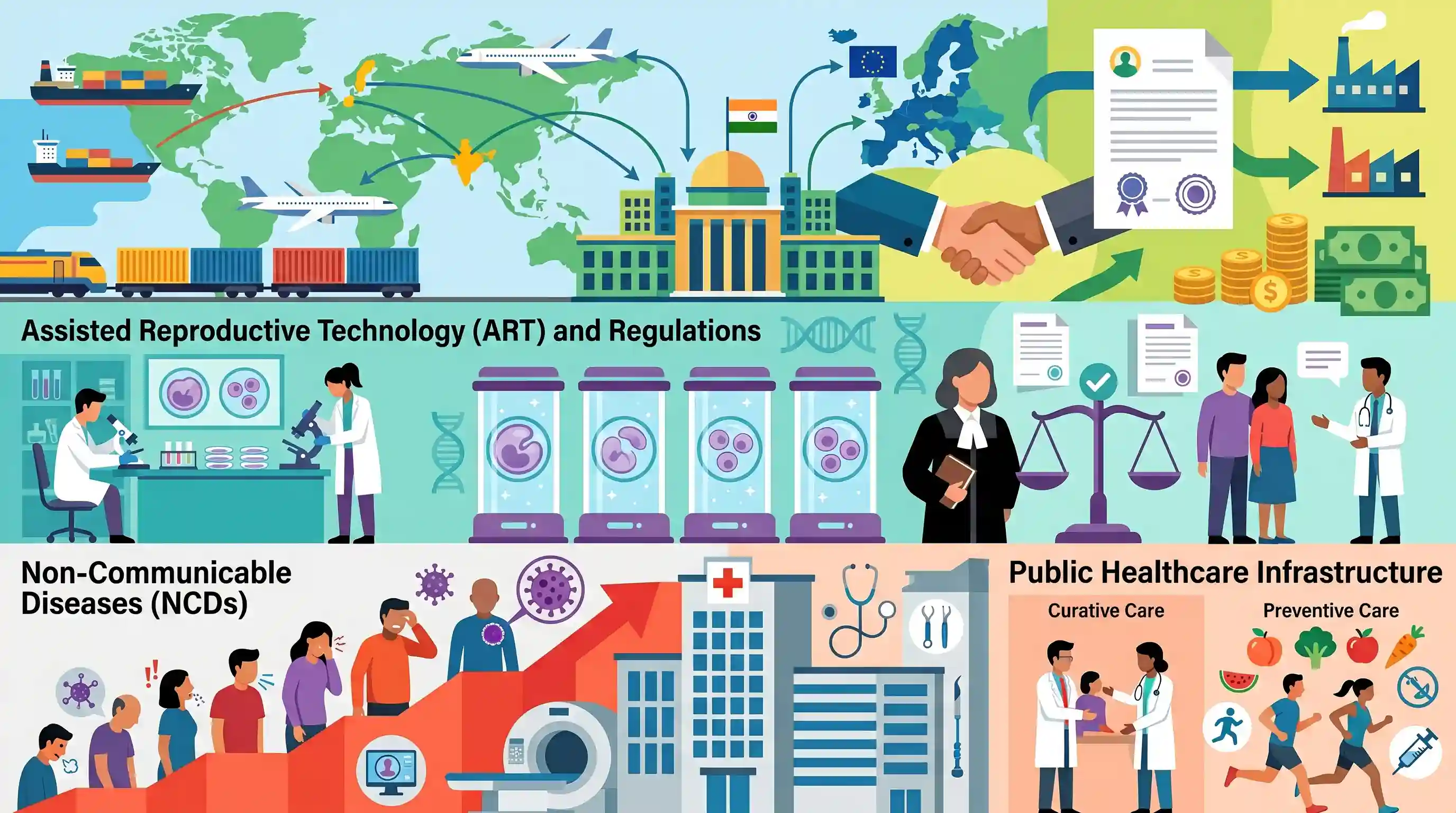
The article covers three diverse yet significant topics for UPSC preparation: international trade diplomacy, medical ethics and regulations, and public health. First, it highlights India's ongoing pursuit of Free Trade Agreements (FTAs) like the TEPA with the EFTA bloc to strengthen its macroeconomic position. Second, it discusses the recent updates to the Assisted Reproductive Technology (ART) Regulations concerning frozen embryo donation, aiming to streamline surrogacy and IVF procedures while ensuring ethical compliance. Lastly, it sheds light on the escalating burden of cancer cases in India, underscoring the urgent need to bolster the country's public healthcare infrastructure to combat the growing wave of Non-Communicable Diseases (NCDs) through both curative and preventive strategies.
Key Points
- India is actively negotiating and formalizing Free Trade Agreements (FTAs), such as the TEPA with EFTA, to boost exports and integrate with global supply chains.
- The Health Ministry has updated regulations regarding frozen embryo donations under the ART framework, addressing critical ethical, medical, and legal dimensions of IVF and surrogacy.
- The rising incidence of cancer in India highlights a severe public health challenge driven by Non-Communicable Diseases (NCDs).
- Addressing India's disease burden necessitates a shift from a purely curative approach towards robust preventive, promotive care and enhanced grassroots healthcare infrastructure.
Important Terms
Trade and Economic Partnership Agreement (TEPA)

A landmark trade deal signed in March 2024 between India and EFTA nations, featuring a first-of-its-kind binding commitment of $100 billion in investments and 1 million jobs for India over 15 years.
UPSC context
GS Paper 3 (Economy); significant for India's 'FTA 2.0' strategy and first-ever investment-linked trade commitments.
European Free Trade Association (EFTA)
An intergovernmental organization of four European nations—Iceland, Liechtenstein, Norway, and Switzerland—focused on free trade and economic integration; notably separate from the European Union (EU).
UPSC context
GS Paper 2 (International Relations); important for India's strategic economic engagement with advanced, non-EU European economies.
Assisted Reproductive Technology (ART) Regulations
Legal framework (Act 2021, Rules 2023) regulating medical procedures like IVF and ICSI to assist conception, mandating registration for clinics/banks and ensuring ethical standards for donors and patients.
UPSC context
GS Paper 2 (Social Justice/Governance); tests understanding of medical ethics, regulatory oversight, and rights in biotechnology.
Surrogacy (Regulation) Act
2021 legislation that prohibits commercial surrogacy in India while permitting altruistic surrogacy for eligible infertile couples, aiming to prevent the exploitation of women and ensure the rights of children.
UPSC context
GS Paper 2 (Social Justice/Vulnerable Sections); critical for debates on reproductive rights and ethical legal frameworks.
Free Trade Agreements (FTAs)
Formal treaties between two or more countries to reduce or eliminate trade barriers like tariffs and quotas, facilitating increased market access and economic integration between member states.
UPSC context
GS Paper 3 (Economy); core topic for international trade policy, global value chains, and bilateral economic diplomacy.
World Trade Organization (WTO)
The global intergovernmental organization (est. 1995) that regulates international trade, resolves disputes, and manages consensus-based agreements among its 164 member nations, including India.
UPSC context
GS Paper 2 & 3; central to multilateral trade governance, dispute resolution, and international institutional frameworks.
Prelims Trap
"Under the ART Act 2021, surplus frozen embryos can be altruistically donated to other infertile couples."
While the ART Act allows altruistic donation of sperm and eggs, it strictly prohibits donating unused, surplus frozen embryos to other couples. They must be destroyed or used for research.
Static Concepts Connected
What distinguishes the EFTA bloc from the European Union (EU) in global trade?
- EFTA Membership: EFTA comprises exactly four non-EU member states: Iceland, Liechtenstein, Norway, and Switzerland.
- Governance Structure: Unlike the EU, EFTA is solely a free trade area. It lacks a political union and does not impose a common external customs tariff.
- India Trade Deals: India finalized the Trade and Economic Partnership Agreement (TEPA) with EFTA, while a separate BTIA is still under negotiation with the EU.
What are the primary regulatory pillars of the ART (Regulation) Act, 2021?
- Clinic Registration: Mandates registration of all ART clinics and gamete banks under a National Registry to enforce standardized ethical and medical protocols.
- Altruistic Gamete Donation: Permits only altruistic donation of sperm and oocytes; strictly criminalizes the commercial trading of gametes and embryos.
- Prescribed Age Limits: Sets strict age thresholds for seeking ART services, capped at 21-50 years for women and 21-55 years for men.
Cross-Topic Patterns
NCD Burden & Demographic Dividend
The epidemiological shift toward NCDs (accounting for ~65% of deaths) directly threatens India's demographic dividend, linking grassroots preventive healthcare to long-term macroeconomic resilience.
FTAs & Generic Pharma IP
EFTA features Switzerland, a global pharma powerhouse. Trade deals here often spark 'data exclusivity' debates, intersecting international trade diplomacy with India's domestic generic drug affordability.

Expect a multi-statement prelims question mixing EFTA's exact non-EU membership with TEPA's unprecedented $100B binding FDI clause.
Linked PYQs · 5
Linked PYQs · 5
- 2012MainsGS2
In the context of Assisted Reproductive Technologies, India has emerged as a hub of commercial surrogacy. What key biological, legal and ethical issues merit consideration while framing the regulation to govern surrogacy in India?
- 2020PrelimsGS1
In the context of recent advances in human reproductive technology, "Pronuclear Transfer" is used for
- 2023PrelimsGS1
Consider the following statements: Statement-I: India's public sector health care system largely focuses on curative care with limited preventive, promotive and rehabilitative care. Statement-II: Under India's decentralized approach to health care delivery, the States are primarily responsible for organizing health services. Which one of the following is correct in respect of the above statements?
- 2024MainsGS2
In a crucial domain like the public healthcare system the Indian State should play a vital role to contain the adverse impact of marketisation of the system. Suggest some measures through which the State can enhance the reach of public healthcare at the grassroots level.
- 2018PrelimsGS1
Consider the following countries: 1. Australia 2. Canada 3. China 4. India 5. Japan 6. USA Which of the above are among the 'free-trade partners' of ASEAN?
