Key Governance and International Relations Concepts for Aspirants
Source:Indian Express ↗
Why It Matters
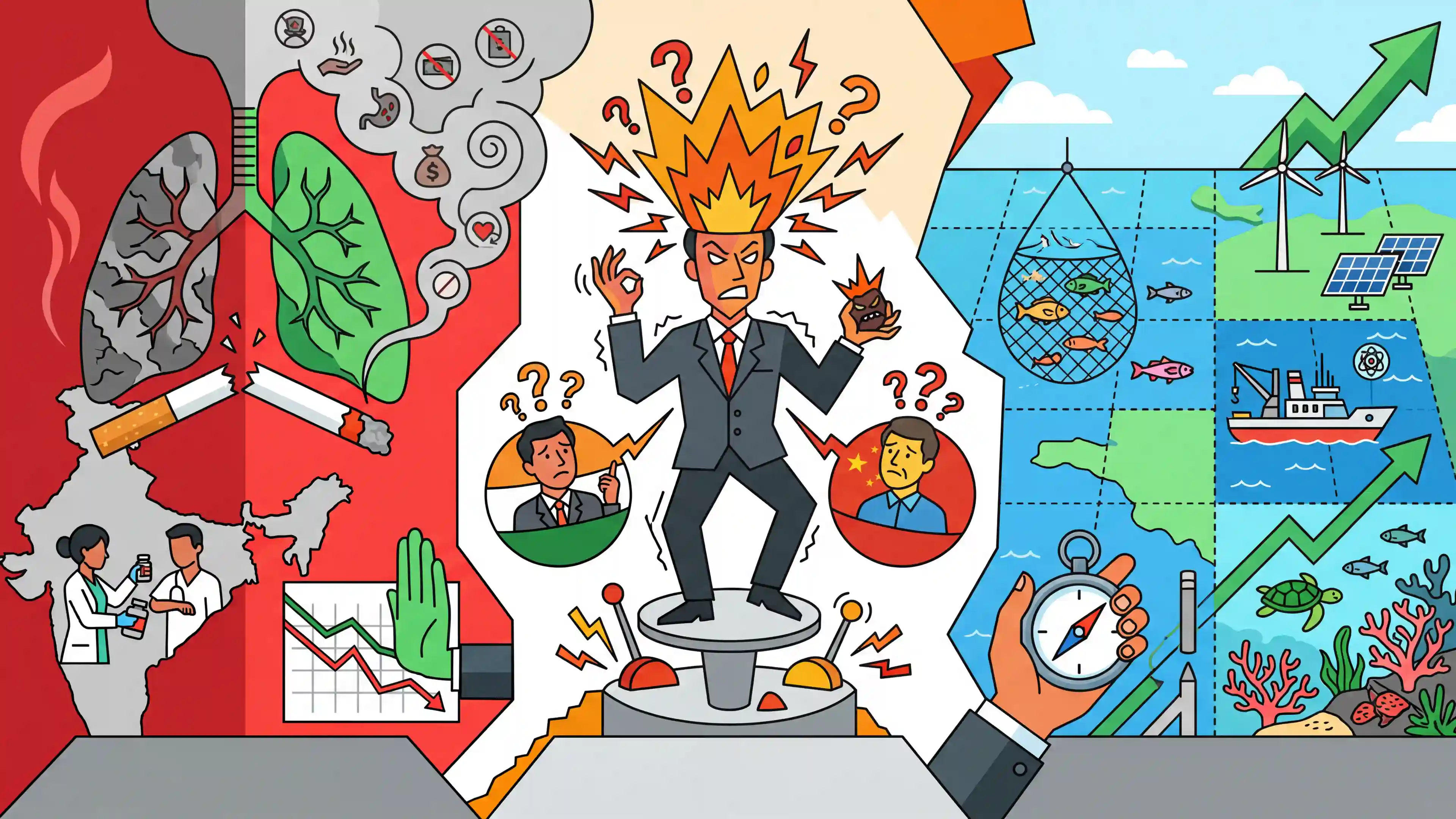
This covers important dimensions of social justice (health policies on tobacco), international relations theories (deterrence and diplomacy), and geography/environment (sustainable management of marine resources via MSP).
Summary
The article outlines three diverse yet critical issues for UPSC preparation. It discusses the severe public health and economic impacts of tobacco consumption in India, underscoring the need for stronger healthcare interventions. It also explains the 'Madman Theory', an international relations concept used to gain diplomatic leverage through calculated unpredictability. Finally, it highlights the importance of the Marine Spatial Plan (MSP) in driving India's Blue Economy, emphasizing the sustainable management of oceanic resources and the protection of marine biodiversity.
Key Points
- Tobacco consumption in India presents a persistent public health challenge, causing widespread diseases and placing significant strain on the healthcare system and economy.
- The Madman Theory is an international relations strategy where a leader projects an unpredictable and volatile image to deter adversaries and extract diplomatic concessions, famously associated with US President Richard Nixon.
- The Marine Spatial Plan (MSP) provides a comprehensive framework to balance India's Blue Economy ambitions with the conservation of marine ecosystems and sustainable use of ocean resources.
- Effective MSP implementation is crucial for reducing conflicts among competing marine activities (fishing, shipping, tourism) and mitigating environmental hazards along India's vast coastline.
Important Terms
Marine Spatial Plan (MSP)

A public governance process that analyzes and allocates the spatial and temporal distribution of human activities in marine areas to achieve ecological, economic, and social objectives sustainably.
UPSC context
GS Paper 3: Environment and Economy; essential for sustainable ocean management and India's Blue Economy Policy.
Madman Theory
An international relations strategy where a leader projects an image of being unpredictable, irrational, or volatile to force adversaries into making diplomatic concessions out of fear of escalation.
UPSC context
GS Paper 2: International Relations; tests understanding of strategic doctrines and coercive diplomacy in global conflicts.
Blue Economy
The sustainable use of ocean resources for economic growth, improved livelihoods, and jobs while preserving the health of marine ecosystems.
UPSC context
GS Paper 3: Economic Development; vital for resource management along India's 7,500 km coastline.
COTPA Act, 2003
Indian legislation enacted to prohibit tobacco advertising and regulate the production, supply, and distribution of cigarettes and other tobacco products to protect public health.
UPSC context
GS Paper 2: Government Policies and Health; critical for evaluating India's legal framework against the tobacco epidemic.
MPOWER Strategy
A WHO technical package to help countries implement the Framework Convention on Tobacco Control, involving Monitoring, Protecting, Offering help, Warning, Enforcing bans, and Raising taxes.
UPSC context
GS Paper 2: Public Health; relevant for comparative analysis of global best practices in tobacco control.
Smokeless Tobacco (SLT)
Tobacco consumed without burning, such as gutkha or khaini; India has the world's highest prevalence, posing a major risk for oral cancers.
UPSC context
GS Paper 2: Social Justice; focuses on health challenges unique to the Indian socio-cultural context.
Prelims Trap
"Marine Spatial Planning in India is spearheaded by the Ministry of Environment, Forest and Climate Change to protect marine biodiversity."
MSP is actually driven by the National Centre for Coastal Research (NCCR) under the Ministry of Earth Sciences (MoES), not the MoEFCC.
Static Concepts Connected
What are the core components of the WHO Framework Convention on Tobacco Control (FCTC)?
- Legally Binding: It is the first legally binding global public health treaty negotiated under the WHO to tackle the tobacco epidemic.
- Demand Reduction: Mandates price measures like high taxation (75% benchmark) and non-price measures like advertising bans and graphic packaging warnings.
- Supply Reduction: Requires state parties to combat illicit tobacco trade and promote economically viable alternative livelihoods for tobacco workers.
How does Marine Spatial Planning (MSP) complement Coastal Regulation in India?
- CRZ Limits: Coastal Regulation Zones (under MoEFCC) dictate permitted land use strictly along the coastline based on ecological sensitivity.
- MSP Scope: MSP (under MoES) extends further into oceanic waters to map and zone overlapping human activities like shipping, fishing, and renewable energy.
- Pilot Projects: India's pilot MSP projects in Lakshadweep and Puducherry combine economic zoning with biodiversity conservation, minimizing sectoral conflicts.
Cross-Topic Patterns
Nordic ties + Blue Economy
India relies heavily on Nordic countries like Norway for technical expertise in maritime spatial planning and offshore wind, marrying diplomacy with GS3 environmental goals.
IR Theories in GS2 Mains
The Madman Theory connects to strategic ambiguity and game theory, highly relevant as a conceptual framework for analyzing nuclear deterrence and modern brinkmanship in IR.

Marine Spatial Planning is highly likely to appear in 2026 GS3, integrating Blue Economy, MoES initiatives, and Nordic bilateral ties.
Linked PYQs · 5
Linked PYQs · 5
- 2024MainsGS2
In a crucial domain like the public healthcare system the Indian State should play a vital role to contain the adverse impact of marketisation of the system. Suggest some measures through which the State can enhance the reach of public healthcare at the grassroots level.
- 2020MainsGS2
In order to enhance the prospects of social development, sound and adequate health care policies are needed particularly in the fields of geriatric and maternal health care. Discuss.
- 2014MainsGS1
Critically evaluate the various resources of the oceans which can be harnessed to meet the resource crisis in the world.
- 2023MainsGS1
Comment on the resource potentials of the long coastline of India and highlight the status of natural hazard preparedness in these areas.
- 2019MainsGS3
Define the concept of carrying capacity of an ecosystem as relevant to an environment. Explain how understanding this concept is vital while planning for sustainable development of a region.
