Tobacco Consumption Policy Geopolitics and Marine Spatial Planning
Source:Indian Express ↗
Why It Matters
Understanding tobacco consumption trends is vital for public health governance and evaluating the effectiveness of health policies. The 'Madman Theory' provides a conceptual lens for analyzing contemporary geopolitical brinkmanship and nuclear deterrence. The Marine Spatial Plan is a pivotal topic at the intersection of GS-1 (Geography) and GS-3 (Economy/Environment) as India increasingly focuses on sustainable marine resource utilization.
Summary
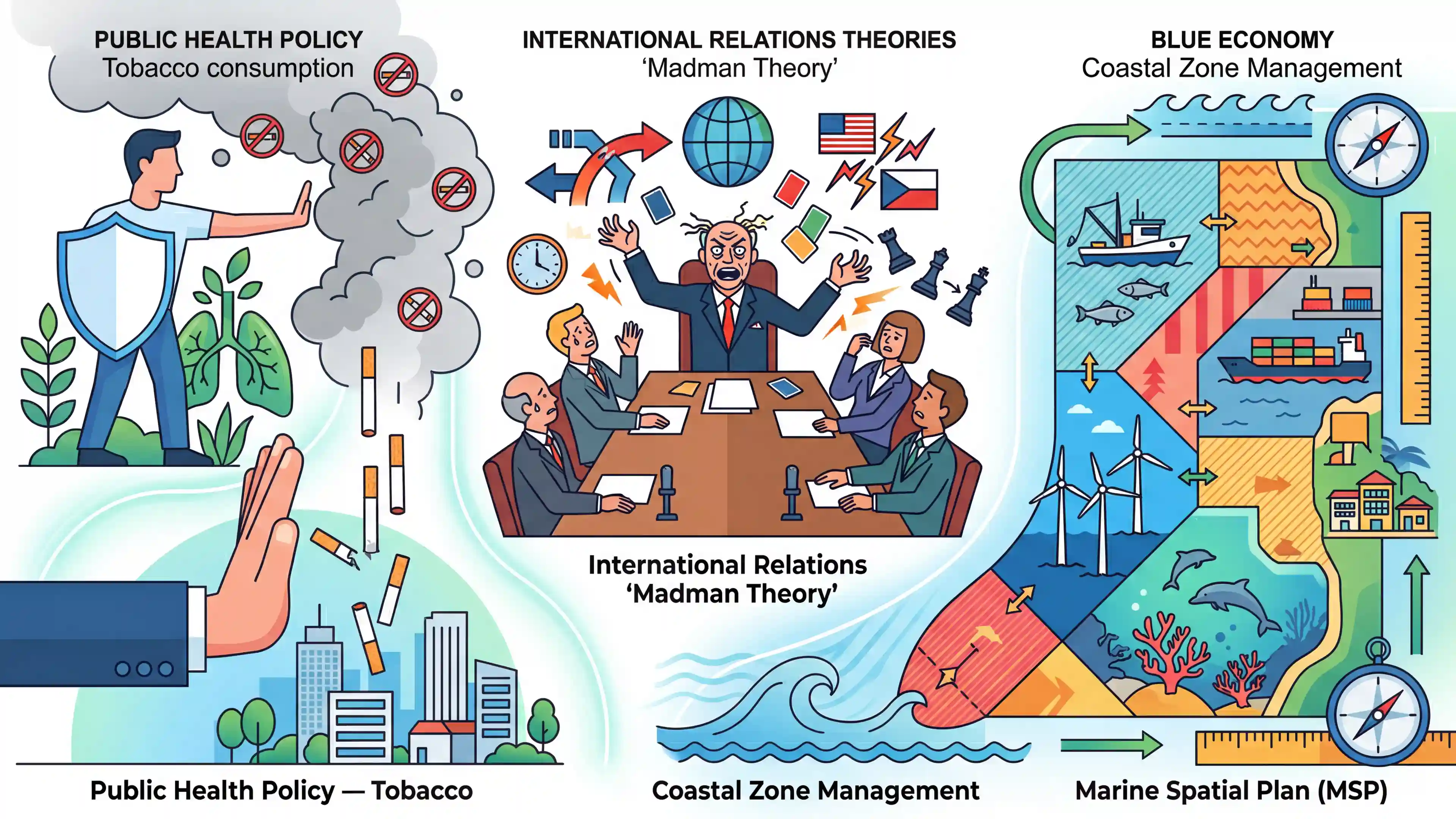
This article covers three diverse topics relevant to the UPSC examination: the public health challenges and policy responses to tobacco consumption in India; the 'Madman Theory' in International Relations, which examines strategic unpredictability and brinkmanship in foreign policy; and the Marine Spatial Plan (MSP), an essential environmental and economic framework for sustainably managing ocean resources and advancing India's Blue Economy.
Key Points
- Tobacco consumption in India continues to be a major public health issue, contributing heavily to the burden of non-communicable diseases and necessitating stronger health policies.
- The 'Madman Theory' is a foreign policy doctrine in International Relations where a leader attempts to appear irrational or unpredictable to intimidate adversaries, most famously used by Richard Nixon.
- The Marine Spatial Plan (MSP) is a strategic framework designed to organize human activities in marine areas to achieve ecological, economic, and social objectives.
- Implementing MSP is crucial for India's Blue Economy, balancing the exploitation of ocean resources (like fisheries and energy) with the conservation of marine ecosystems and maritime security.
Important Terms
Marine Spatial Plan (MSP)

An ecosystem-based framework for managing marine spaces by allocating zones for activities like fisheries and energy to balance economic growth with environmental protection.
UPSC context
GS Paper 3: Environment/Economy. Tests understanding of sustainable resource management and coastal governance.
WHO Framework Convention on Tobacco Control (FCTC)
The first international public health treaty negotiated under the WHO, setting universal standards on tobacco taxation, advertising, and packaging to reduce consumption.
UPSC context
GS Paper 2: International Relations/Health. Tests knowledge of global health governance and India's international commitments.
Madman Theory
A strategic doctrine where a leader projects unpredictability or irrationality to make adversaries fear extreme escalation, thereby forcing diplomatic concessions.
UPSC context
GS Paper 2: International Relations. Tests understanding of strategic doctrines, deterrence, and foreign policy tactics.
Blue Economy
Sustainable use of ocean resources for economic growth and improved livelihoods while preserving marine ecosystem health; India's 'Blue Economy 2.0' focuses on climate resilience.
UPSC context
GS Paper 3: Indian Economy/Environment. Tests knowledge of maritime potential and SDG 14.
COTPA Act, 2003
India’s primary tobacco control law prohibiting smoking in public places, tobacco advertisements, and sales to minors or near schools.
UPSC context
GS Paper 2: Governance/Social Justice. Tests understanding of domestic health legislation and its implementation.
Prelims Trap
"Lakshadweep and Puducherry were the first Indian states/UTs to formally launch the Marine Spatial Plan."
While Lakshadweep and Puducherry were chosen as initial pilot sites under the 2019 Indo-Norway initiative, Odisha is actually the first Indian state to formally launch an MSP.
Static Concepts Connected
What are the key obligations under the WHO Framework Convention on Tobacco Control (FCTC)?
- Price and Tax: Implementing tax measures to reduce tobacco demand, with the WHO recommending at least a 75% tax share on retail prices.
- Non-price measures: Banning advertising and sponsorship, mandating graphic health warnings on packaging, and creating smoke-free public spaces.
- Illicit trade: Adopting measures to combat smuggling and illicit trade in tobacco products globally.
How does Coercive Diplomacy function in International Relations?
- Definition: Using threats or limited force to persuade an adversary to stop or undo an action.
- Deterrence vs Compellence: Deterrence prevents an action from happening, while coercive diplomacy (compellence) forces a change in behavior.
- Brinkmanship: Pushing a situation to the edge of disaster to force the opponent to back down, often linked to irrationality.
Cross-Topic Patterns
MSP and Deep Ocean Mission
MSP aligns with India's Deep Ocean Mission and CRZ norms, integrating spatial mapping to balance offshore wind, deep-sea mining, and marine biodiversity conservation.
Tobacco taxation and GST cess
Tobacco attracts the highest GST slab plus a compensation cess. Despite this, the total tax burden remains below WHO's 75% recommendation, highlighting structural tax policy gaps.

Expect a Prelims question matching IR doctrines (Madman theory) to meanings, or a GS3 Mains question on MSP and India's Blue Economy.
Linked PYQs · 5
Linked PYQs · 5
- 2020MainsGS2
In order to enhance the prospects of social development, sound and adequate health care policies are needed particularly in the fields of geriatric and maternal health care. Discuss.
- 2020MainsGS2
Critically examine the role of WHO in providing global health security during the Covid-19 pandemic.
- 2021PrelimsGS1
What is blue carbon?
- 2025MainsGS3
Why is maritime security vital to protect India's sea trade? Discuss maritime and coastal security challenges and the way forward.
- 2018MainsGS2
In what ways would the ongoing US-Iran Nuclear Pact Controversy affect the national interest of India? How should India respond to this situation?
