India Cancer Registry and Seismic Risk Mapping
Source:Indian Express ↗
Why It Matters
This multidimensional coverage provides critical case studies for UPSC aspirants. India's cancer map offers data points for GS-2 answers on health policy and the shift from curative to preventive care. The Afghanistan earthquake is a prime example for GS-1 physical geography (plate tectonics) and GS-3 disaster management. Meanwhile, diplomatic troikas are key conceptual tools for GS-2 International Relations.
Summary
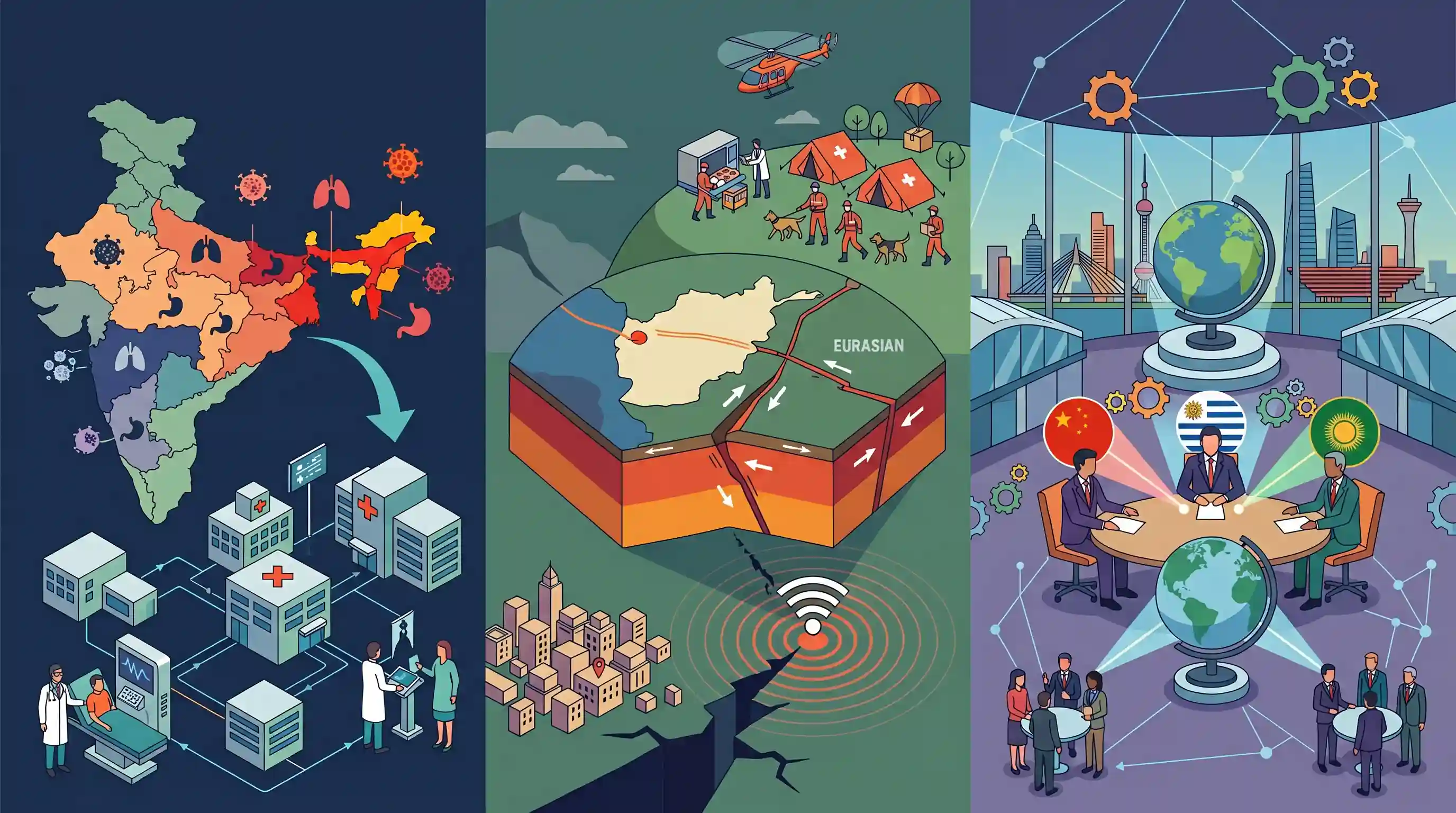
The article highlights three major contemporary issues spanning health, geography, and international relations. First, it discusses India's "cancer map" based on ICMR data, revealing stark regional variations in cancer incidence (particularly high in the Northeast) and emphasizing the urgent need for robust, preventive healthcare infrastructure to manage non-communicable diseases. Second, it examines the devastating shallow-focus earthquakes in Herat, Afghanistan, explaining the underlying tectonic plate dynamics (Indian, Eurasian, and Arabian plates) and the acute need for disaster preparedness in seismically active zones. Finally, it touches upon the "Tianjin Troika," illustrating the significance of minilateral diplomatic mechanisms in shaping consensus on complex global geopolitical challenges.
Key Points
- The ICMR's cancer registry provides a comprehensive "cancer map" of India, highlighting that the Northeast region bears the highest burden of cancer incidence.
- The rising burden of non-communicable diseases (NCDs) like cancer underscores the need for India's public health infrastructure to pivot from purely curative care to preventive and promotive care.
- Devastating earthquakes in Herat, Afghanistan, are driven by complex tectonic plate interactions between the Arabian, Indian, and Eurasian plates, making the region highly vulnerable to seismic activity.
- Shallow-focus earthquakes, such as those that struck Afghanistan, typically cause more severe surface destruction because seismic waves retain more energy upon reaching the surface.
- The concept of diplomatic troikas (such as the Tianjin Troika) highlights the growing role of minilateralism and consensus-building in addressing global geopolitical and environmental challenges.
Important Terms
Indian Council of Medical Research (ICMR)

India's apex body for formulating, coordinating, and promoting biomedical research, functioning under the Ministry of Health and Family Welfare to guide national health policy through scientific evidence.
UPSC context
GS Paper 2/3: Statutory/Regulatory bodies; Science & Tech; crucial for health governance and disease management questions.
National Centre for Disease Informatics and Research (NCDIR)
A Bengaluru-based constituent institute of ICMR that utilizes information science to maintain comprehensive national databases on non-communicable diseases like cancer, diabetes, and cardiovascular conditions.
UPSC context
GS Paper 2/3: Health infrastructure and E-governance in health; vital for NCD management and data-driven policy.
National Cancer Registry Programme (NCRP)
A flagship ICMR-NCDIR initiative since 1981 that systematically collects and analyzes cancer incidence data through a network of population and hospital-based registries.
UPSC context
GS Paper 2: Issues relating to Health; relevant for discussing regional health disparities and cancer control.
Tianjin Troika
Informal minilateral engagement between leaders of India, Russia, and China at the SCO Summit in Tianjin, symbolizing India’s strategic autonomy and balancing role in multipolar geopolitics.
UPSC context
GS Paper 2: International Relations; Global groupings and their impact on India’s interests.
Shallow-focus Earthquake
Earthquakes with a hypocenter less than 70 km deep, which often cause higher surface destruction because seismic waves dissipate less energy before reaching the surface.
UPSC context
GS Paper 1: Important Geophysical phenomena; tests understanding of seismology and disaster vulnerability.
Alpide Belt
The world's second most seismically active zone, stretching from the Atlantic through the Mediterranean and Himalayas to Indonesia; where tectonic collisions cause frequent earthquakes in Afghanistan.
UPSC context
GS Paper 1: Geography; physical features and tectonic activity of global regions.
Prelims Trap
Deep-focus earthquakes cause more severe surface destruction than shallow-focus earthquakes.
Aspirants often assume 'deep' implies more power. In reality, shallow-focus earthquakes (0-70 km) cause much worse surface damage because seismic waves lose less energy before hitting the crust.
Static Concepts Connected
How do focal depth and plate interactions determine earthquake destructiveness?
- Shallow-focus (0-70km): Highly destructive at the surface because seismic waves have less distance to travel, thereby retaining maximum energy upon impact.
- Deep-focus (300-700km): Cause less surface damage as energy dissipates during upward transit, but they can be felt over a much wider geographical area.
- Afghanistan's Tectonics: The region is highly vulnerable due to the complex convergence and continuous faulting of the Indian, Eurasian, and Arabian tectonic plates.
What is the National Cancer Registry Programme (NCRP) and its significance?
- NCRP Role: Operated by the ICMR and NCDIR to systematically collect, map, and analyze data on cancer incidence, mortality, and clinical outcomes across India.
- Epidemiological Transition: Highlights India's epidemiological transition where Non-Communicable Diseases (NCDs) dominate, demanding a structural shift from merely curative to proactive, preventive healthcare.
Cross-Topic Patterns
Regional disparities in NCDs
Northeast India's high cancer incidence links epidemiology with geography, highlighting how socio-cultural habits and historically limited tertiary care infrastructure compound regional health vulnerabilities.
Shift to agile minilateralism
The Tianjin Troika exemplifies how modern diplomacy is pivoting from rigid multilateral institutions to flexible, issue-based minilateral groupings to forge consensus on complex geopolitical issues.

Expect a 2026 prelims match-the-following question pairing recent earthquake epicenters (like Herat) with their exact plate boundaries.
Linked PYQs · 4
Linked PYQs · 4
- 2023PrelimsGS1
Consider the following statements: Statement-I: India's public sector health care system largely focuses on curative care with limited preventive, promotive and rehabilitative care. Statement-II: Under India's decentralized approach to health care delivery, the States are primarily responsible for organizing health services. Which one of the following is correct in respect of the above statements?
- 2020MainsGS2
In order to enhance the prospects of social development, sound and adequate health care policies are needed particularly in the fields of geriatric and maternal health care. Discuss.
- 2023PrelimsGS1
Consider the following statements: 1. In a seismograph, P waves are recorded earlier than S waves. 2. In P waves, the individual particles vibrate to and fro in the direction of wave propagation whereas in S waves, the particles vibrate up and down at right angles to the direction of wave propagation. Which of the statements given above is/are correct?
- 2020MainsGS3
Discuss the recent measures initiated in disaster management by the Government of India departing from the earlier reactive approach.
