UPSC Civil Services Exam Prep Current Affairs Analysis
Source:Indian Express ↗
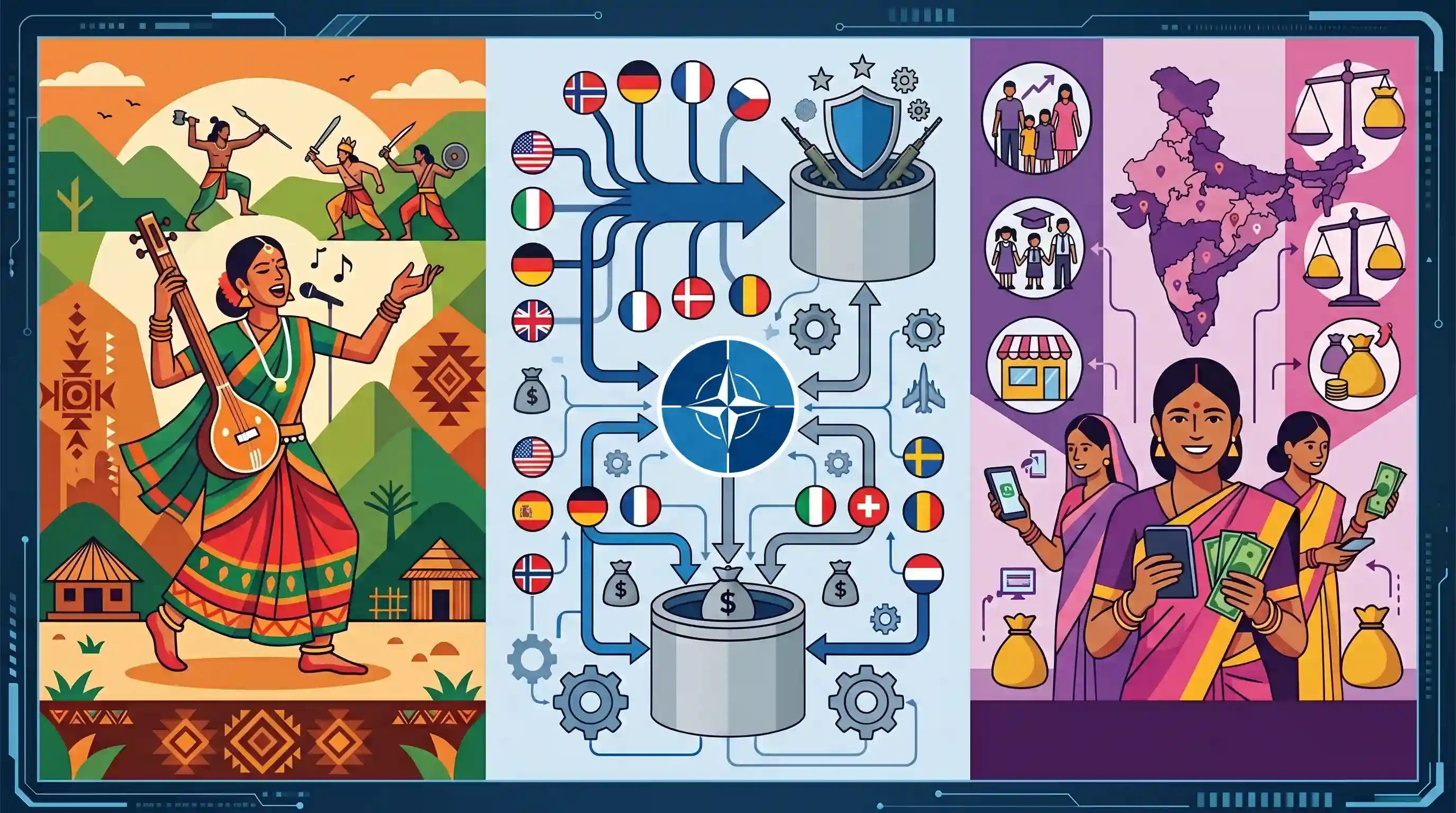
Why It Matters
This article bridges vital dimensions of General Studies: Art and Culture (traditional folk performing arts), International Relations (the financial and geopolitical dynamics of the world's primary security alliance), and Social Justice/Governance (the developmental impact vs. fiscal sustainability of cash-based welfare schemes).
Summary
This article covers three crucial areas of the UPSC syllabus: the artistic legacy of Teejan Bai and the traditional Pandavani performing art of Chhattisgarh; the complex direct and indirect funding architecture of NATO alongside the 2% defense spending mandate; and the multi-dimensional fiscal and social debate surrounding targeted sub-national cash transfer schemes for women in India.
Key Points
- Pandavani is a traditional folk performing art of Chhattisgarh narrating episodes of the Mahabharata, divided into two styles: Vedamati (narrated while sitting) and Kapalik (enacted while standing and moving). Teejan Bai is a world-renowned pioneer of the Kapalik style and a recipient of Padma Shri, Padma Bhushan, and Padma Vibhushan.
- NATO funding relies on two mechanisms: Direct Funding (contributions to the common budget based on a GNI-linked formula for civil, military, and infrastructure costs) and Indirect Funding (national military assets and forces volunteered by allies at their own expense).
- The NATO 2% defense spending target, adopted at the 2014 Wales Summit, remains a major geopolitical focus as allies face pressure (particularly from the US) to meet the guideline to ensure collective security and burden-sharing in the post-Ukraine war era.
- Sub-national direct cash transfer (DBT) schemes targeted at women (like Maharashtra's Majhi Ladki Bahin, MP's Ladli Behna, Karnataka's Gruha Lakshmi, and Chhattisgarh's Mahtar Vandana) are expanding rapidly across India to foster financial agency and social security.
- The debate surrounding cash transfer schemes centers on 'women empowerment and increased household spending on nutrition/education' versus 'fiscal sustainability, potential work disincentives, and the crowding out of productive capital expenditure (capex)'.
Important Terms
NATO (North Atlantic Treaty Organization)

An intergovernmental military alliance of 32 North American and European countries established in 1949, operating on the principle of collective defense where an attack on one member is considered an attack on all.
UPSC context
GS Paper II (International Relations). Tests knowledge of global security groupings, their mandates, geopolitical roles, and India's strategic alignment.
Washington Treaty
The founding document of NATO signed on April 4, 1949, in Washington, D.C., which establishes the legal and political framework of the alliance, famously including the Article 5 collective defense provision.
UPSC context
GS Paper II (Global Groupings). Tests understanding of international treaties governing collective defense and global security architectures.
Ladli Behna Yojana
A welfare initiative by the Madhya Pradesh government providing direct monthly cash transfers (initially ₹1,000, later ₹1,250) to eligible women aged 21–60 from economically weaker families to promote self-reliance.
UPSC context
GS Paper II (Welfare Schemes). Tests comprehension of state-led direct benefit transfers, their fiscal impacts, and gender empowerment outcomes.
Majhi Ladki Bahin Yojana
A social welfare scheme launched by the Maharashtra government in 2024, providing a monthly financial transfer of ₹1,500 to eligible women aged 21–65 to foster economic independence and welfare.
UPSC context
GS Paper II (Welfare Schemes). Tests knowledge of targeted fiscal interventions, direct benefit transfers, and gender budgeting at the state level.
Gruha Lakshmi Yojana
A major income support scheme under Karnataka's "five guarantee schemes" that provides ₹2,000 monthly to eligible female heads of households via Direct Benefit Transfer to enhance financial autonomy.
UPSC context
GS Paper II (Welfare Schemes). Tests understanding of sub-national welfare models, household-targeted financial inclusion, and social safety nets.
Mahtar Vandana Yojana
A Chhattisgarh government scheme providing ₹1,000 monthly (₹12,000 annually) to eligible married, widowed, or abandoned women aged 21 and older to improve financial independence, nutrition, and household status.
UPSC context
GS Paper II (Welfare Schemes). Tests critical analysis of targeted gender-based cash transfer schemes, their implementation, and socio-economic empowerment.
Prelims Trap
The common direct budget of NATO represents the majority of its total military capability and operational expenditure.
Indirect funding (member states volunteering national forces at their own expense) constitutes the bulk of NATO's military capabilities, not direct common budget contributions.
Static Concepts Connected
What was the Criminal Tribes Act, 1871 and its post-independence status?
- Colonial classification: Labelled entire nomadic and tribal communities (such as Pardhis) as habitual criminals, restricting their civil liberties.
- De-notification: Repealed in 1952; these communities were reclassified as De-notified, Nomadic, and Semi-Nomadic Tribes (DNTs).
- Policy focus: Supported by schemes like SEED and monitored by the Development and Welfare Board for DNTs (DWBDNC).
What is the economic trade-off between Capital and Revenue Expenditure?
- Capital expenditure: Creates long-term physical assets like infrastructure that multiplier-boost economic productivity and future revenues.
- Revenue expenditure: Covers operational costs and transfers that support short-term consumption but do not build productive state assets.
- Fiscal crowding-out: Excessive revenue spending on populism compresses state-level capital budgets, violating FRBM targets and hurting long-term growth.
Cross-Topic Patterns
Welfare DBTs + Fiscal Federalism
Rising sub-national unconditional cash transfers challenge state compliance with FRBM fiscal deficit limits, triggering central borrowing restrictions under Article 293(3).
Tribal Art + Social Mobility
Performers from historically criminalized tribes use folk traditions to challenge deeply entrenched caste-gender barriers and secure mainstream socio-economic representation.

State-level gender-focused DBTs versus capex compression under FRBM rules will be a core GS-3 fiscal policy theme in 2026.
Linked PYQs · 3
Linked PYQs · 3
- 2014PrelimsGS1
A community of people called Manganiyars is well-known for their
- 2023MainsGS2
‘The expansion and strengthening of NATO and a stronger US-Europe strategic partnership works well for India.’ What is your opinion about this statement ? Give reasons and examples to support your answer.
- 2025MainsGS2
Women's social capital complements in advancing empowerment and gender equity. Explain.
