Geopolitical shifts in trade tariffs and regional security dynamics
Source:Indian Express ↗
Why It Matters
This compilation touches upon overlapping themes in GS Paper 2 (International Relations) and GS Paper 3 (Science & Technology, Internal Security). Understanding US trade dynamics and regional security volatility (Pakistan-Afghanistan) is essential for answering questions on India's strategic footprint. Similarly, the boom in AI data centres bridges technological advancement with infrastructure challenges, highly relevant for GS3.
Summary
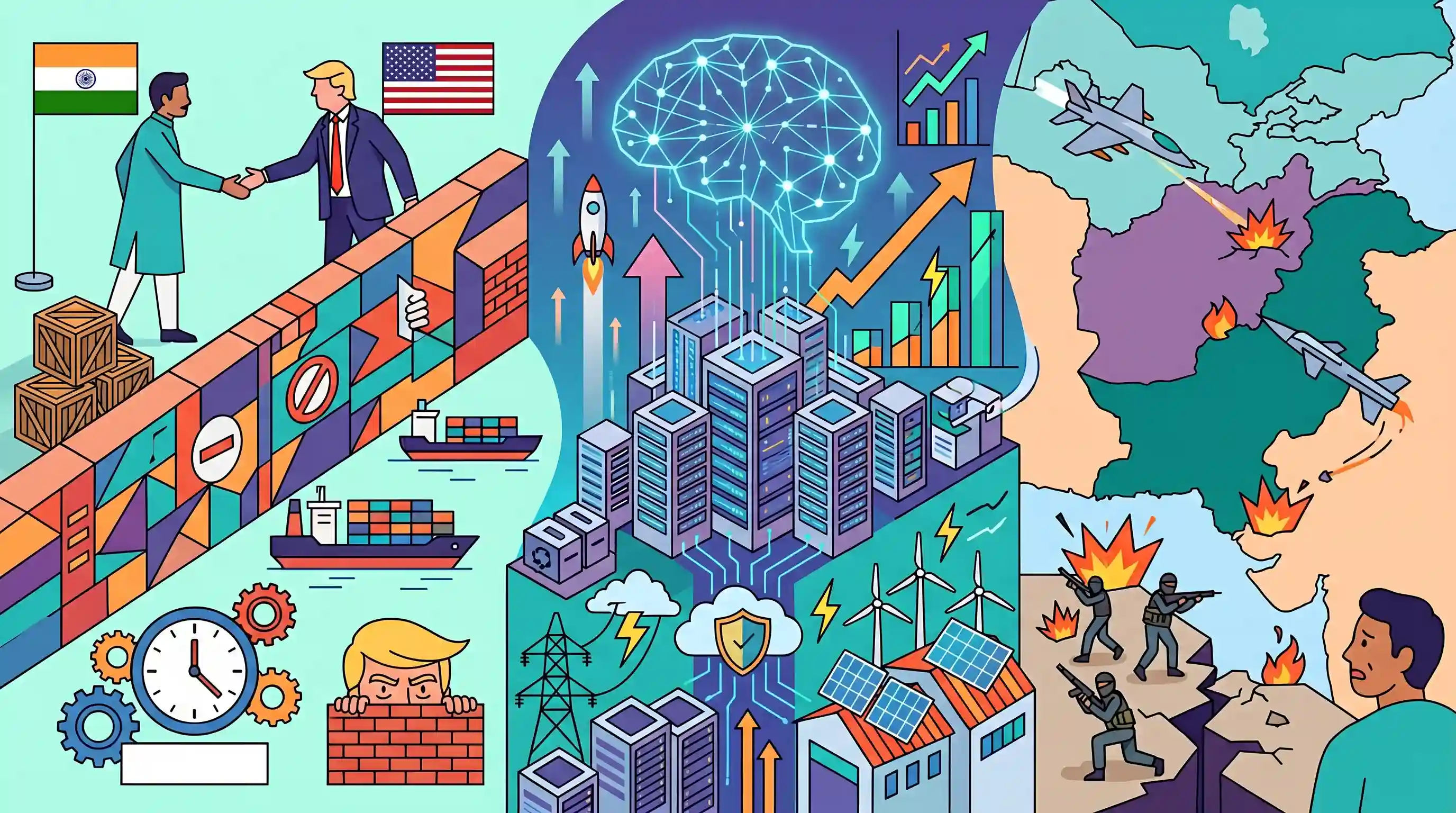
The article covers three critical developments relevant to UPSC aspirants: the rescheduling of India-US trade talks, the surge in infrastructure for AI data centres, and recent cross-border military strikes by Pakistan into Afghanistan. In economic diplomacy, bilateral trade relations with the US remain a focal point amid shifting tariff regimes and protectionist rhetoric associated with Trump. On the technology front, the exponential growth of AI relies heavily on data centres, bringing forth infrastructure opportunities, data sovereignty concerns, and energy sustainability challenges. Geopolitically, Pakistan's strikes targeting TTP militants within Afghan territory highlight the deteriorating security situation along the Durand Line, carrying significant implications for regional stability and counter-terrorism in South Asia.
Key Points
- India-US trade discussions have been rescheduled amidst ongoing debates on tariffs and protectionist policies under the potential influence of Trump's agenda, signaling a need to recalibrate bilateral economic diplomacy.
- The rapid expansion of Artificial Intelligence has catalyzed the demand for AI data centres, presenting both opportunities for digital infrastructure growth in India and challenges related to high energy consumption and data sovereignty.
- Pakistan has conducted military strikes inside Afghanistan targeting militant groups such as the Tehrik-i-Taliban Pakistan (TTP), heightening border tensions and straining relations between Islamabad and the Taliban regime.
- The strikes in Afghanistan underscore the volatile security environment in India's neighborhood, with implications for regional stability and cross-border terrorism dynamics.
Important Terms
Tehrik-i-Taliban Pakistan (TTP)

An umbrella militant organization founded in 2007 along the Afghanistan-Pakistan border. It seeks to overthrow the Pakistani state and establish an Islamic emirate through Deobandi jihadist ideology.
UPSC context
GS Paper-III (Internal Security) and GS Paper-II (International Relations); relevant for neighborhood challenges and cross-border terrorism.
Durand Line
The 2,640-kilometre frontier established in 1893 between British India and Afghanistan. Pakistan recognizes it as an international border, but Afghanistan historically disputes its legitimacy, leading to persistent regional tensions.
UPSC context
GS Paper-II (International Relations/Neighborhood) and GS Paper-I (Geography); tests knowledge of border disputes and colonial legacies.
Data Sovereignty
The principle that digital data is subject to the laws and governance of the country where it is generated. It emphasizes local control over data storage, access, and usage for national security.
UPSC context
GS Paper-III (Science and Technology/IT) and GS Paper-II (Governance); critical for understanding India's digital policy and the DPDP Act 2023.
Protectionism
Economic policy of restricting imports through tariffs, quotas, or subsidies to protect domestic industries. It is a recurring friction point in India-US trade talks, often linked to the "Tariff King" rhetoric.
UPSC context
GS Paper-III (Indian Economy) and GS Paper-II (Bilateral Relations); relevant for international trade dynamics and global economic shifts.
Afghan Taliban
The Sunni Islamist movement that returned to power in Afghanistan in 2021. While sharing ideological roots with the TTP, it focuses on governing Afghanistan rather than overthrowing the Pakistani state.
UPSC context
GS Paper-II (International Relations); essential for analyzing regional stability, neighborhood policy, and counter-terrorism.
India-US Bilateral Trade
Economic exchange between India and the US, reaching record highs (~$132 billion in FY25). Key issues include tariff rationalization, GSP status, and the "Mission 500" target for 2030.
UPSC context
GS Paper-II (Bilateral Groupings) and GS Paper-III (Economy); tests understanding of strategic partnerships and global trade dependencies.
Prelims Trap
The Durand Line forms the international border exclusively between Pakistan and Afghanistan.
India officially shares a 106 km border with Afghanistan (in Pakistan-occupied Kashmir) along the Durand Line. Therefore, it does not strictly separate only Pakistan and Afghanistan.
Static Concepts Connected
What is the Generalized System of Preferences (GSP) in international trade?
- Non-reciprocal framework: It is a preferential tariff system where developed nations grant reduced or zero tariffs to eligible products from developing countries.
- WTO Exemption: GSP falls under the WTO's Enabling Clause, which allows exceptions to the Most Favored Nation (MFN) principle for developing states.
- US-India context: The US revoked India's GSP status in 2019, citing that India had not assured equitable and reasonable access to its domestic markets.
What is the historical and geopolitical context of the Durand Line?
- Historical Origin: Demarcated in 1893 following an agreement between British Indian civil servant Mortimer Durand and Afghan Amir Abdur Rahman Khan.
- Border Dispute: Afghanistan has historically refused to recognize it as a formal international border, as it artificially divides the ethnic Pashtun population.
- India's Stance: India officially recognizes its 106 km boundary with Afghanistan (in Gilgit-Baltistan) as part of this historical alignment.
Cross-Topic Patterns
AI Data Centres + Energy Transition
AI's massive base-load power demands contradict green energy goals, forcing a linkage between digital infrastructure growth and India's renewable energy generation and water-cooling policies.
Durand Line + Counter-Terrorism
Pakistan's cross-border strikes against TTP sanctuaries complicate India's security calculus, as a volatile Af-Pak region directly impacts cross-border terrorism dynamics in Jammu & Kashmir.
US Protectionism + Make in India
US tariff threats and GSP removal force India to balance its domestic "Make in India" import substitution strategies with the critical need for export market access in Western economies.

Expect a mains question on how AI data centres challenge India's net-zero targets due to immense base-load cooling and power requirements.
Linked PYQs · 3
Linked PYQs · 3
- 2012MainsGS2
Discuss the likely negative impact of the protectionist measures proposed by the US on India's software industry.
- 2023MainsGS3
Introduce the concept of Artificial Intelligence (AI). How does Al help clinical diagnosis? Do you perceive any threat to privacy of the individual in the use of Al in healthcare?
- 2020MainsGS3
Analyze internal security threats and transborder crimes along Myanmar, Bangladesh and Pakistan borders including Line of Control (LoC). Also discuss the role played by various security forces in this regard.
