Parliamentary Motions AI Stack and Bangladesh Referendum
Source:Indian Express ↗
Why It Matters
The article intersects three diverse yet vital syllabus areas: constitutional mechanisms (Polity), emerging technologies and digital public infrastructure (Science & Technology), and geopolitical stability in the immediate neighborhood (International Relations). Understanding these topics is crucial for both Prelims and Mains examinations.
Summary
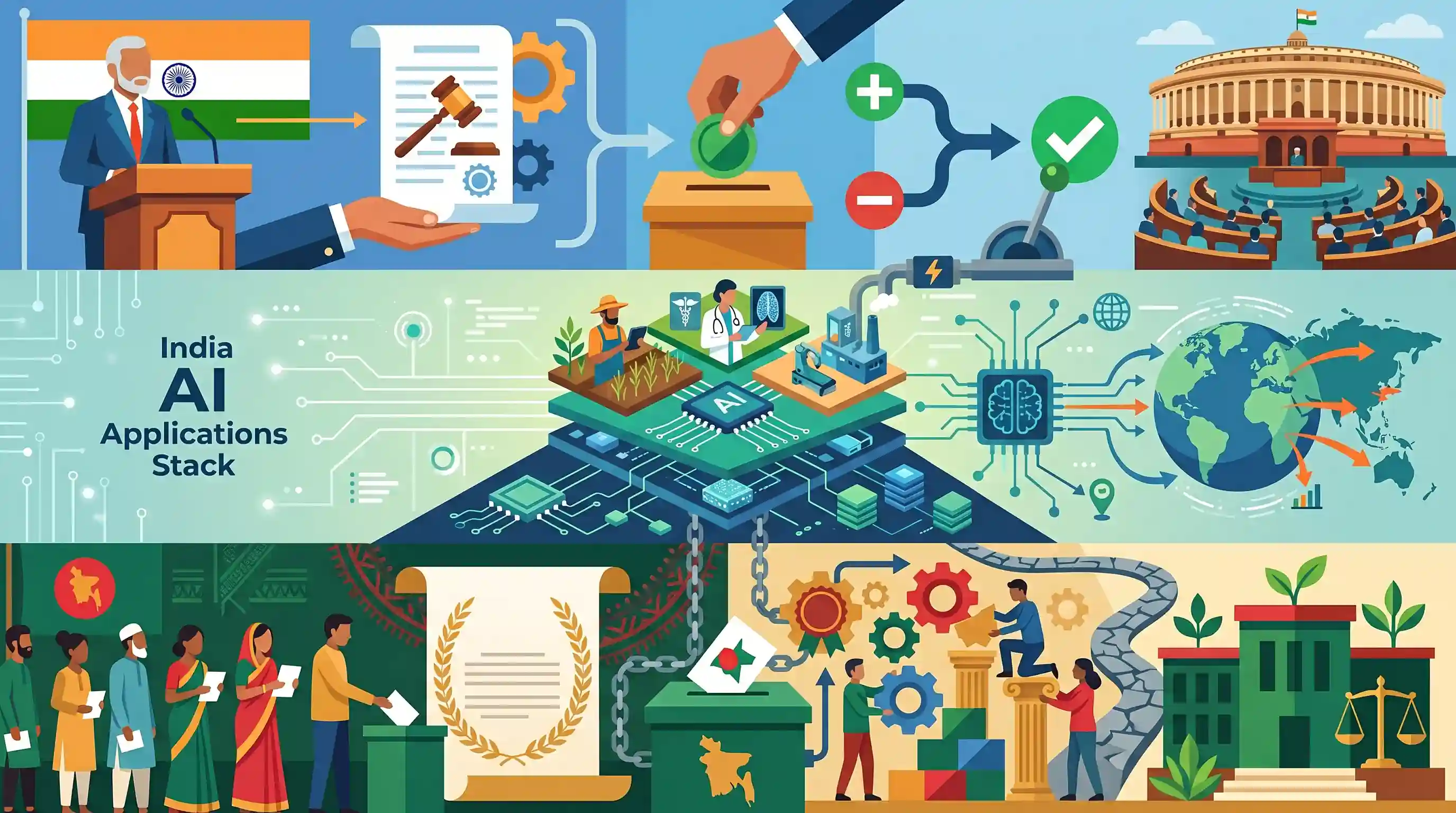
The article outlines three crucial issues for UPSC preparation. Firstly, it explains the procedural significance of substantive motions in the Indian Parliament, which are independent proposals put to vote to reflect the House's decision. Secondly, it examines the push for an 'India AI Applications Stack', aimed at scaling grassroots artificial intelligence solutions and fostering a digital ecosystem for global deployment. Finally, it analyzes the upcoming referendum in Bangladesh, where voters will decide on the July National Charter proposed by the interim government to institutionalize structural and constitutional reforms following political upheaval.
Key Points
- A substantive motion in Parliament is an independent proposal that expresses the decision of the House, requires prior notice, and generally must be moved by the member who gave notice.
- The government aims to orchestrate grassroots AI innovations and integrate the most impactful ones into an 'India AI Applications Stack' for scalable, global deployment.
- Bangladesh is heading toward a crucial referendum on the July National Charter, proposed by the Muhammad Yunus-led interim government, which includes significant constitutional reforms.
- The constitutional charter seeks to formalize political reforms and recognize the August 2024 uprising that resulted in Sheikh Hasina's ouster.
Important Terms
Substantive motion

An independent, self-contained proposal submitted for the House's approval, intended to express a definite opinion or decision on a significant matter, such as the impeachment of high officials.
UPSC context
GS Paper II (Polity); tests knowledge of parliamentary procedures, rules of conduct (Rule 184), and mechanisms for executive accountability.
India AI Applications Stack
A unified, scalable ecosystem of AI solutions focused on sector-specific applications (health, agriculture, education) rather than foundational infrastructure, aimed at fostering inclusive growth and digital public goods.
UPSC context
GS Paper III (Science & Tech); relevant for Digital Public Infrastructure (DPI) and the "Human Primacy" principle in Economic Survey 2026.
July National Charter
A 2025 political agreement in Bangladesh seeking to overhaul the nation's governance structure and prevent future authoritarianism through constitutional, electoral, and administrative reforms following the 2024 mass uprising.
UPSC context
GS Paper II (International Relations); tests understanding of India’s neighborhood, democratic transitions, and constitutional reform processes in South Asia.
Global Partnership on AI (GPAI)
An international, multi-stakeholder initiative (founded 2020) that guides the responsible development of AI. India is a founding member and has held the lead chairmanship.
UPSC context
GS Paper II/III (International Relations/S&T); tests global technology governance and India's leadership in setting ethical AI standards.
Referendum
A direct vote by the electorate on a specific proposal or constitutional change; in 2026, Bangladesh held its first since 1991 to ratify the July National Charter.
UPSC context
GS Paper II (Polity/IR); tests concepts of direct democracy and the legitimacy of major constitutional shifts in neighboring states.
Prelims Trap
All motions introduced in Parliament are substantive in nature and must be put to a vote.
Not all motions are substantive or require a vote (e.g., subsidiary motions). However, ALL Resolutions are substantive motions and mandate a formal vote.
Static Concepts Connected
What are the three main categories of Parliamentary Motions?
- Substantive Motion: A self-contained independent proposal dealing with important matters like the impeachment of the President or a no-confidence motion.
- Substitute Motion: Moved in substitution of an original motion and proposes an alternative. If adopted, it supersedes the original motion.
- Subsidiary Motion: Relates to a regular motion or ongoing proceeding; it has no meaning or independent existence apart from the original motion.
What are the primary tools of Direct Democracy?
- Referendum: A procedure where a proposed legislation or constitutional amendment is referred directly to the electorate for settlement by popular vote.
- Initiative: A method by which the public can propose a specific bill or policy to the legislature for enactment.
- Recall & Plebiscite: Recall allows voters to remove a representative before term expiry. Plebiscite is generally used to resolve territorial or sovereignty disputes.
Cross-Topic Patterns
India Stack + Tech Diplomacy
The 'India AI Applications Stack' leverages DPI architecture (like UPI) to project soft power and lead global tech-diplomacy, particularly for the Global South.
Neighborhood flux + Internal Security
Constitutional restructuring via the July National Charter in Bangladesh has direct downstream impacts on India's border management, Act East policy, and regional connectivity projects.

The semantic difference between motions & resolutions, and the India AI Stack's DPI framework, are prime targets for a 2026 Prelims MCQ.
Linked PYQs · 5
Linked PYQs · 5
- 2022PrelimsGS1
With reference to Deputy Speaker of Lok Sabha, consider the following statements: 1. As per the Rules of Procedure and Conduct of Business in Lok Sabha, the election of Deputy Speaker shall be held on such date as the Speaker may fix. 2. There is a mandatory provision that the election of a candidate as Deputy Speaker of Lok Sabha shall be from either the principal opposition party or the ruling party. 3. The Deputy Speaker has the same power as of the Speaker when presiding over the sitting of the House and no appeal lies against his rulings. 4. The well established parliamentary practice regarding the appointment of Deputy Speaker is that the motion is moved by the Speaker and duly seconded by the Prime Minister. Which of the statements given above are correct?
- 2024PrelimsGS1
Which of the following statements are correct in respect of a Money Bill in the Parliament? 1. Article 109 mentions special procedure in respect of Money Bills. 2. A Money Bill shall not be introduced in the Council of States. 3. The Rajya Sabha can either approve the Bill or suggest changes but cannot reject it. 4. Amendments to a Money Bill suggested by the Rajya Sabha have to be accepted by the Lok Sabha. Select the answer using the code given below :
- 2025MainsGS2
Indian Constitution has conferred the amending power on the ordinary legislative institutions with a few procedural hurdles. In view of this statement, examine the procedural and substantive limitations on the amending power of the Parliament to change the Constitution.
- 2023MainsGS2
Compare and contrast the British and Indian approaches to Parliamentary sovereignty.
- 2020PrelimsGS1
In India, the term "Public Key Infrastructure" is used in the context of
