Su-30 MKI upgrades, Cyclone Montha, and panda diplomacy insights
Source:Indian Express ↗
Why It Matters
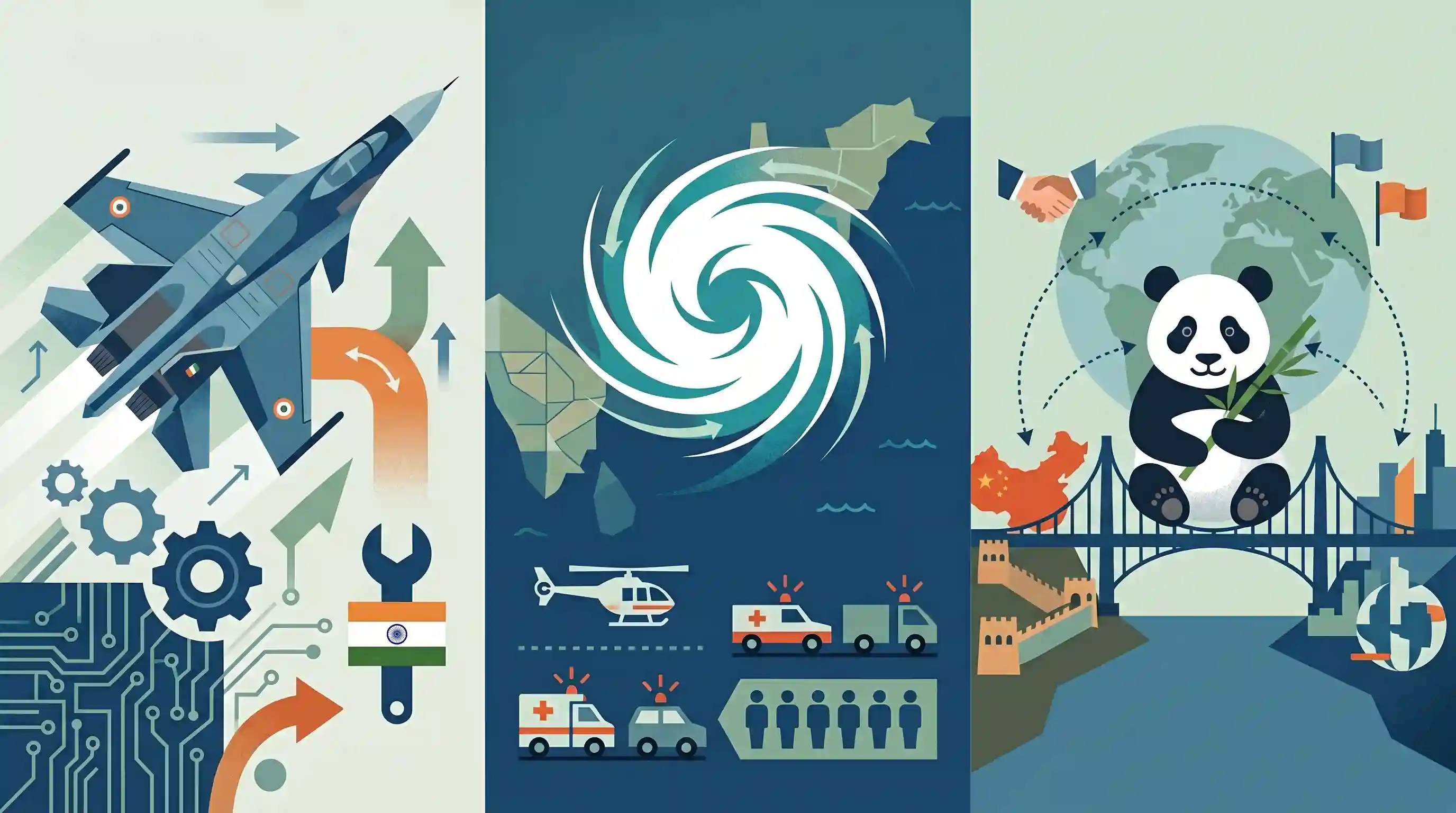
Understanding these diverse topics equips aspirants to address multidimensional questions ranging from India's push for self-reliance in defence manufacturing (GS3) and the geographical mechanics of natural disasters (GS1/GS3), to the subtler diplomatic strategies employed by global powers like China to exert geopolitical influence (GS2).
Summary
This 'UPSC Key' compilation addresses three distinct topics essential for civil services preparation: India's defence indigenisation efforts through the Su-30 MKI upgrade programme, the geographical and disaster management aspects of Cyclone Montha, and the nuances of China's soft power strategy known as 'Panda Diplomacy'. Together, these topics span national security, physical geography, and international relations.
Key Points
- The Su-30 MKI fleet is undergoing critical indigenous upgrades in avionics, radar, and weapon systems to bolster the Indian Air Force's combat capabilities and align with self-reliance goals.
- Cyclone Montha brings into focus the mechanics of tropical cyclone formation, the role of sea surface temperatures, and the importance of established naming conventions for disaster preparedness.
- China's 'Panda Diplomacy' remains a potent tool of soft power, strategically leveraging the loaning of giant pandas to strengthen bilateral ties and shape its global image.
Important Terms
Atmanirbhar Bharat

India's flagship mission to achieve self-reliance across sectors, particularly in defence manufacturing, by reducing import dependency and fostering indigenous technological development.
UPSC context
GS Paper III (Economy/Indigenisation); vital for questions on self-reliance, defence production, and 'Make in India' initiatives.
Cyclone Montha
A severe tropical cyclone that formed in the Bay of Bengal in October 2025, making landfall in Andhra Pradesh and causing widespread rainfall and infrastructure damage.
UPSC context
GS Paper I (Physical Geography) and GS III (Disaster Management); tests knowledge of tropical cyclogenesis and disaster preparedness.
Panda Diplomacy
China's practice of leasing giant pandas to foreign nations as a soft power tool to build goodwill, foster strategic partnerships, and signal diplomatic favor.
UPSC context
GS Paper II (International Relations) and GS IV (Ethics); relevant for topics on soft power, cultural diplomacy, and animal ethics.
Hindustan Aeronautics Limited (HAL)
India’s premier state-owned aerospace and defence company, responsible for the indigenous manufacturing, maintenance, and 'Super Sukhoi' upgrade of the Su-30 MKI fleet.
UPSC context
GS Paper III (Science & Tech/Indigenisation); tests roles of PSUs in national security and technological self-sufficiency.
World Meteorological Organization (WMO)
The United Nations specialized agency that coordinates international cooperation on meteorology and climate, maintaining the global framework for naming and monitoring tropical cyclones.
UPSC context
GS Paper II (International Institutions); crucial for understanding global governance of climate and early warning systems.
Indian Air Force (IAF)
The aerial warfare branch of the Indian Armed Forces, currently modernizing its backbone Su-30 MKI fleet to maintain air superiority amidst regional squadron shortages.
UPSC context
GS Paper III (Internal Security/Defence); relevant for discussions on national air power, squadron strength, and modernization.
Prelims Trap
The panel for naming tropical cyclones in the North Indian Ocean comprises only South Asian and Southeast Asian coastal countries.
The WMO/ESCAP panel expanded in 2018 to include 13 countries, notably adding Middle Eastern nations like Iran, Saudi Arabia, UAE, Qatar, and Yemen.
Static Concepts Connected
What are the essential prerequisite conditions for tropical cyclone formation?
- Warm oceans: Sea surface temperature above 26.5°C to provide an uninterrupted supply of latent heat and moisture.
- Coriolis force: Sufficient Coriolis force to deflect winds and create a cyclonic vortex; hence they do not form exactly at the equator.
- Low wind shear: Small variations in vertical wind speed to prevent the storm's latent-heat structure from being torn apart.
- Pre-existing low pressure: A pre-existing low-level-cyclonic circulation or weak low-pressure area to act as the seed for the storm.
What is Soft Power in the context of International Relations?
- Definition: The ability to influence other states' actions through attraction and persuasion rather than coercion or financial payment.
- Instruments: Primarily utilizes culture, political values, and foreign policies (e.g., China's Panda Diplomacy, India's Yoga and Vaccine Maitri).
- Versus Hard Power: Contrasts with hard power, which relies on military intervention, alliances, and economic sanctions to compel behavior.
Cross-Topic Patterns
Defence Indigenisation & Import Substitution
The Su-30 MKI upgrade mirrors Project 75I and LCA Tejas, reflecting India's structural shift from a buyer-seller import model to domestic joint-production via the Atmanirbhar Bharat initiative.
Soft Power in Asian Geopolitics
China's Panda Diplomacy directly contrasts with India's 'Vaccine Maitri' and Buddhist diplomacy. This comparative soft-power dynamic is a recurring theme in GS2 questions on India's strategic neighborhood.

Expect a 2026 Prelims question mixing cyclone formation physics with the expanded WMO/ESCAP naming list (which includes Middle East nations).
Linked PYQs · 3
Linked PYQs · 3
- 2024MainsGS1
What is sea surface temperature rise? How does it affect the formation of tropical cyclones?
- 2021MainsGS3
How is S-400 air defence system technically superior to any other system presently available in the world?
- 2024MainsGS2
‘The West is fostering India as an alternative to reduce dependence on China's supply chain and as a strategic ally to counter China's political and economic dominance.’ Explain this statement with examples.
