Strategic Reserves and Public Health Challenges for UPSC
Source:Indian Express ↗
Why It Matters
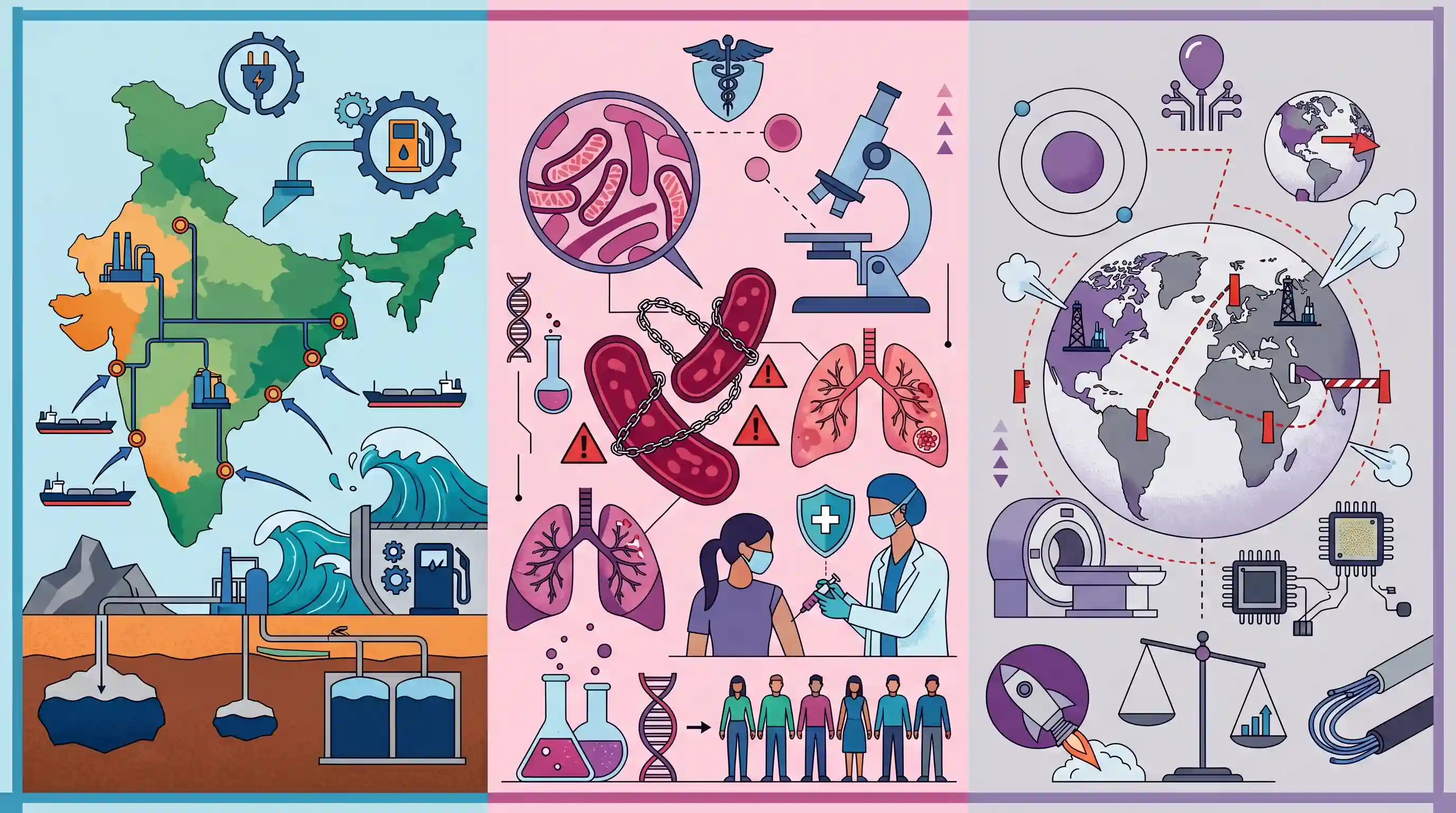
India's heavy reliance on imported crude oil makes SPRs a non-negotiable component of national security. TB remains a massive public health burden requiring sustained policy intervention. Meanwhile, helium shortages threaten critical scientific and medical infrastructure, underscoring India's vulnerability to global strategic mineral and gas monopolies.
Summary
The article highlights three vital topics for UPSC aspirants: the development of Strategic Petroleum Reserves (SPRs) in India to ensure energy security against supply disruptions; the health challenge posed by Mycobacterium tuberculosis, focusing on its characteristics, multidrug-resistant strains (MDR-TB), and the BCG vaccine; and the global helium crisis, which is driven by supply chain vulnerabilities, geopolitical bottlenecks, and its critical, irreplaceable applications in high-tech industries.
Key Points
- Strategic Petroleum Reserves (SPRs) act as a crucial buffer against crude oil supply shocks. India has established underground rock caverns in Visakhapatnam, Mangaluru, and Padur to enhance energy security.
- Mycobacterium tuberculosis is the aerobic, pathogenic bacterium responsible for Tuberculosis (TB). Its slow growth and the emergence of multidrug-resistant (MDR-TB) and extensively drug-resistant (XDR-TB) strains make it a persistent global health challenge.
- The ongoing global helium crisis is driven by its limited non-renewable extraction as a byproduct of natural gas, coupled with soaring demand for its unique properties in cryogenics, MRI machines, semiconductor manufacturing, and aerospace.
Important Terms
National Strategic Petroleum Reserves Programme

India's initiative to build massive underground crude oil stockpiles to ensure energy security during global supply disruptions, price shocks, or geopolitical conflicts.
UPSC context
GS Paper III (Energy Security). Tests knowledge of India's strategic resource management and energy self-reliance policies.
Indian Strategic Petroleum Reserves Limited (ISPRL)
A Special Purpose Vehicle (SPV) under the Ministry of Petroleum and Natural Gas responsible for maintaining and operating India’s strategic crude oil storage facilities.
UPSC context
GS Paper III (Infrastructure/Energy). Relevant for understanding the institutional framework of India's energy security architecture.
Mycobacterium tuberculosis
The slow-growing, aerobic bacterium that causes tuberculosis (TB), primarily affecting the lungs but capable of infecting other organs like the brain or kidneys.
UPSC context
GS Paper III (Science & Technology/Health). Essential for understanding infectious diseases and public health challenges in India.
Multidrug-Resistant Tuberculosis (MDR-TB)
A form of TB caused by bacteria resistant to at least isoniazid and rifampicin, the two most potent first-line anti-TB drugs.
UPSC context
GS Paper III (Health). Tests awareness of antimicrobial resistance (AMR) and its impact on national health goals.
BCG (Bacillus Calmette–Guérin) Vaccine
The world's only available vaccine for TB, developed from a weakened strain of Mycobacterium bovis; it primarily prevents severe TB in infants and children.
UPSC context
GS Paper III (S&T/Health). Important for immunization programs and historical medical milestones.
Global Helium Crisis
A supply shortage of helium gas caused by geopolitical bottlenecks, threatening critical industries like healthcare (MRI cooling) and semiconductor manufacturing.
UPSC context
GS Paper I (Resource Distribution) & GS Paper III (S&T). Relevant for supply chain resilience and strategic resource management.
World Health Organization (WHO)
The UN specialized agency for public health that sets global standards and leads international efforts like the 'End TB Strategy.'
UPSC context
GS Paper II (International Institutions). Significant for global health governance and India's alignment with international health targets.
Prelims Trap
"Helium is an abundant gas that is primarily extracted directly from the Earth's atmosphere."
Helium is non-renewable and extracted almost exclusively as a byproduct of natural gas processing. It easily escapes Earth's gravity, making atmospheric extraction impossible.
Static Concepts Connected
What distinguishes MDR-TB from XDR-TB in public health diagnostics?
- MDR-TB: Resistant to at least Isoniazid and Rifampicin, which are the two most powerful first-line anti-TB drugs.
- XDR-TB: Resistant to Isoniazid and Rifampicin, plus any fluoroquinolone and at least one second-line injectable drug.
- Pathogen Characteristics: Aerobic bacteria with thick, waxy cell walls rich in mycolic acid, making them slow-growing and impervious to Gram stains.
How and where is India's Strategic Petroleum Reserve (SPR) infrastructure distributed?
- Phase I Locations: Phase I comprises operational facilities at Visakhapatnam (AP), Mangaluru (Karnataka), and Padur (Karnataka).
- Phase II Expansion: Phase II focuses on new reserves at Chandikhol (Odisha) and expanding Padur under a Public-Private Partnership (PPP) model.
- Storage Mechanics: SPRs are built as unlined underground rock caverns, which are globally considered the safest method for storing hydrocarbons.
Cross-Topic Patterns
Helium & Critical Technologies
Helium's cryogenic properties make it irreplaceable for cooling superconducting magnets in quantum computers and semiconductor fabs, directly linking resource geography to India's deep-tech ambitions.
SPRs & IEA Mandates
India's associate membership with the International Energy Agency (IEA) requires maintaining a 90-day strategic reserve of net oil imports, tying domestic SPR expansion to global frameworks.
TB Elimination vs SDG Targets
India targets TB elimination by 2025 (supported by the Ni-kshay Poshan Yojana), an ambitious deadline set exactly five years ahead of the UN SDG target of 2030.

Expect a multi-statement science MCQ in 2026 pairing Helium's cryogenic properties with quantum computing and semiconductor applications.
Linked PYQs · 3
Linked PYQs · 3
- 2025PrelimsGS1
Consider the following activities : I. Production of crude oil II. Refining, storage and distribution of petroleum III. Marketing and sale of petroleum products IV. Production of natural gas How many of the above activities are regulated by the Petroleum and Natural Gas Regulatory Board in our country?
- 2020PrelimsGS1
What is the importance of using Pneumococcal Conjugate Vaccines in India? 1. These vaccines are effective against pneumonia as well as meningitis and sepsis. 2. Dependence on antibiotics that are not effective against drug-resistant bacteria can be reduced. 3. These vaccines have no side effects and cause no allergic reactions. Select the correct answer using the code given below:
- 2012PrelimsGS1
Recently, there has been a concern over the short supply of a group of elements called 'rare earth metals'. Why? 1. China, which is the largest producer of these elements, has imposed some restrictions on their export. 2. Other than China, Australia, Canada and Chile, these elements are not found in any country. 3. Rare earth metals are essential for the manufacture of various kinds of electronic items and there is a growing demand for these elements. Which of the statements given above is/are correct?
