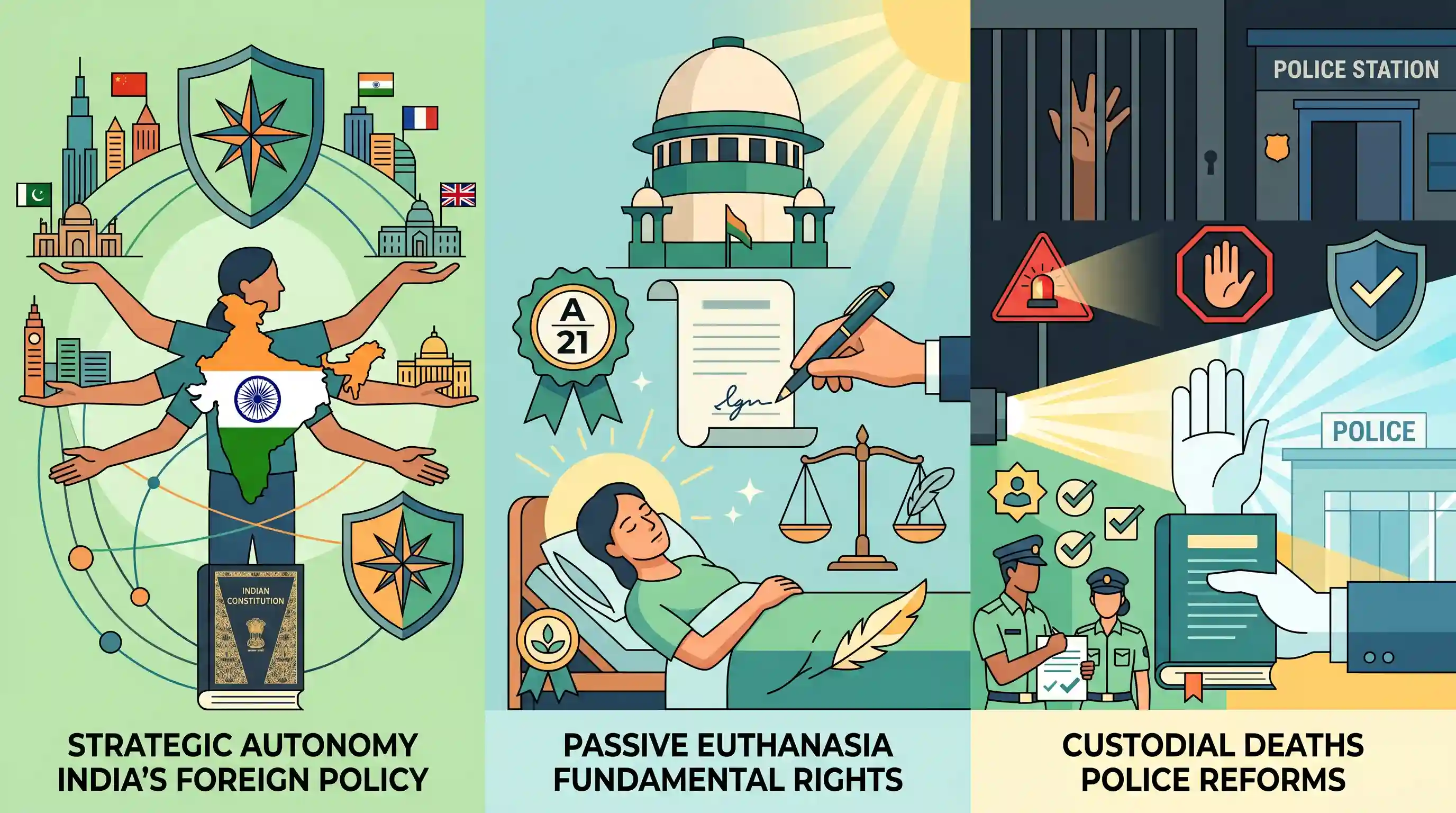
Key UPSC Concepts on Strategic Autonomy and Passive Euthanasia
Source:Indian Express ↗
Why It Matters
These themes comprehensively cover key areas of the GS2 syllabus, connecting fundamental rights (Article 21) with bioethics, analyzing the evolution of India's independent foreign policy, and addressing crucial governance challenges regarding law enforcement and human rights violations.
Summary
The article outlines three critical concepts for UPSC preparation: Strategic Autonomy, Passive Euthanasia, and Custodial Deaths. It examines strategic autonomy as the guiding principle of India's contemporary foreign policy, emphasizing the nation's capacity to act independently in global affairs. On passive euthanasia, it details the legal framework established by the Supreme Court, including the recognition of 'living wills' as an extension of the right to life with dignity under Article 21. Additionally, it highlights the pressing issue of custodial deaths, emphasizing the need for robust police reforms, strict adherence to the D.K. Basu guidelines, and systemic checks to prevent human rights violations in state custody.
Key Points
- Strategic autonomy defines India's proactive and independent foreign policy choices, shifting from rigid non-alignment to issue-based partnerships that prioritize national interests.
- Passive euthanasia, involving the withdrawal of life support, is legally permissible in India under specific safeguards established by the Supreme Court.
- The recognition of 'living wills' falls under the purview of Article 21, affirming an individual's right to live and die with dignity.
- Custodial deaths represent grave human rights abuses, prompting debates over police reforms, implementation of D.K. Basu guidelines, and the ratification of the UN Convention against Torture (UNCAT).
Important Terms
Article 21 of the Indian Constitution

Guarantees that no person shall be deprived of life or personal liberty except by legal procedure; expanded by the Supreme Court to include the right to live with dignity.
UPSC context
GS Paper II (Polity/Fundamental Rights); central to privacy, euthanasia, and custodial justice debates.
Strategic Autonomy
A principle in foreign policy where a nation makes independent sovereign decisions based on national interest, avoiding binding alliances or external pressures from major global powers.
UPSC context
GS Paper II (International Relations); fundamental to India's multi-alignment and contemporary diplomatic strategy.
UN Convention against Torture (UNCAT)
An international human rights treaty adopted in 1984 that absolutely prohibits torture; India is a signatory (1997) but remains among the few nations that haven't ratified it.
UPSC context
GS Paper II (IR/Human Rights); critical for discussions on custodial violence and police accountability.
Advance Medical Directive (Living Will)
A legal document specifying a person's medical preferences—such as refusing life support—in case they become terminally ill or incapacitated; recognized as part of the right to die with dignity.
UPSC context
GS Paper II (Governance) and GS Paper IV (Ethics); relevant to passive euthanasia and personal autonomy.
National Human Rights Commission (NHRC)
A statutory body established in 1993 to protect human rights, investigate violations, and oversee custodial conditions; it acts as the primary human rights watchdog in India.
UPSC context
GS Paper II (Statutory Bodies); essential for studying institutional safeguards against state-led rights violations.
D.K. Basu Guidelines
Binding procedural safeguards established in 1997 to be followed by police during arrest and detention to prevent custodial torture and ensure transparency in custody.
UPSC context
GS Paper II (Polity/Governance); key for topics on police reforms and protection of prisoner rights.
Supreme Court of India
The highest judicial body in India with original, appellate, and advisory jurisdiction; it serves as the ultimate interpreter of the Constitution and protector of fundamental rights.
UPSC context
GS Paper II (Polity/Judiciary); central to landmark rulings on personal liberty and executive oversight.
Prelims Trap
"India is a signatory and has formally ratified the UN Convention against Torture (UNCAT)."
India signed UNCAT in 1997 but has never ratified it. UPSC frequently tests the critical distinction between merely signing and formally ratifying international treaties.
Static Concepts Connected
What are the core mandates of the D.K. Basu Guidelines (1997) for police?
- Clear Identification: Arresting officers must wear accurate, visible name tags with their designations.
- Arrest Memo: A memo of arrest must be prepared at the time of arrest, attested by at least one witness (family member or respectable local).
- Right to Inform: The arrested person has the fundamental right to have one friend, relative, or known person informed about the arrest and detention location.
How has the Supreme Court evolved the legal stance on euthanasia in India?
- Aruna Shanbaug (2011): The SC permitted passive euthanasia (withdrawing life support for terminally ill patients) under strict guidelines. Active euthanasia remains illegal.
- Common Cause (2018): Recognized 'Living Wills' (advance medical directives), ruling that the right to die with dignity is an intrinsic part of Article 21.
- Modified Guidelines (2023): Simplified the execution of Living Wills, removing the need for a Judicial Magistrate's countersignature to make the process more accessible.
Cross-Topic Patterns
NAM vs. Multi-alignment evolution
India's foreign policy evolution traces a shift from ideological Non-Alignment (NAM) during the Cold War to pragmatic, issue-based Strategic Autonomy, prioritizing national interests in a multipolar world.
Article 21's dynamic judicial expansion
The Right to die with dignity joins privacy, clean environment, and free legal aid as prime examples of judicial activism continuously expanding Article 21 of the Constitution.
Prakash Singh directives & Police Accountability
The persistence of custodial deaths highlights the chronic failure of states to implement the Supreme Court's 2006 Prakash Singh directives regarding police autonomy, accountability, and systemic reform.

Expect a 2026 Prelims question mixing D.K. Basu guidelines with India's UNCAT ratification status and NHRC's powers.
Linked PYQs · 2
Linked PYQs · 2
- 2023MainsGS2
“The Constitution of India is a living instrument with capabilities of enormous dynamism. It is a constitution made for a progressive society.” Illustrate with special reference to the expanding horizons of the right to life and personal liberty.
- 2021MainsGS2
Though the Human Rights Commissions have contributed immensely to the protection of human rights in India, yet they have failed to assert themselves against the mighty and powerful. Analyzing their structural and practical limitations, suggest remedial measures.
