CJI Appointment Process and PM SHRI Scheme Overview
Source:Indian Express ↗
Why It Matters
The appointment process of the CJI is a fundamental concept in Indian Polity and Constitutional Law. The PM SHRI scheme is a flagship government initiative critical for understanding ongoing educational reforms and the practical implementation of the NEP 2020 in the governance and social justice syllabus.
Summary
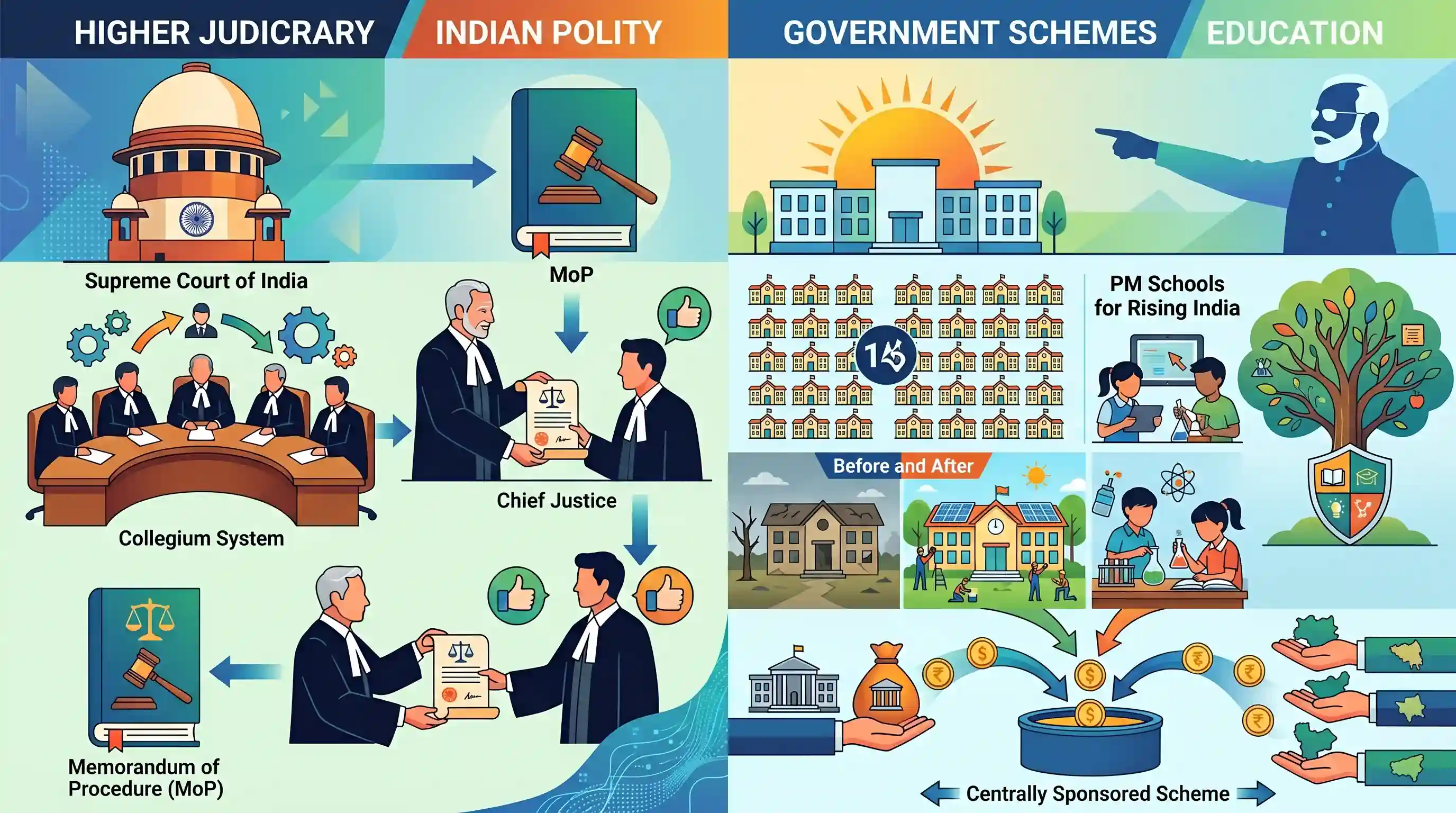
The article highlights key UPSC revision topics, focusing on the appointment process of the Chief Justice of India and the PM SHRI education scheme. It details the established convention where the outgoing CJI recommends the senior-most judge as their successor, a process guided by the Memorandum of Procedure (MoP) under the Collegium system. Furthermore, it outlines the PM Schools for Rising India (PM SHRI) initiative, a Centrally Sponsored Scheme designed to upgrade 14,500 schools. These schools will act as model institutions showcasing the National Education Policy (NEP) 2020, supported by a structured fund-sharing mechanism between the Centre and the States.
Key Points
- The outgoing Chief Justice of India traditionally recommends the senior-most Supreme Court judge as their successor, adhering to established constitutional conventions.
- The appointment process for higher judiciary judges, including the CJI, is guided by the Memorandum of Procedure (MoP) and the Collegium system.
- The PM Schools for Rising India (PM SHRI) is a Centrally Sponsored Scheme intended to upgrade 14,500 existing schools to exemplify the National Education Policy (NEP) 2020.
- PM SHRI operates on a fund-sharing basis: 60:40 between the Centre and most States/UTs, and 90:10 for Special Category States.
Important Terms
PM SHRI scheme

A Centrally Sponsored Scheme launched in 2022 to upgrade 14,500 schools into model institutions that showcase the National Education Policy 2020 with modern infrastructure and holistic pedagogy.
UPSC context
GS-II (Government Schemes); tests knowledge of education reforms and federal funding mechanisms for social sector initiatives.
National Education Policy (NEP) 2020
A 2020 framework designed to transform India’s education system, replacing the 1986 policy. It introduces a 5+3+3+4 school structure and emphasizes universal access and multidisciplinary learning.
UPSC context
GS-II (Social Justice/Education); tests policy implementation and reforms aimed at achieving Sustainable Development Goal 4.
Memorandum of Procedure (MoP)
A formal set of guidelines and an agreement between the Government and the Judiciary that outlines the process for the appointment and transfer of higher judiciary judges.
UPSC context
GS-II (Judiciary); tests understanding of the executive-judiciary balance and procedural aspects of judicial appointments.
Collegium System
A system for appointing and transferring judges of the Supreme Court and High Courts, evolved through the 'Three Judges Cases' rather than specific constitutional text.
UPSC context
GS-II (Indian Polity); critical for questions on judicial independence, the Three Judges Cases, and separation of powers.
Supreme Court of India
The apex judicial body established under Article 124, serving as the final court of appeal, protector of fundamental rights, and the ultimate interpreter of the Constitution.
UPSC context
GS-II (Judiciary); tests knowledge of constitutional provisions, judicial review, and the court's diverse jurisdictions.
Ministry of Education
The nodal Union ministry responsible for formulating national policies on education and overseeing primary, secondary, and higher education institutions throughout India.
UPSC context
GS-II (Governance); relevant for administrative structures in human resource development and social sector service delivery.
Prelims Trap
The procedure and seniority principle for appointing the Chief Justice of India are explicitly detailed in the Constitution.
Article 124 only empowers the President to appoint judges. The seniority rule is a convention formalized entirely in the executive Memorandum of Procedure (MoP), not the Constitution.
Static Concepts Connected
What is the Memorandum of Procedure (MoP) for higher judiciary appointments?
- Evolution: Framed by the Executive in consultation with the CJI following the 1998 Third Judges Case to guide appointments and transfers.
- Legal Status: It is an executive rulebook, meaning it is neither enshrined in the Constitution nor established by an Act of Parliament.
- CJI Process: The Union Law Minister formally initiates the process by seeking the recommendation of the outgoing CJI at an appropriate time.
How do Centrally Sponsored Schemes differ from Central Sector Schemes?
- Funding Split: Centrally Sponsored Schemes (CSS) like PM SHRI require state matching funds (e.g., 60:40 or 90:10), whereas Central Sector Schemes are 100% Union-funded.
- Implementation: CSS are implemented by State government machinery, while Central Sector Schemes are executed directly by Central government ministries.
- Legislative Domain: CSS typically target State or Concurrent List subjects (e.g., Education, Health) to supplement and guide state-level efforts.
Cross-Topic Patterns
CSS funding and Fiscal Federalism
Schemes like PM SHRI rely on a 60:40 state matching component, frequently leading to Centre-State friction as states argue this mandates expenditure on centrally designed priorities, squeezing state fiscal autonomy.
Constitutional silences and Conventions
Just as Article 124 omits the CJI seniority rule, UPSC frequently tests other constitutional silences filled by conventions, such as the appointment of a Chief Minister when no party holds a majority.

Expect a Prelims question pairing constitutional text (Art 124) with executive frameworks (MoP) to test the limits of the Constitution.
Linked PYQs · 3
Linked PYQs · 3
- 2025MainsGS2
Discuss the evolution of collegium system in India. Critically examine the advantages and disadvantages of the system of appointment of the Judges of the Supreme Court of India and that of the USA.
- 2017MainsGS2
Critically examine the Supreme Court's judgement on 'National Judicial Appointments Commission Act, 2014' with reference to appointment of judges of higher judiciary in India.
- 2020MainsGS2
National Education Policy 2020 is in conformity with the Sustainable Development Goal-4 (2030). It intends to restructure and reorient education system in India. Critically examine the statement.
