Somnath Temple History and Global Rice Production Patterns
Source:Indian Express ↗
Why It Matters
It requires aspirants to synthesize knowledge across multiple disciplines: understanding the historical context of India's cultural heritage, analyzing geographical and economic factors of staple crop production, and evaluating the geopolitical implications of shifts in US foreign policy.
Summary
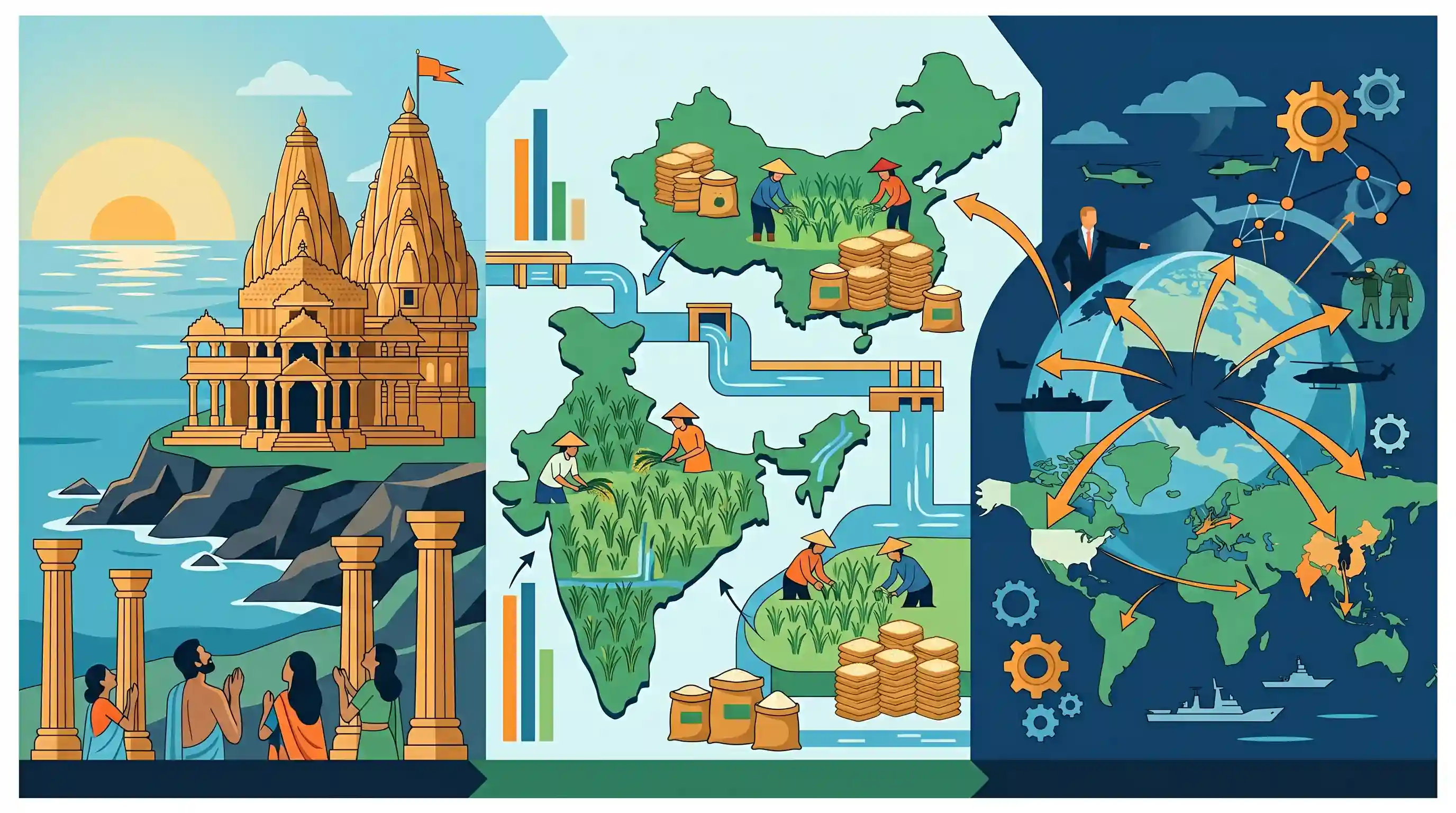
This compilation highlights three distinct areas critical for UPSC aspirants: the historical and architectural legacy of the Somnath Temple (commemorated via Somnath Swabhiman Parv), the economic geography surrounding the world's largest rice producers (India and China), and international relations focusing on America's return to an interventionist foreign policy. The topics bridge ancient Indian history, global agriculture, and contemporary geopolitics.
Key Points
- The Somnath Temple holds immense historical and cultural significance, famously attacked by Mahmud of Ghazni and rebuilt post-independence through the efforts of Sardar Vallabhbhai Patel.
- Global rice production is heavily concentrated in Asia, with India and China playing dominant roles in agricultural exports and food security.
- Shifts in US foreign policy indicate a return to interventionism, raising important questions about the evolving global world order and hegemony.
Important Terms
Somnath Swabhiman Parv

A national commemoration (2026) marking 1,000 years since the 1026 CE attack on Somnath Temple, celebrating India\'s civilisational resilience and 75 years of the temple\'s post-Independence reconstruction.
UPSC context
GS Paper I (History & Culture); tests knowledge of medieval invasions, cultural heritage, and modern national symbols.
Māru-Gurjara Architecture
An 11th-13th century West Indian temple architecture style (Solanki style) known for intricate carvings, multiple recesses, and features like the Garbhagriha, Sabha Mandapa, and Step-tanks (Surya-kund).
UPSC context
GS Paper I (Art and Culture); critical for distinguishing regional sub-styles within the broader Nagara school of architecture.
India as Largest Rice Producer
India surpassed China in the 2024-25 season, producing approximately 150 million tonnes, driven by expanded acreage in Telangana and state-level incentives, marking a historic shift in global food security.
UPSC context
GS Paper III (Agriculture & Economy); tests trends in crop production, food security, and agricultural geography.
Monroe Doctrine
An 1823 US policy asserting that any intervention by external powers in the politics of the Americas is a potentially hostile act against the United States.
UPSC context
GS Paper II (International Relations); foundational for understanding historical and modern American foreign policy in the Western Hemisphere.
Trump Corollary (Don-roe Doctrine)
A 2026 reinterpretation of the Monroe Doctrine used to justify direct US military intervention and regime change in Latin America, specifically in Venezuela (Operation Absolute Resolve).
UPSC context
GS Paper II (International Relations); examines evolving geopolitical doctrines, sovereignty, and their impact on global order and India’s strategic autonomy.
Triveni Sangam (Somnath)
The sacred confluence of the Kapila, Hiran, and Saraswati rivers at Prabhas Patan, Gujarat, where the Somnath Temple is situated on the Arabian Sea coast.
UPSC context
GS Paper I (Geography/Culture); relates physical geography to spiritual sites and pilgrimage circuits in India.
Prelims Trap
"India is the world's largest producer and exporter of rice."
Aspirants conflate export dominance with production volume. China produces more rice globally, but India is the undisputed leader in the global export market.
Static Concepts Connected
What are the key features of Māru-Gurjara (Solanki) temple architecture?
- Stepped Tanks: Presence of a deeply stepped water tank (Surya Kund) in front of the temple, often adorned with multiple miniature shrines on its steps.
- Intricate Carvings: Extensive and elaborate ornamentation on walls, ceilings, and pillars, characteristic of a style that avoids leaving any stone surface uncarved.
- Solar Alignment: Many shrines are designed so that the sun's rays directly illuminate the sanctum sanctorum during the equinoxes.
How does the System of Rice Intensification (SRI) differ from traditional cultivation?
- Alternate Wetting: Replaces continuous flooding with alternate wetting and drying, drastically reducing water consumption and methane (CH4) emissions from anaerobic decomposition.
- Seed Reduction: Uses younger, single seedlings planted with wider spacing rather than clumps, reducing the total seed requirement and promoting robust root growth.
- N2O Trade-off: While lowering methane, aerobic soil conditions in SRI can inadvertently increase nitrous oxide (N2O) emissions if nitrogen fertilizers are not meticulously managed.
Cross-Topic Patterns
Post-Independence cultural revival
Somnath connects medieval history (Al-Biruni/Ghazni) with post-1947 state-building, frequently used to highlight differing visions of Indian secularism between Jawaharlal Nehru, Sardar Patel, and Rajendra Prasad.
Agriculture + Climate Commitments
India's agricultural export dominance (rice) directly intersects with its environmental ecology. UPSC frequently links cropping methodologies like SRI with climate negotiations (e.g., Global Methane Pledge).

Expect a multi-statement 2026 Prelims question testing India's rice export dominance alongside SRI's exact impact on CH4 vs N2O emissions.
Linked PYQs · 5
Linked PYQs · 5
- 2022PrelimsGS1
The Prime Minister recently inaugurated the new Circuit House near Somnath Temple at Veraval. Which of the following statements are correct regarding Somnath Temple ? 1. Somnath Temple is one of the Jyotirlinga shrines. 2. A description of Somnath Temple was given by Al-Biruni. 3. Pran Pratishtha of Somnath Temple (installation of the present day temple) was done by President S. Radhakrishnan. Select the correct answer using the code given below:
- 2019PrelimsGS1
With reference to the cultivation of Kharif crops in India in the last five years, consider the following statements: 1. Area under rice cultivation is the highest. 2. Area under the cultivation of jowar is more than that of oilseeds. 3. Area of cotton cultivation is more than that of sugarcane. 4. Area under sugarcane cultivation has steadily decreased. Which of the statements given above are correct?
- 2022PrelimsGS1
Among the following crops, which one is the most important anthropogenic source of both methane and nitrous oxide?
- 2025MainsGS2
"With the waning of globalization, post-Cold War world is becoming a site of sovereign nationalism.” Elucidate.
- 2021MainsGS2
“The USA is facing an existential threat in the form of a China, that is much more challenging than the erstwhile Soviet Union.” Explain.
