UPSC Key: Secondary Sanctions, Agriculture Schemes and Water Disputes
Source:Indian Express ↗
Why It Matters
Understanding these topics is essential across multiple UPSC papers. Secondary sanctions are highly relevant for GS2 International Relations (India's foreign policy and strategic autonomy). The PM Dhan Dhaanya Krishi Yojana covers critical GS3 themes on agricultural subsidies and farmers' welfare. Lastly, inter-state water disputes are a recurring theme in GS2 Polity, testing the nuances of federalism and the jurisdiction of tribunals versus standard courts.
Summary
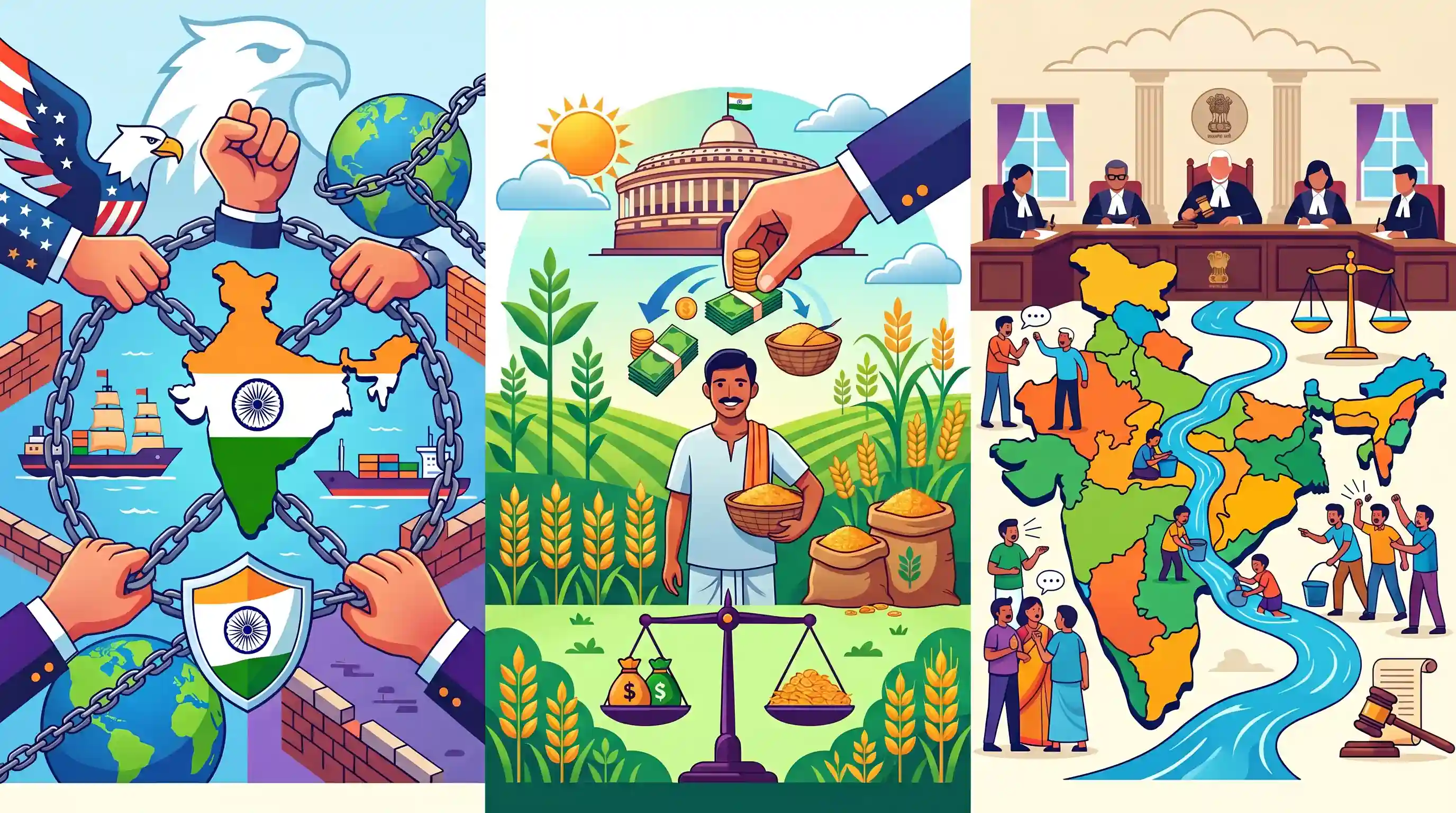
The article breaks down three key concepts for UPSC preparation: the geopolitical impact of Secondary Sanctions, the objectives of the PM Dhan Dhaanya Krishi Yojana, and the constitutional framework for resolving Inter-State water disputes. It explains how secondary sanctions impose extraterritorial trade restrictions that challenge India's strategic autonomy. It also covers the agricultural welfare goals of the PM Dhan Dhaanya Krishi Yojana and details the legal mechanisms under Article 262 and the Inter-State Water Disputes Act of 1956 used to address river-sharing conflicts among Indian states via specialized tribunals.
Key Points
- Secondary sanctions refer to economic measures used by a country (like the US) to penalize third-party nations or entities that engage in trade with a primarily sanctioned state (e.g., Russia or Iran), thereby attempting to control global trade networks through extraterritoriality.
- India often navigates secondary sanctions (like CAATSA) to maintain its strategic autonomy, balancing its historical defense and energy partnerships with Western trade dependencies.
- The PM Dhan Dhaanya Krishi Yojana aims to bolster the agricultural sector by providing targeted support to enhance crop production, stabilize farmers' incomes, and ensure robust national food security frameworks.
- Inter-state water disputes in India are constitutionally managed under Article 262, which empowers Parliament to legislate the adjudication of river-sharing conflicts, leading to the Inter-State River Water Disputes Act of 1956 and the formation of exclusive tribunals.
Important Terms
PM Dhan Dhaanya Krishi Yojana

A district-focused scheme launched in 2025 targeting 100 underperforming agricultural districts. It converges 36 central schemes to enhance productivity, crop diversification, and infrastructure through decentralized planning and improved credit access.
UPSC context
GS Paper III: Agricultural schemes. Tests understanding of convergence models and interventions for underperforming regions to achieve food self-reliance.
Secondary Sanction
Extraterritorial trade restrictions imposed by one country on third-party nations for engaging in transactions with primary sanctioned entities. They aim to isolate targets by cutting off their global financial and trade access.
UPSC context
GS Paper II: International Relations. Tests knowledge of geopolitical challenges to India’s strategic autonomy and the impact of global trade restrictions.
CAATSA
A 2017 US federal law (Countering America’s Adversaries Through Sanctions Act) that penalizes third countries engaging in significant defense or intelligence transactions with Russia, Iran, or North Korea to deter global engagement with them.
UPSC context
GS Paper II: India-US Relations. Important for understanding defense procurement challenges, such as the S-400 deal, and the necessity of presidential waivers.
Article 262 of the Indian Constitution
A constitutional provision empowering Parliament to adjudicate disputes relating to inter-state rivers or river valleys. It uniquely allows Parliament to exclude the jurisdiction of the Supreme Court and other courts in such matters.
UPSC context
GS Paper II: Indian Polity. Tests knowledge of the constitutional framework for federalism and mechanisms to resolve conflicts over shared natural resources.
Inter-State River Water Disputes Act 1956
Enacted under Article 262, this law enables the Union government to establish ad-hoc tribunals for adjudicating river water conflicts between states when bilateral negotiations fail. It is the primary statutory mechanism for water-sharing resolution.
UPSC context
GS Paper II: Statutory bodies and federalism. Evaluates understanding of the legal processes and legislative amendments governing water-sharing disputes among states.
Inter-State River Water Disputes Tribunals
Specialized adjudicatory bodies constituted by the Union to resolve specific inter-state river sharing conflicts. Their final awards, once notified, carry the force of a Supreme Court decree and are binding on involved states.
UPSC context
GS Paper II: Federalism and Dispute Redressal. Tests awareness of specialized adjudicatory mechanisms and their role in managing sensitive inter-state water issues.
Prelims Trap
The Supreme Court holds original jurisdiction over inter-state river water disputes under Article 131.
Article 262 allows Parliament to bar court jurisdiction. The 1956 Act expressly removes these disputes from the Supreme Court's original jurisdiction (Article 131).
Static Concepts Connected
How does the Constitution handle inter-state river water disputes?
- Article 262: Empowers Parliament to provide for the adjudication of any dispute regarding the use, distribution, or control of inter-state rivers.
- Jurisdiction Bar: Parliament may by law provide that neither the Supreme Court nor any other court shall exercise jurisdiction over such disputes.
- 1956 Disputes Act: Enacted by Parliament, this allows the Centre to constitute ad-hoc, exclusive tribunals to adjudicate specific river water conflicts.
What is the difference between primary and secondary sanctions?
- Primary Sanctions: Prohibit citizens and companies of the sanctioning nation from engaging in trade with the targeted country.
- Secondary Sanctions: Penalize third-party countries or entities for trading with the target, cutting off their access to the sanctioning country's financial markets.
- Extraterritoriality: Secondary sanctions rely on extraterritorial application of domestic law, often challenging the strategic autonomy of non-aligned nations like India.
Cross-Topic Patterns
Convergence as a Governance Model
PMDDKY's focus on converging 36 existing schemes in low-performing districts perfectly mirrors the Aspirational Districts Programme's administrative philosophy, representing a shift from scheme-creation to scheme-integration.
Sanctions & Rupee Internationalisation
Navigating secondary sanctions directly links to India's push for Vostro accounts, Rupee trade settlement, and alternative financial messaging systems to bypass Western SWIFT control.

Expect a 2026 Prelims question contrasting SC's original jurisdiction under Art 131 with the tribunal mechanism under Art 262.
Linked PYQs · 4
Linked PYQs · 4
- 2018MainsGS2
How far do you agree with the view that tribunals curtail the jurisdiction of ordinary courts? In view of the above, discuss the constitutional validity and competency of the tribunals in India.
- 2018MainsGS3
What do you mean by Minimum Support Price (MSP)? How will MSP rescue the farmers from the low income trap?
- 2022PrelimsGS1
Consider the following pairs: Reservoirs States 1. Ghataprabha - Telangana 2. Gandhi Sagar - Madhya Pradesh 3. Indira Sagar - Andhra Pradesh 4. Maithon - Chhattisgarh How many pairs given above are not correctly matched?
- 2020PrelimsGS1
Consider the following pairs: River Flows into 1. Mekong : Andaman Sea 2. Thames : Irish Sea 3. Volga : Caspian Sea 4. Zambezi : Indian Ocean Which of the pairs given above is/are correctly matched?
