Etalin Hydroelectric Project and Biodiversity Conservation Debate
Source:Indian Express ↗
Why It Matters
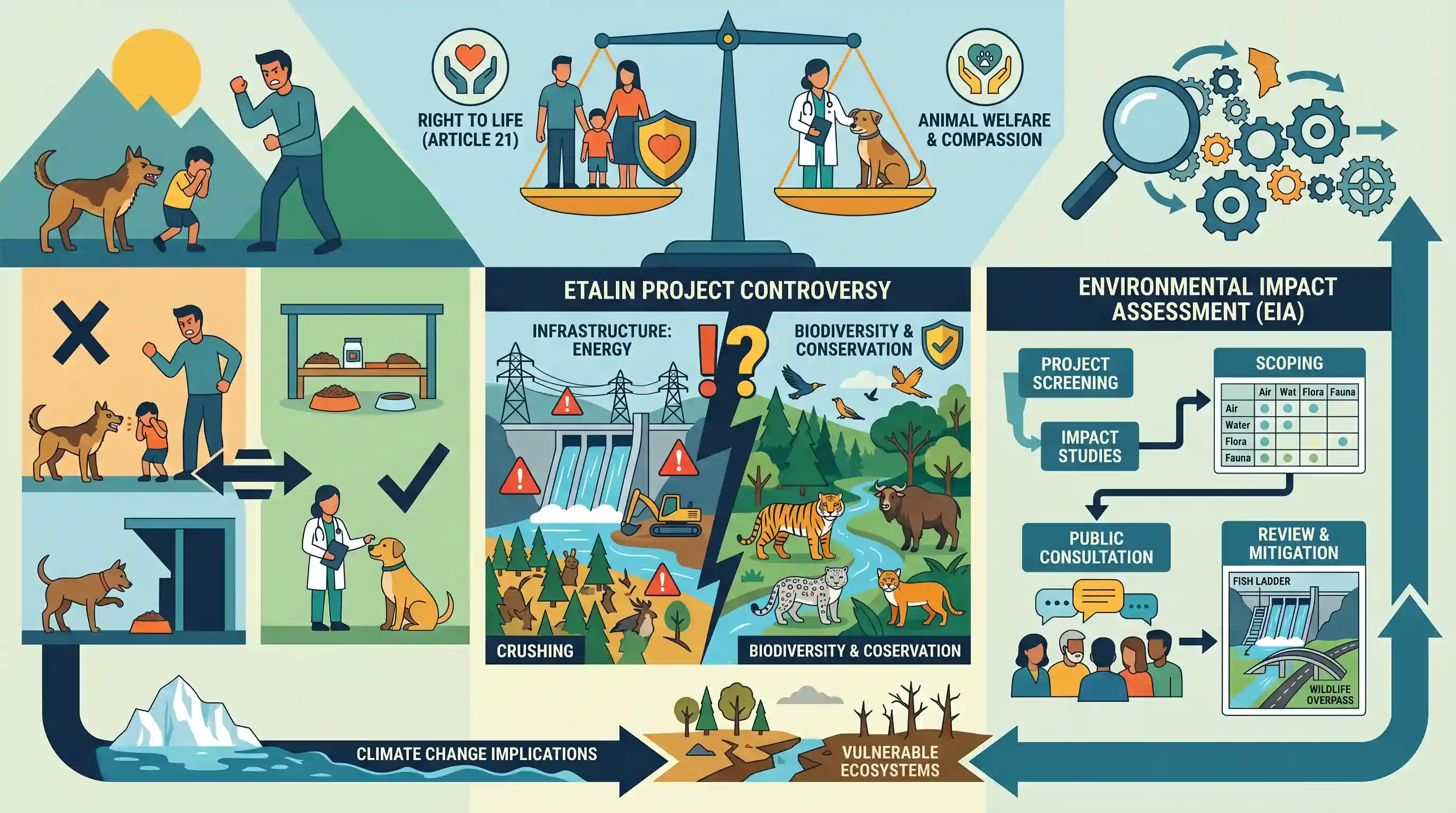
The conflict between the Etalin project and biodiversity conservation serves as a critical case study for the 'development vs. environment' debate in GS3. The stray dog issue highlights the governance challenge of balancing animal welfare with the constitutional Right to Life (Article 21) under GS2.
Summary
The article highlights three key issues: the Supreme Court's observations on managing the stray dog menace while balancing animal welfare and human safety; the controversy surrounding the Etalin hydroelectric project in Arunachal Pradesh's Dibang Valley, which threatens local biodiversity and forests; and the broader implications of climate change on vulnerable ecosystems, emphasizing the need for robust Environmental Impact Assessments (EIA).
Key Points
- The Supreme Court has addressed the stray dog menace, attempting to balance animal rights under the Prevention of Cruelty to Animals Act with citizens' Fundamental Right to Life (Article 21).
- The Etalin Hydroelectric Project, a massive 3,097 MW plant proposed on the Dri and Tangon rivers in Arunachal Pradesh, faces significant opposition due to its environmental footprint.
- Executing the Etalin project in the biodiversity-rich Dibang Valley would necessitate the felling of over 2.7 lakh trees, prompting scrutiny from the Forest Advisory Committee (FAC) and local tribal groups like the Idu Mishmi.
- Climate change and extreme weather events exacerbate the vulnerabilities of the Himalayan ecosystem, necessitating rigorous Environmental Impact Assessments (EIA) before clearing mega infrastructure projects.
Important Terms
Prevention of Cruelty to Animals Act, 1960

Enacted to prevent unnecessary pain and suffering to animals, this foundational law establishes the framework for animal welfare in India and mandates the creation of the Animal Welfare Board.
UPSC context
GS Paper II/III: Essential for topics on animal rights, social justice, and environmental legislation; often tested in Prelims.
Animal Birth Control Rules
Statutory rules under the PCA Act regulating humane stray dog management via sterilization and vaccination (ABC) instead of culling, with the 2023 update introducing the term 'community animals.'
UPSC context
GS Paper II/III/IV: Relevant for urban governance, human-wildlife conflict, and ethical dilemmas regarding animal welfare vs. public safety.
Animal Welfare Board of India (AWBI)
A statutory advisory body under the Ministry of Fisheries, Animal Husbandry and Dairying that advises the government on animal welfare laws and grants recognition to welfare organizations.
UPSC context
GS Paper II: Important statutory body under Governance; tests knowledge of institutional frameworks for protecting animal rights.
Environmental Impact Assessment (EIA) Notification
A regulatory process under the Environment (Protection) Act, 1986, used to identify and evaluate the environmental, social, and economic impacts of developmental projects before granting clearance.
UPSC context
GS Paper III: A high-yield topic for Environment and Disaster Management; tests regulatory compliance and sustainable development.
Forest Advisory Committee (FAC)
A statutory body under the Forest (Conservation) Act, 1980, that examines and recommends the diversion of forest land for non-forestry purposes like dams or mining to the Central Government.
UPSC context
GS Paper III: Vital for environmental conservation and infrastructure topics; focuses on the procedural balance between development and forest protection.
Fundamental Rights (Article 21)
A Fundamental Right guaranteeing the right to life and personal liberty, which the Supreme Court has progressively interpreted to include the right to a clean environment and animal dignity.
UPSC context
GS Paper II: Core Polity topic; tests understanding of judicial activism and the expansion of constitutional protections to non-human entities.
Prelims Trap
The Animal Welfare Board of India (AWBI) is a statutory body under the Wildlife (Protection) Act, 1972.
Aspirants often confuse environmental laws. AWBI is established under the Prevention of Cruelty to Animals Act, 1960, not the WPA. This is a classic UPSC swap.
Static Concepts Connected
What is the geographical and cultural significance of the Dibang Valley?
- River System: Drained by the Dri and Tangon rivers, which are key upstream tributaries of the Dibang River (part of the Brahmaputra basin).
- Idu Mishmi Tribe: Home to the indigenous Idu Mishmi tribe, renowned for their traditional 'iyu-ena' belief system that strictly prohibits the killing of tigers, acting as a cultural conservation model.
What is the mandate and statutory backing of the Forest Advisory Committee (FAC)?
- Statutory Origin: It is a statutory body constituted under the Forest (Conservation) Act, 1980, distinct from bodies formed under the Environment Protection Act.
- Core Mandate: It is responsible for advising the Central Government on whether to approve the diversion of forest land for non-forest uses, such as dams or mining.
- Appraisal Role: It conducts rigorous cost-benefit analyses, weighing the ecological destruction (like felling lakhs of trees) against the strategic or economic necessity of mega-infrastructure projects.
Cross-Topic Patterns
Mega-dams & Tribal Conservation Models
The Etalin project threatens not just ecology, but the Idu Mishmi's tiger-protecting 'iyu-ena' belief system, seamlessly linking GS3 infrastructure and EIA to GS1 tribal culture and geography.
Article 21 vs Statutory Animal Rights
The Supreme Court's attempt to balance human safety from stray dogs against statutory animal protections adds a unique public safety dimension to the continuously expanding Article 21 jurisprudence.

Expect a 2026 prelims question merging Brahmaputra tributaries (Dibang, Dri), Idu Mishmi conservation beliefs, and the Etalin project.
Linked PYQs · 5
Linked PYQs · 5
- 2014MainsGS3
Environmental Impact Assessment studies are increasingly undertaken before a project is cleared by the Government. Discuss the environmental impacts of coal-fired thermal plants located at coal pitheads.
- 2024MainsGS3
What role do environmental NGOs and activists play in influencing Environmental Impact Assessment (EIA) outcomes for major projects in India? Cite four examples with all important details.
- 2008PrelimsGS1
Where are Tapovan and Vishnugarh Hydroelectric Projects located?
- 2009PrelimsGS1
Where is the headquarters of Animal Welfare Board of India located?
- 2022MainsGS3
Discuss global warming and mention its effects on the global climate. Explain the control measures to bring down the level of greenhouse gases which cause global warming, in the light of the Kyoto Protocol, 1997.
