Supreme Court Defines Constitutional Powers of Governors
Source:Indian Express ↗
Why It Matters
The role of the Governor has been a recurrent area of friction between states and the Centre, making the Supreme Court's interpretation highly probable for Mains GS2. Birsa Munda's Ulgulan is a recurring theme in Prelims, while climate summits and fossil fuel transitions are perennial high-yield topics in GS3.
Summary
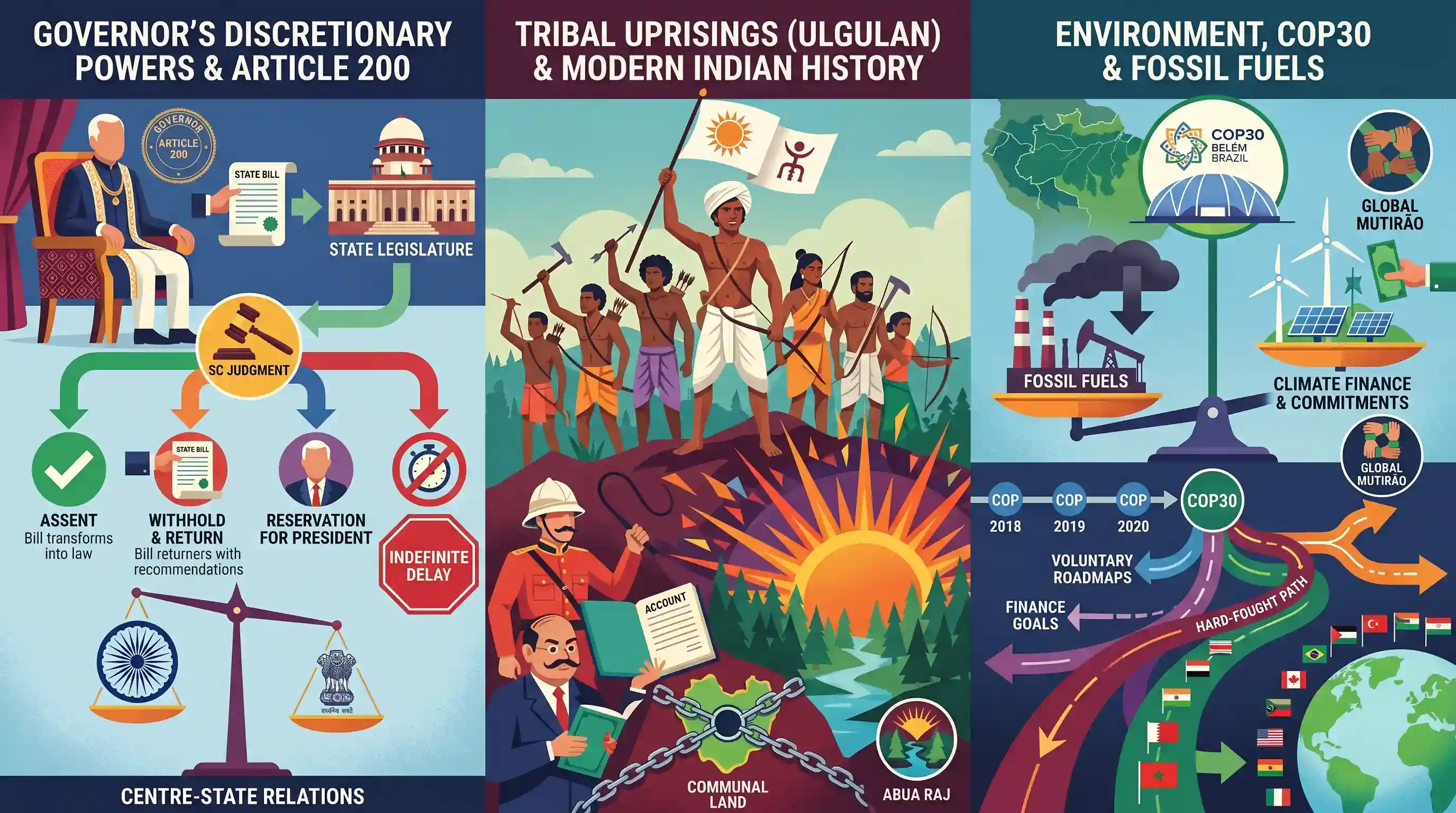
The article details crucial topics for UPSC aspirants, spanning three main subjects: Polity, History, and Environment. It covers the recent Supreme Court judgment defining the limits of a Governor's power to withhold assent to state bills under Article 200, the historical context of Birsa Munda's tribal uprising (Ulgulan) against British exploitation, and the evolving international climate commitments regarding the phase-out of fossil fuels leading up to COP30.
Key Points
- The Supreme Court has clarified the constitutional role of Governors, emphasizing that they cannot indefinitely withhold assent to Bills passed by the State Legislature and must act in accordance with Article 200.
- The legacy of Birsa Munda and the historical significance of the 'Ulgulan' (Great Tumult) remain highly relevant, particularly in the context of tribal land rights and anti-colonial uprisings.
- Global climate negotiations ahead of COP30 focus heavily on establishing definitive commitments and timelines for a just phase-out of fossil fuels within the UNFCCC framework.
Important Terms
Article 200 of the Constitution of India

Article 200 empowers the Governor to grant/withhold assent to state bills or reserve them for the President. They can also return non-money bills for legislative reconsideration once.
UPSC context
GS Paper 2: Federalism & Executive. Tests understanding of legislative processes and the scope of gubernatorial powers versus state sovereignty.
Ulgulan
Meaning "Great Tumult," it was a 1899-1900 tribal uprising led by Birsa Munda against British exploitation, land alienation (Dikus), and the erosion of the traditional Khuntkatti system.
UPSC context
GS Paper 1: Modern History/Tribal Revolts. Essential for understanding tribal resistance and the socio-economic impact of colonial land policies.
UNFCCC COP30
The 30th UN Climate Change Conference (2025) in Belém, Brazil, focusing on the "Belém Political Package," adaptation finance, and the transition away from fossil fuels.
UPSC context
GS Paper 3: Environment/International Relations. Evaluates global climate governance, India's commitments, and challenges in phasing out fossil fuels.
Governor’s Discretionary Powers
Powers exercised by the Governor independently of the Council of Ministers. The Supreme Court has clarified these are limited and cannot be used to cause legislative paralysis.
UPSC context
GS Paper 2: Polity. Tests constitutional limits on unelected heads and the doctrine of "aid and advice" in a parliamentary democracy.
Fossil Fuel Phase-out
A global climate goal to transition energy systems away from coal, oil, and gas to achieve net-zero emissions, often a contentious point in UNFCCC negotiations.
UPSC context
GS Paper 3: Environment/Energy Security. Crucial for discussing India's "Common But Differentiated Responsibilities" and the challenge of balancing development with decarbonization.
Khuntkatti System
An ancestral tribal system of joint land ownership practiced by the Mundas, which was disrupted by British zamindari systems, leading to the Ulgulan rebellion.
UPSC context
GS Paper 1: History/Social Issues. Highlights indigenous land rights and the root causes of historical tribal discontent.
Chotanagpur Tenancy Act, 1908
Enacted after the Ulgulan rebellion, this law prohibited the transfer of tribal land to non-tribals (Dikus) and recognized traditional community land rights in Chotanagpur.
UPSC context
GS Paper 1: History. Demonstrates the legal impact of tribal movements on colonial administration and land reforms.
Prelims Trap
"A Governor can indefinitely withhold assent to an ordinary State Bill."
The Supreme Court recently clarified that if a Governor withholds assent under Article 200, they cannot simply pocket it; they are constitutionally bound to return it "as soon as possible."
Static Concepts Connected
What are the Governor's options under Article 200 when presented with a State Bill?
- Grant Assent: The Governor can grant assent, making the Bill an Act.
- Withhold Assent: If assent is withheld, the SC clarifies the Governor must return the Bill (if not a Money Bill) to the legislature for reconsideration.
- Reserve Bill: The Governor can reserve the Bill for the consideration of the President (mandatory if it derogates High Court powers).
What was the Khuntkatti system central to Birsa Munda's Ulgulan?
- Communal Ownership: It was a traditional Munda socio-economic system of joint land ownership and communal cultivation by tribal lineages.
- Colonial Erosion: British agrarian policies and non-tribal landlords (dikus) dismantled this system, replacing it with exploitative tenant farming, triggering the rebellion.
- Legal Restoration: The uprising forced the British to pass the Chotanagpur Tenancy Act (1908), which legally protected customary Khuntkatti rights.
Cross-Topic Patterns
Governor's discretion & Federal relations
The SC's ruling on Article 200 curbs the perceived "pocket veto" of Governors, directly tying into broader debates on Centre-State relations, federalism, and the judicial review of constitutional silences.
Just Transition vs. CBDR-RC
The shift from "phase-down" to "phase-out" of fossil fuels at COP30 will heavily test the UNFCCC's Common But Differentiated Responsibilities (CBDR-RC) principle, as developing nations demand strict Just Transition finance mechanisms.

Expect a 2026 prelims question on Article 200 testing the SC ruling that withholding assent mandates returning the bill to the legislature.
Linked PYQs · 4
Linked PYQs · 4
- 2022MainsGS2
Discuss the essential conditions for exercise of the legislative powers by the Governor. Discuss the legality of re-promulgation of ordinances by the Governor without placing them before the Legislature.
- 2020PrelimsGS1
With reference to the history of India, "Ulgulan" or the Great Tumult is the description of which of the following events?
- 2021MainsGS3
Describe the major outcomes of the 26th session of the Conference of the Parties (COP) to the United Nations Framework Convention on Climate Change (UNFCCC). What are the commitments made by India in this conference?
- 2022MainsGS3
Do you think India will meet 50 percent of its energy needs from renewable energy by 2030 ? Justify your answer. How will the shift of subsidies from fossil fuels to renewables help achieve the above objective ? Explain.
