Bonnard Standard Defamation Jurisprudence and Fentanyl Threat
Source:Indian Express ↗
Why It Matters
The Saudi-Pakistan military alignment directly impacts India's strategic environment and its Middle East diplomacy (GS2). The proliferation of synthetic opioids like Fentanyl highlights vulnerabilities in border management and the growing threat of narco-terrorism (GS3). The Bonnard standard is highly relevant for understanding the judicial balance between the right to reputation and freedom of expression in India (GS2 Polity).
Summary
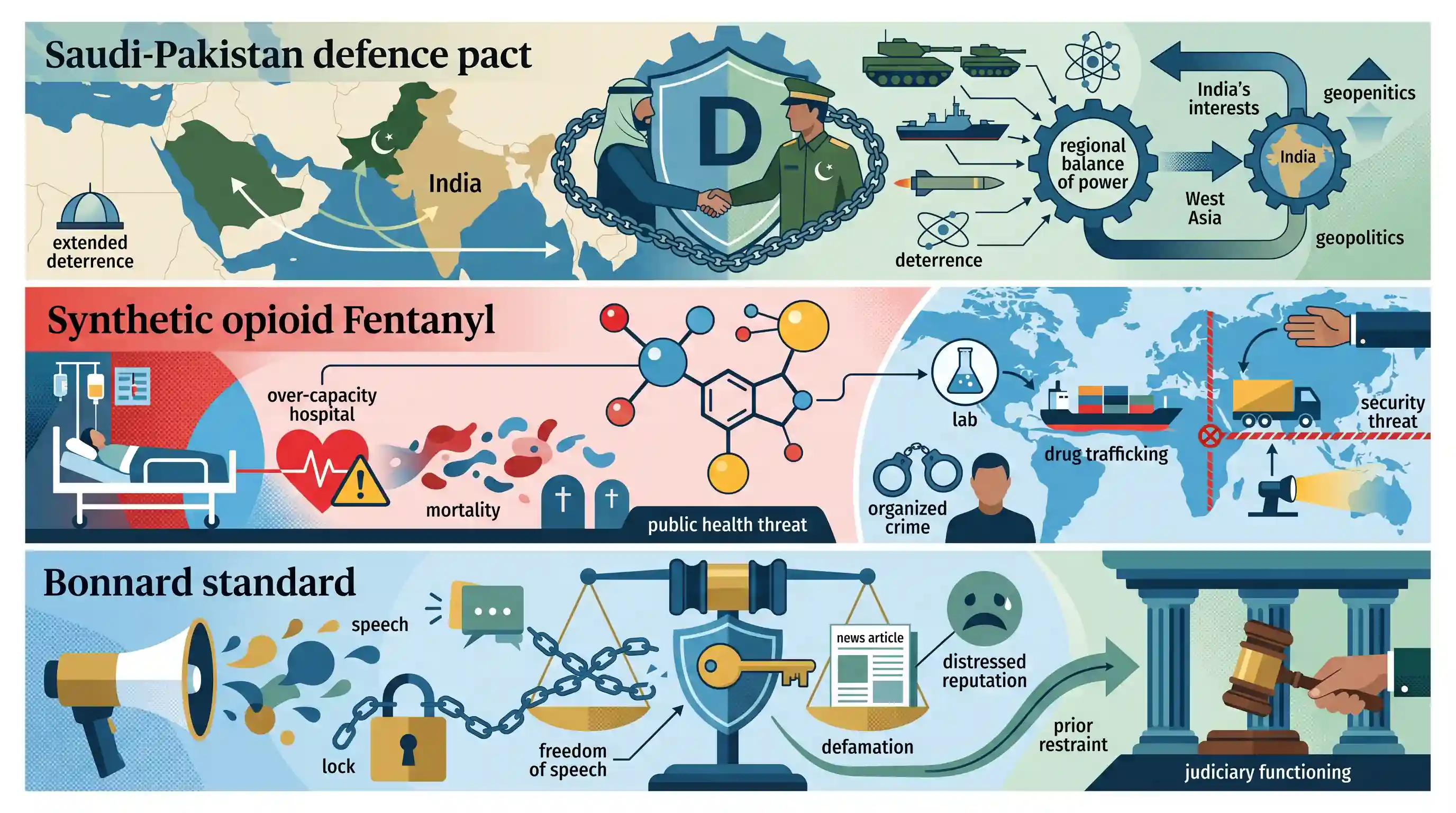
This article covers three distinct current affairs topics: the strategic implications of the Saudi-Pakistan defence pact on Middle Eastern and South Asian geopolitics, the public health and security threats posed by the synthetic opioid Fentanyl, and the 'Bonnard standard'—a key legal principle protecting freedom of speech against prior restraint in defamation cases.
Key Points
- The recent defence pact between Saudi Arabia and Pakistan signifies a deepening military and strategic partnership, which has implications for India's foreign policy and security calculus in the Middle East and South Asia.
- Fentanyl, a highly potent synthetic opioid, is driving a severe global public health crisis and poses significant challenges related to illicit drug trafficking, border security, and narco-terrorism.
- The Bonnard standard, originating from the landmark Bonnard v Perryman case, establishes a high legal threshold for granting pre-publication injunctions in defamation cases, serving as a crucial safeguard for freedom of speech and the press against prior restraint.
Important Terms
Saudi-Pakistan Strategic Mutual Defence Agreement (SMDA)

A 2025 formal military alliance with a collective defense clause stating aggression against one is aggression against both, institutionalizing decades of informal security cooperation.
UPSC context
GS Paper 2: International Relations; impacts India's West Asia policy and strategic competition with Pakistan.
Bonnard Standard
A legal principle setting a high threshold for pre-trial injunctions in defamation cases; courts shouldn't restrain publication unless the defense of truth is bound to fail.
UPSC context
GS Paper 2: Judiciary/Fundamental Rights; tests balancing of Article 19(1)(a) and the right to reputation.
Fentanyl
A highly potent synthetic opioid (50-100x stronger than morphine) used medically for pain but illicitly trafficked, causing a global public health and security crisis.
UPSC context
GS Paper 3: Internal Security; relates to drug trafficking, organized crime, and precursor chemical regulation.
Prior Restraint
Government action or court order that prohibits speech or other expression before it can take place, often viewed as a severe restriction on free speech.
UPSC context
GS Paper 2: Indian Constitution; concerns judicial "gag orders" and Article 19(1)(a) freedoms.
SLAPP (Strategic Lawsuit Against Public Participation)
Legal actions intended to censor, intimidate, or silence critics by burdening them with the cost of a legal defense until they abandon their criticism.
UPSC context
GS Paper 2: Polity; relates to misuse of defamation laws against investigative journalism.
Prelims Trap
"Fentanyl is a highly potent, naturally occurring opioid derived from the poppy plant."
Fentanyl is entirely lab-manufactured (synthetic), distinguishing it from natural opiates like morphine or codeine. It requires no agricultural cultivation.
Static Concepts Connected
What is 'prior restraint' under Article 19(1)(a)?
- Pre-censorship: Prohibiting expression or publication before it occurs, typically via judicial injunctions, gag orders, or pre-censorship.
- Exception, not rule: Under Article 19(2), restrictions usually apply post-publication. Prior restraint is highly restricted and requires exceptional justification.
- Bonnard Standard limit: The Bonnard standard dictates that courts should not grant pre-trial injunctions in defamation unless the statement is demonstrably false.
How is India vulnerable to synthetic drug trafficking?
- Sandwiched geography: India sits directly between the Golden Crescent (NW) and Golden Triangle (NE), making it a natural transit corridor.
- Precursor diversion: India's massive pharmaceutical and chemical sector makes it vulnerable to the illicit diversion of dual-use precursor chemicals.
Cross-Topic Patterns
Saudi hedging vs India's IMEC
Saudi Arabia's formal collective defence pact with Pakistan complicates India's strategic push in the Gulf via initiatives like IMEC and I2U2.
Bonnard Standard + Media SLAPP suits
Connects Article 19(1)(a) to corporate governance, where wealthy entities file Strategic Lawsuits Against Public Participation (SLAPP) to secure ex-parte gag orders against investigative journalists.

Expect a 2026 Prelims question distinguishing synthetic opioids from natural opiates, and a Mains question on prior restraint and SLAPPs.
Linked PYQs · 4
Linked PYQs · 4
- 2025MainsGS2
"Energy security constitutes the dominant kingpin of India's foreign policy, and is linked with India's overarching influence in Middle Eastern countries.” How would you integrate energy security with India's foreign policy trajectories in the coming years?
- 2024MainsGS3
Explain how narco-terrorism has emerged as a serious threat across the country. Suggest suitable measures to counter narco-terrorism.
- 2018MainsGS3
India's proximity to two of the world's biggest illicit opium-growing states has enhanced her internal security concerns. Explain the linkages between drug trafficking and other illicit activities such as gunrunning, money laundering and human trafficking. What counter-measures should be taken to prevent the same?
- 2023PrelimsGS1
Consider the following statements: Statement-I: Israel has established diplomatic relations with some Arab States. Statement-II: The 'Arab Peace Initiative' mediated by Saudi Arabia was signed by Israel and Arab League. Which one of the following is correct in respect of the above statements?
