Sahyog Portal Transshipment Ports and Black Hole Astrophysics
Source:Indian Express ↗
Why It Matters
Aspirants must understand India's port infrastructure and maritime trade strategies (transshipment) for GS3 Economy. E-governance portals (Sahyog) are relevant for GS2 Governance, and fundamental space concepts (Black Holes, Event Horizon) are high-yield topics for GS1 Prelims Science & Technology.
Summary
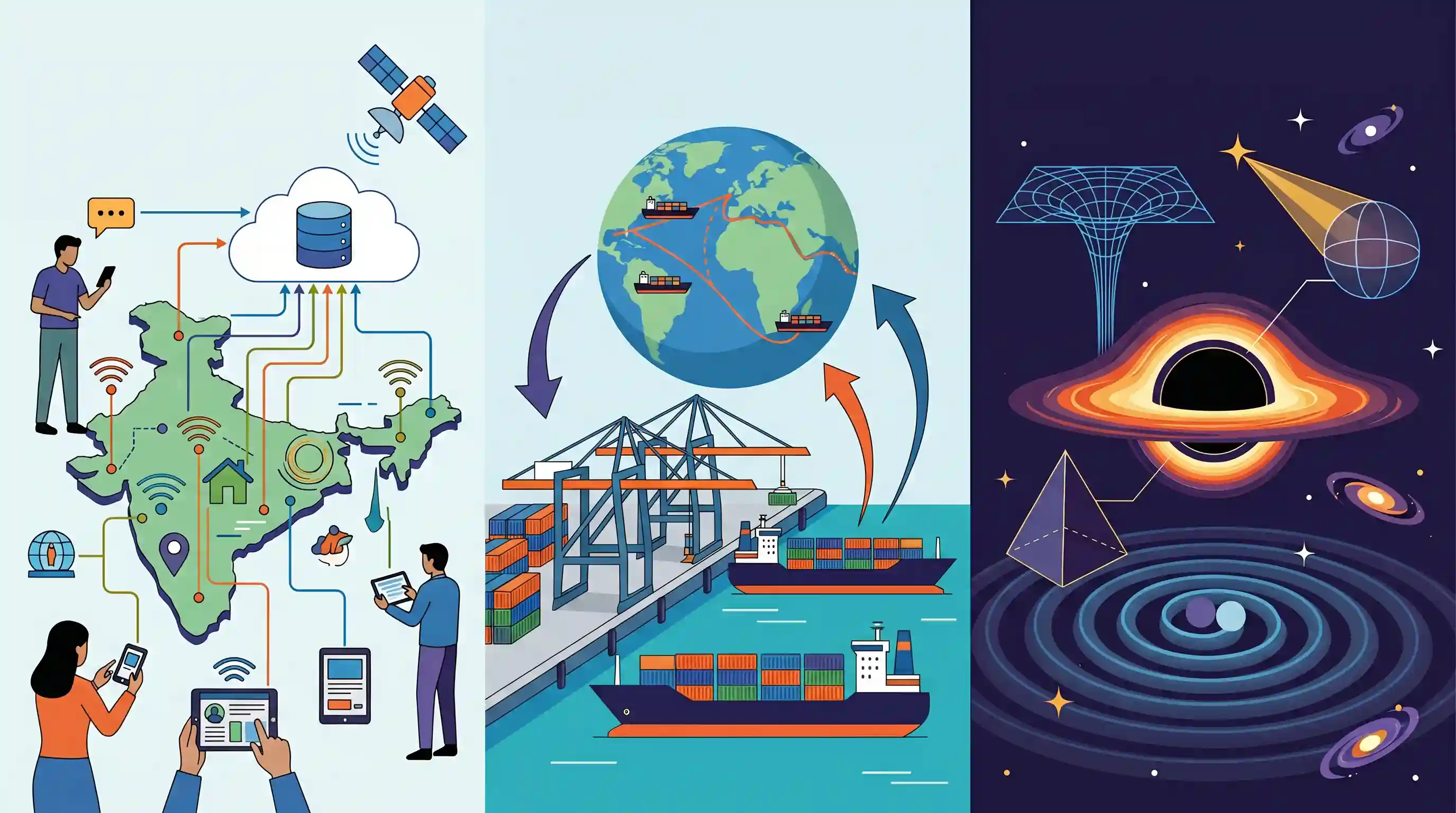
This compilation covers three distinct UPSC-relevant topics: the Sahyog portal for geospatial e-governance, the economic significance of transshipment ports in global trade, and the astrophysical concept of black holes. The Sahyog initiative by the Survey of India reflects the push toward interactive e-governance and crowdsourced mapping. In the realm of infrastructure, developing Indian transshipment hubs at Vizhinjam and Galathea Bay aims to secure maritime supply chains and reduce dependence on international hubs. Finally, the foundational science of black holes—including phenomena like the Event Horizon, Singularity, and gravitational waves—remains a highly tested area in Science & Technology.
Key Points
- The Sahyog portal and mobile application by the Survey of India aim to crowdsource geospatial data, promoting e-governance and improving the national mapping infrastructure.
- Transshipment in trade involves moving cargo from one vessel to another while in transit to its final destination. Developing domestic transshipment hubs (e.g., Vizhinjam, Galathea Bay) is essential for India to reduce reliance on foreign ports like Colombo or Singapore and improve supply chain security.
- A black hole is a region of spacetime where gravity is extremely intense, preventing even light from escaping. Crucial concepts include the 'Event Horizon' (the boundary of no return) and 'Singularity'.
- Studying black hole mergers has directly led to the detection of gravitational waves, a major milestone in observational astronomy.
Important Terms
Sahyog Portal

A mobile application and web portal by the Survey of India for crowdsourcing geospatial data, enabling citizens to report and update mapping info to enhance national datasets.
UPSC context
GS II (E-governance) and III (S&T); tests digital inclusion and citizen-centric governance initiatives.
Transshipment Port
A maritime hub where cargo is moved from large mother ships to smaller feeder vessels to reach final destinations, optimizing global shipping routes and logistics.
UPSC context
GS III (Infrastructure); focuses on maritime strategy, logistics costs, and projects like Vizhinjam and Galathea Bay.
National Geospatial Policy 2022
A policy aimed at liberalizing the geospatial sector to develop high-resolution topographical surveys by 2030 and democratize access to mapping data for economic growth.
UPSC context
GS III (S&T/Economy); covers deregulation, ‘Atmanirbhar Bharat’ in tech, and data-driven infrastructure planning.
Survey of India
The National Mapping Agency under the Department of Science & Technology, responsible for topographical surveys and maintaining the country's maps and geographical data since 1767.
UPSC context
GS I (History/Geography) and III (S&T); tests institutional frameworks and national scientific heritage.
LIGO-India
An advanced gravitational-wave observatory in Maharashtra, part of a global network detecting spacetime ripples from cataclysmic events like black hole mergers.
UPSC context
GS III (S&T/Space); pertains to international research collaborations and major scientific infrastructure.
Event Horizon
The boundary surrounding a black hole beyond which the gravitational pull is so strong that nothing, including light, can escape.
UPSC context
GS III (S&T/Space); frequently tested concept in fundamental physics and astrophysical breakthroughs.
Prelims Trap
"The Sahyog portal is a flagship mapping initiative launched by ISRO."
Sahyog is launched by the Survey of India (under DST), not ISRO. Aspirants reflexively link all spatial/mapping portals to ISRO.
Static Concepts Connected
How is the administration of Major and Non-Major ports divided in India?
- Major Ports: Administered by the Central Government under the Major Port Authorities Act, 2021.
- Non-Major Ports: Regulated by the respective State Maritime Boards or State Governments under the Indian Ports Act, 1908.
What distinguishes Gravitational Waves from standard Electromagnetic radiation?
- Spacetime Ripples: They are distortions in the fabric of spacetime itself caused by massive accelerating objects, not oscillating electromagnetic fields.
- Unimpeded Travel: Unlike light, they pass through cosmic matter almost completely unimpeded, allowing observation of astronomical events hidden behind dense dust clouds.
Cross-Topic Patterns
Port infra + Andaman & Nicobar strategy
Developing Galathea Bay isn't just about trade; it integrates with India's maritime security architecture to monitor Malacca Strait choke points.
Crowdsourced mapping + Disaster resilience
The National Geospatial Policy's push for portals like Sahyog aids localized disaster risk reduction and smart city planning through decentralized data.

Expect a 2026 prelims question merging the economic role of Galathea Bay transshipment port with Great Nicobar ecological sensitivities.
Linked PYQs · 5
Linked PYQs · 5
- 2024MainsGS2
e-governance is not just about the routine application of digital technology in service delivery process. It is as much about multifarious interactions for ensuring transparency and accountability. In this context evaluate the role of the 'Interactive Service Model' of e-governance.
- 2022MainsGS3
What are the maritime security challenges in India ? Discuss the organisational, technical and procedural initiatives taken to improve the maritime security.
- 2019PrelimsGS1
Recently, scientists observed the merger of giant 'blackholes' billions of light-years away from the Earth. What is the significance of this observation?
- 2017PrelimsGS1
The terms 'Event Horizon', 'Singularity', 'String Theory' and 'Standard Model' are sometimes seen in the news in the context of
- 2023PrelimsGS1
Consider the following pairs: Objects in space Description 1. Cepheids: Giant clouds of dust and gas in space 2. Nebulae: Stars which brighten and dim periodically 3. Pulsars: Neutron stars that are formed when massive stars run out of fuel and collapse How many of the above pairs are correctly matched?
