Border de-escalation and GLP-1 drugs in focus for UPSC
Source:Indian Express ↗
Why It Matters
Understanding de-escalation protocols is vital for GS-2 International Relations and Internal Security. GLP-1 drugs are a major breakthrough in biotechnology and healthcare, highly relevant for GS-3 Science and Tech. The Coastline paradox provides a conceptual understanding of mapping and topography relevant to GS-1 Geography.
Summary
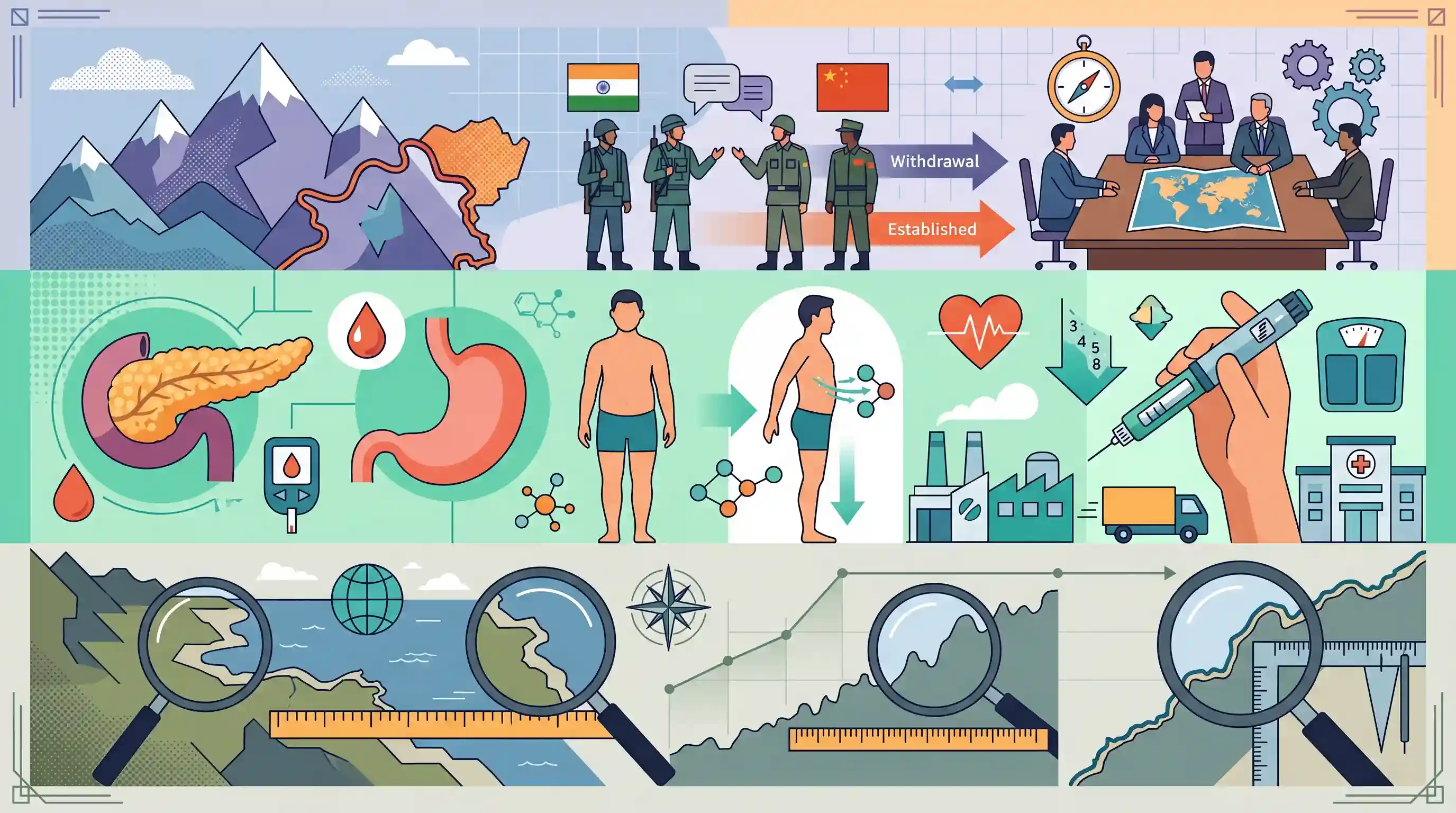
The article highlights three distinct topics relevant to UPSC preparation. Firstly, it discusses the ongoing diplomatic and military efforts between India and China to create a roadmap for de-escalation along the LAC, moving beyond immediate disengagement. Secondly, it examines the rise of GLP-1 drugs, which have revolutionized treatments for type 2 diabetes and obesity but raise considerations regarding pharmaceutical availability and healthcare impacts. Finally, it explores the 'Coastline Paradox', a concept in fractal geometry and physical geography demonstrating that a coastline's measured length increases as the scale of measurement becomes finer.
Key Points
- India and China have engaged in diplomatic and military dialogues to establish a roadmap for de-escalation and disengagement along the Line of Actual Control (LAC).
- De-escalation follows the initial phases of disengagement at friction points and involves a broader reduction of troop deployments in the border areas to restore peace.
- GLP-1 (Glucagon-like peptide-1) receptor agonists are a class of medications initially used for type 2 diabetes that have gained global prominence for their effectiveness in weight loss and obesity management.
- The 'Coastline Paradox' is a geographical and mathematical phenomenon stating that the measured length of a landmass's coastline depends on the scale of measurement used.
- Smaller measuring units reveal more intricacies and indentations (due to fractal geometry), resulting in a longer overall measured coastline length, a concept expanded upon by mathematician Benoit Mandelbrot.
Important Terms
Line of Actual Control (LAC)

The de-facto, non-demarcated boundary separating Indian-controlled territory from Chinese-controlled territory, traditionally divided into the Western (Ladakh), Middle (Himachal/Uttarakhand), and Eastern (Arunachal/Sikkim) sectors.
UPSC context
GS Paper II: International Relations (India-China border); GS Paper III: Internal Security and border management challenges.
De-escalation
A diplomatic and military process aimed at reducing troop density, removing heavy weaponry, and withdrawing long-range equipment from border friction points to restore peace and stability.
UPSC context
GS Paper II: Diplomacy; GS Paper III: National Security. Tests understanding of phased border normalization (disengagement, de-escalation, de-induction).
Disengagement
The initial military step where opposing forces move away from close-range contact or 'eyeball-to-eyeball' standoffs at specific friction points to prevent accidental clashes.
UPSC context
GS Paper III: Border management. Distinguishes tactical tactical troop movement from broader strategic de-escalation.
People's Liberation Army (PLA)
The unified military forces of the People's Republic of China, which institutionally serve as the armed wing of the Chinese Communist Party (CCP) rather than the state itself.
UPSC context
GS Paper II: International Relations. Understanding the political-military structure of China and its implications for regional security.
GLP-1 Receptor Agonists
A class of drugs that mimic a natural hormone to regulate insulin release and suppress appetite, recently popularized for treating type 2 diabetes and chronic obesity.
UPSC context
GS Paper III: Science and Technology (Medicine/Health). Relevant for non-communicable disease (NCD) management and pharmaceutical breakthroughs.
Coastline Paradox
The geographical observation that a coastline's measured length increases as the measurement scale becomes finer, because smaller scales capture more intricate details like inlets and bays.
UPSC context
GS Paper I: Physical Geography. Critical for understanding map resolution and India's updated official coastline length.
Fractal Geometry
A mathematical branch studying complex, irregular shapes that exhibit self-similarity; used to model natural features like coastlines, river networks, and lungs that do not follow Euclidean geometry.
UPSC context
GS Paper I: Physical Geography; GS Paper III: Science. Explains the theoretical basis for geographic measurement anomalies.
Prelims Trap
"De-escalation refers to the immediate creation of buffer zones and pulling troops back from friction points."
This describes 'disengagement'. 'De-escalation' is the subsequent, broader withdrawal of heavy troop deployments and reserves across the entire border, not just immediate friction points.
Static Concepts Connected
How do GLP-1 receptor agonists function in the human body?
- Insulin stimulation: They mimic natural incretin hormones, prompting the pancreas to release insulin specifically when blood sugar levels are high.
- Appetite suppression: They delay gastric emptying and target satiety centers in the brain, effectively suppressing appetite and aiding in weight management.
What defines the Coastline Paradox in physical geography?
- Scale dependence: The measured length of a landmass's coastline paradoxically increases as the measurement unit or ruler becomes smaller and more precise.
- Fractal irregularity: Coastlines exhibit fractal geometry with self-similar, repeating irregular indentations, meaning they lack smooth Euclidean edges, making absolute measurement impossible.
Cross-Topic Patterns
GLP-1 drugs and India's NCD burden
The rise of pharmacological obesity treatments highlights India's epidemiological transition, linking S&T pharmaceutical breakthroughs directly to the growing economic burden of Non-Communicable Diseases (NCDs) in public health.
Coastline Paradox & CRZ Mapping
The scale used to measure coastal indentations directly impacts the precise spatial demarcation of Coastal Regulation Zones (CRZ) and vulnerability mapping for climate-induced sea-level rise.

Expect a 2026 Prelims question testing the biological mechanism of GLP-1 (incretin mimicry) or a geography statement on fractal coastlines.
Linked PYQs · 5
Linked PYQs · 5
- 2014MainsGS2
With respect to the South China sea, maritime territorial disputes and rising tension affirm the need for safeguarding maritime security to ensure freedom of navigation and over flight throughout the region. In this context, discuss the bilateral issues between India and China.
- 2023MainsGS2
‘Virus of Conflict is affecting the functioning of the SCO’ In the light of the above statement point out the role of India in mitigating the problems.
- 2024PrelimsGS1
In which of the following are hydrogels used? 1. Controlled drug delivery in patients 2. Mobile air-conditioning systems 3. Preparation of industrial lubricants Select the correct answer using the code given below:
- 2023MainsGS3
Introduce the concept of Artificial Intelligence (AI). How does Al help clinical diagnosis? Do you perceive any threat to privacy of the individual in the use of Al in healthcare?
- 2021MainsGS3
What are the research and developmental achievements in applied biotechnology? How will these achievements help to uplift the poorer sections of the society?
