Rio Declaration Elephant Database and Agentic AI for UPSC
Source:Indian Express ↗
Why It Matters
The G20 is a recurring theme in GS2 International Relations. Wildlife protection, particularly regarding flagship species like elephants, is a staple of GS3 Environment and Prelims. The evolution of AI into autonomous systems (Agentic AI) is highly relevant for GS3 Science and Technology questions regarding the capabilities, applications, and ethical concerns of emerging technologies.
Summary
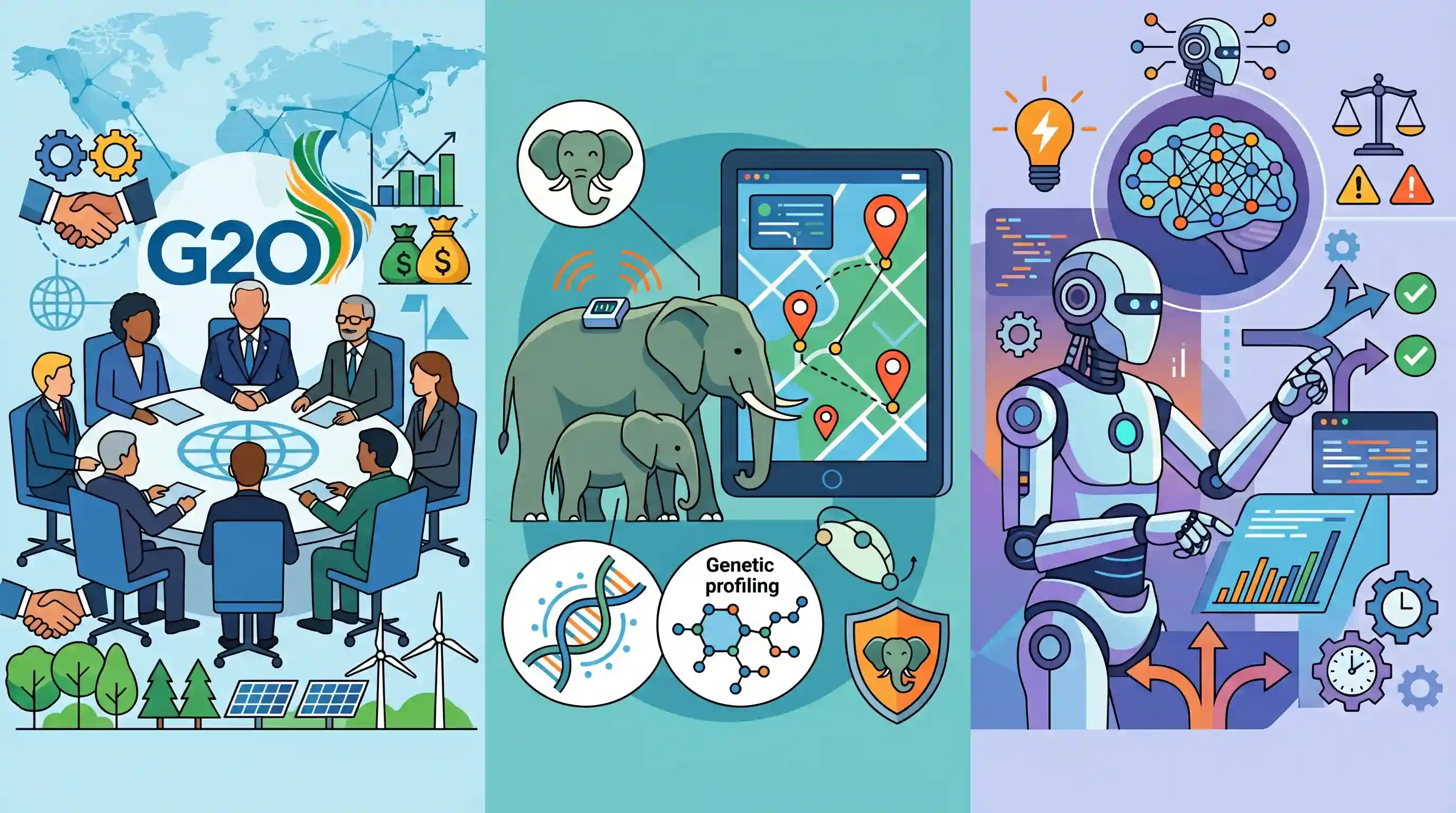
This edition of 'UPSC Key' covers three crucial current affairs topics. First, the G20 Rio de Janeiro Declaration, which outlines international commitments on global governance, economic stability, and sustainable development. Second, the MoEFCC's Captive Elephant database project, which utilizes digital mapping and genetic profiling to safeguard elephant welfare and regulate their transfer under the amended Wildlife Protection Act. Third, the emergence of Agentic AI, a technological advancement where artificial intelligence systems function as autonomous agents capable of independent decision-making and execution, raising significant opportunities and regulatory challenges.
Key Points
- The G20 Rio de Janeiro Declaration highlights global priorities such as sustainable development, reform of global governance institutions, and energy transitions under Brazil's presidency.
- The Ministry of Environment, Forest and Climate Change (MoEFCC) has introduced a Captive Elephant database project to map and genetically profile captive elephants to ensure their welfare and monitor legal transfers under the Wildlife Protection Act.
- Agentic AI represents a paradigm shift in artificial intelligence, moving from generative text capabilities to autonomous systems capable of goal-oriented decision-making and task execution with minimal human intervention.
Important Terms
Rio de Janeiro Declaration

The outcome document of the 19th G20 Summit (2024), focusing on social inclusion, global governance reform, and urgent climate action through the "Global Mobilization against Climate Change."
UPSC context
GS Paper II (Global Groupings); tests understanding of international consensus on economic stability and multilateral reforms.
Wildlife Protection Act, 1972
India's primary legal framework for protecting flora and fauna. Recent 2022 amendments specifically addressed the regulation of captive elephant transfers for religious or other purposes.
UPSC context
GS Paper III (Environment/Conservation); crucial for questions on biodiversity laws and endangered species management.
Agentic AI
Advanced AI systems that exhibit "agency"—the ability to reason, set independent goals, and execute complex workflows without constant human intervention.
UPSC context
GS Paper III (Science & Technology); assesses awareness of disruptive technologies and their socio-economic or regulatory impacts.
Global Alliance against Hunger and Poverty
A G20 initiative launched by Brazil (2024) to mobilize finance and knowledge for reaching 500 million people with cash transfers and school meals by 2030.
UPSC context
GS Paper II (International Relations); pertains to global cooperation for Sustainable Development Goals (SDGs) and poverty alleviation.
Ministry of Environment, Forest and Climate Change (MoEFCC)
The nodal central ministry for planning and overseeing India's environmental policies, forest conservation, and implementation of wildlife protection programs.
UPSC context
GS Paper III (Environment); focuses on institutional roles in environmental governance and climate policy.
Captive Elephant Genetic Database
A specialized MoEFCC project using the 'Gajah Suchana' app to collect biological samples for identifying and monitoring captive elephants to curb illegal trade.
UPSC context
GS Paper III (Wildlife Conservation); relates to the use of technology in preventing illegal wildlife trafficking.
Prelims Trap
The Gajah Soochna application is designed to track the real-time movement and population of wild elephant herds across India.
It exclusively records the genetic and demographic data of CAPTIVE elephants to monitor their legal transfers and curb illegal capture under the Wildlife Protection Act.
Static Concepts Connected
What are the legal provisions for captive elephants under the Wildlife Protection Act?
- Schedule I status: Elephants are Schedule I animals, but captive elephants historically hold distinct legal status allowing private ownership and upkeep under strict conditions.
- 2022 WPA Amendment: Allows the transfer or transport of captive elephants for 'religious or any other purpose' by a person with a valid certificate of ownership.
- Commercial trade ban: Strictly prohibits commercial sale. All transfers require prior permission from the Chief Wildlife Warden and genetic profiling.
How does the G20 Troika function in the absence of a permanent secretariat?
- Troika mechanism: The G20 agenda is coordinated by a three-member Troika comprising the past, present, and incoming presidencies to ensure continuity.
- Current composition: It currently consists of India (2023), Brazil (2024), and South Africa (2025)—marking the first consecutive Global South leadership.
Cross-Topic Patterns
G20 Troika and Global South alignment
The unprecedented India-Brazil-South Africa G20 Troika seamlessly connects IR with socio-economic development, driving initiatives like the 'Global Alliance Against Hunger and Poverty' into mainstream multilateralism.
Evolution from Generative to Agentic AI
Agentic AI's autonomous decision-making bridges S&T with governance and ethics. Expect questions testing the functional boundaries between prompt-dependent Generative AI and goal-oriented Agentic AI.

The functional distinction between Agentic and Generative AI, and the 'Gajah Soochna' app's specific focus on captive elephants, are prime 2026 targets.
Linked PYQs · 4
Linked PYQs · 4
- 2023PrelimsGS1
Consider the following statements about G-20: 1. The G-20 group was originally established as a platform for the Finance Ministers and Central Bank Governors to discuss the international economic and financial issues. 2. Digital public infrastructure is one of India's G-20 priorities. Which of the statements given above is/are correct?
- 2022PrelimsGS1
With reference to Indian laws about wildlife protection, consider the following statements : 1. Wild animals are the sole property of the government. 2. When a wild animal is declared protected, such animal is entitled for equal protection whether it is found in protected areas or outside. 3. Apprehension of a protected wild animal becoming a danger to human life is sufficient ground for its capture or killing. Which of the statements given above is/are correct?
- 2020PrelimsGS1
With the present state of development, Artificial Intelligence can effectively do which of the following? 1. Bring down electricity consumption in industrial units 2. Create meaningful short stories and songs 3. Disease diagnosis 4. Text-to-Speech Conversion 5. Wireless transmission of electrical energy Select the correct answer using the code given below:
- 2023MainsGS3
Introduce the concept of Artificial Intelligence (AI). How does Al help clinical diagnosis? Do you perceive any threat to privacy of the individual in the use of Al in healthcare?
