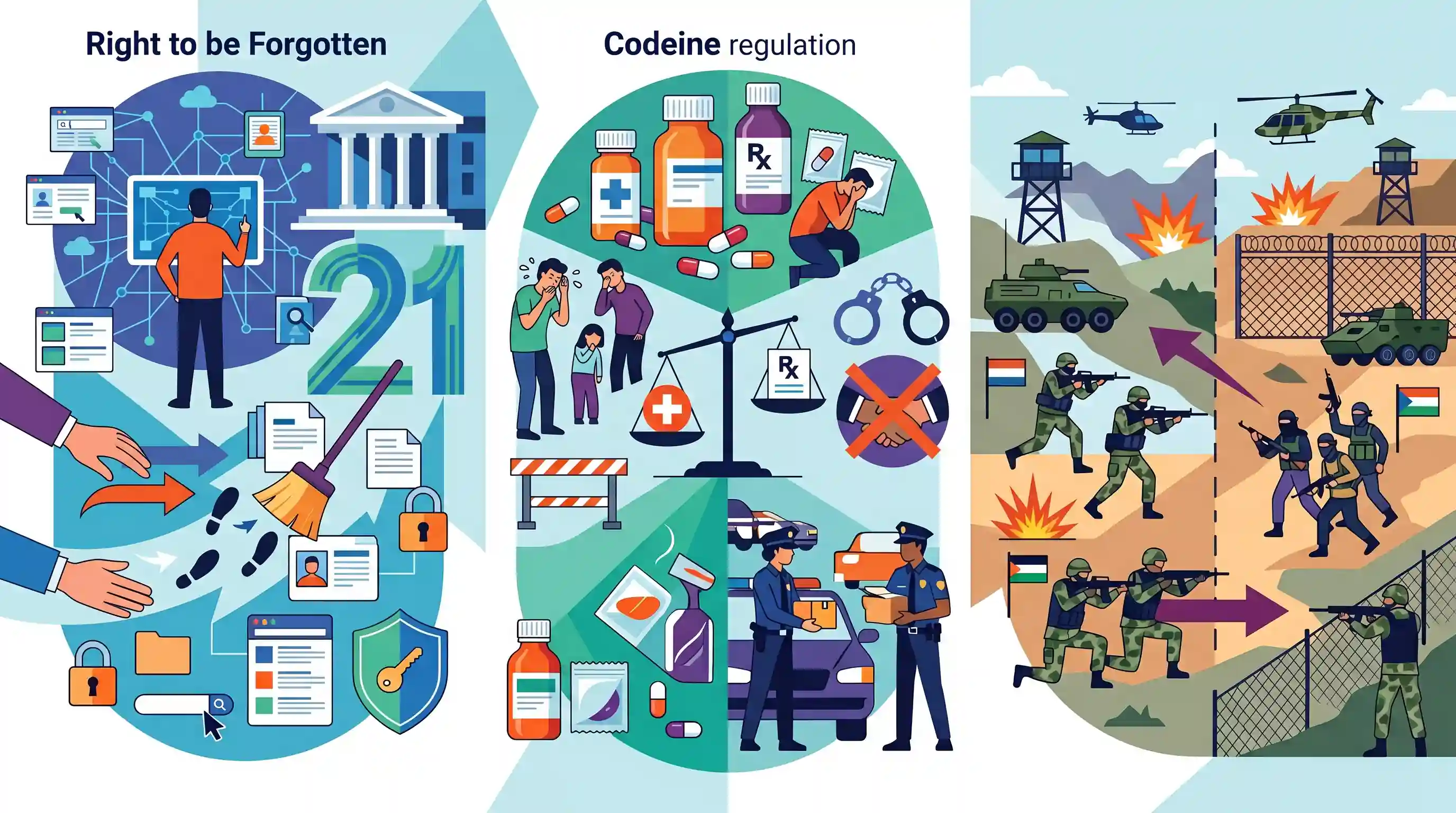
Right to be Forgotten Codeine Regulation and Hot Pursuit
Source:Indian Express ↗
Why It Matters
These topics bridge GS-2 and GS-3 domains, linking fundamental constitutional rights (privacy and data protection) with critical internal security challenges like pharmaceutical drug abuse and the strategic use of cross-border military doctrines.
Summary
The article outlines three diverse but crucial concepts for UPSC preparation: the Right to be Forgotten, Codeine regulation, and Operation Hot Pursuit. The Right to be Forgotten, rooted in the landmark K.S. Puttaswamy judgment (Article 21), enables citizens to have their digital footprint erased under the DPDP Act. Codeine highlights the intersection of public health and internal security, as codeine-based cough syrups are heavily abused and trafficked, prompting stringent actions under the NDPS Act. Lastly, Operation Hot Pursuit discusses the strategic doctrine of conducting cross-border operations to neutralize terrorists and insurgents, a critical aspect of India's border management and counter-terrorism posture.
Key Points
- The Right to be Forgotten is an essential facet of the Right to Privacy under Article 21, allowing individuals to request the deletion of their personal data from the internet under specific conditions.
- It is legally recognized in the Digital Personal Data Protection (DPDP) Act, 2023, though it must be balanced against the freedom of expression and public interest.
- Codeine, an opiate commonly found in cough syrups, is subject to strict regulation in India under the NDPS Act due to rampant misuse, addiction, and cross-border smuggling.
- Operation Hot Pursuit refers to the military and security doctrine of crossing international borders to pursue and neutralize fleeing terrorists or hostile actors.
- India has historically utilized this doctrine (e.g., cross-border strikes in Myanmar) to manage internal security threats, though it involves complex strategic and international law implications.
Important Terms
Right to be Forgotten

The right of individuals to have outdated, irrelevant, or inaccurate personal information removed or de-indexed from search engines and public platforms to protect their reputation and dignity.
UPSC context
GS Paper 2: Fundamental Rights/Judiciary. Tests understanding of privacy jurisprudence and Article 21's evolving scope post-Puttaswamy judgment.
Digital Personal Data Protection Act, 2023
India's primary data privacy law regulating digital personal data processing. It mandates user consent, establishes data fiduciary obligations, and grants individuals rights like data erasure and grievance redressal.
UPSC context
GS Paper 3: IT & Computers/Internal Security. Crucial for questions on data sovereignty, privacy legislation, and digital governance.
Narcotic Drugs and Psychotropic Substances (NDPS) Act, 1985
A stringent law prohibiting the cultivation, possession, and trafficking of narcotic drugs and psychotropic substances except for medical purposes. It includes provisions for asset forfeiture and severe penalties.
UPSC context
GS Paper 3: Internal Security (Drug Trafficking). Tests knowledge of legal frameworks for combating the drug menace and organized crime.
Operation Hot Pursuit
A military doctrine allowing security forces to pursue fleeing insurgents or terrorists across international borders immediately after an attack to neutralize the threat within a limited geographical scope.
UPSC context
GS Paper 3: Internal Security/Border Management. Relates to proactive counter-terrorism strategies, regional stability, and international law (self-defense).
Article 21 of the Indian Constitution
The constitutional provision guaranteeing that no person shall be deprived of their life or personal liberty except according to legal procedure; the foundation for the Fundamental Right to Privacy.
UPSC context
GS Paper 2: Polity/Constitution. Central to debates on civil liberties, judicial activism, and the expansion of fundamental rights.
Drugs and Cosmetics Act, 1940
The primary legislation regulating the manufacture, import, and sale of medicines and cosmetics in India, ensuring products meet safety, efficacy, and quality standards via licensing.
UPSC context
GS Paper 2: Social Justice/Health. Tests understanding of regulatory governance in the pharmaceutical sector and public health protection.
Prelims Trap
The Right to be Forgotten is an absolute fundamental right explicitly enshrined in the Indian Constitution.
RTBF is an implicit right derived from Article 21 via the Puttaswamy judgment, not explicitly mentioned. Furthermore, it is not absolute and is restricted by free speech and public interest.
Static Concepts Connected
How did the Puttaswamy judgment (2017) expand Article 21?
- Right to Privacy: Recognized privacy as a constitutionally protected right, intrinsic to the right to life and personal liberty.
- Informational Privacy: Granted individuals control over their personal data and commercial exploitation of their digital footprint.
- Right to be Forgotten: Established that individuals can request the deletion of personal data online, subject to reasonable restrictions.
What are the primary drug trafficking routes threatening India?
- Golden Triangle: Located on India's eastern border (Myanmar, Laos, Thailand); heavily associated with heroin smuggling and insurgent financing.
- Golden Crescent: Located on India's western border (Iran, Afghanistan, Pakistan); a major source of illicit opium and hashish.
- Reverse Trafficking: The smuggling of Indian pharmaceutical drugs (like codeine-based syrups) into neighboring regions to fund illicit activities.
Cross-Topic Patterns
DPDP Act meets Article 21
The statutory "Right to Erasure" under the DPDP Act 2023 operationalizes the fundamental Right to be Forgotten derived from the Supreme Court's Puttaswamy judgment.
Dual-use pharma and border security
Legitimate medicinal preparations like codeine syrups become internal security threats when diverted to the Golden Triangle, blending public health policy with border management.
Sovereignty vs. Counter-Terrorism Doctrines
Cross-border hot pursuit operations test the boundaries of UN Charter Article 2(4) on territorial integrity versus a state's right to self-defense against non-state actors.

DPDP's Right to Erasure exemptions vs Article 21's Right to be Forgotten limits is a prime candidate for a 2026 multi-statement question.
Linked PYQs · 5
Linked PYQs · 5
- 2024MainsGS2
Right to privacy is intrinsic to life and personal liberty and is inherently protected under Article 21 of the constitution. Explain. In this reference discuss the law relating to D.N.A. testing of child in the womb to establish its paternity.
- 2017MainsGS2
Examine the scope of Fundamental Rights in the light of the latest judgement of the Supreme Court on Right to Privacy.
- 2016MainsGS3
The terms 'Hot Pursuit' and 'Surgical Strikes' are often used in connection with armed action against terrorist attacks. Discuss the strategic impact of such actions.
- 2024MainsGS3
Explain how narco-terrorism has emerged as a serious threat across the country. Suggest suitable measures to counter narco-terrorism.
- 2018MainsGS3
India's proximity to two of the world's biggest illicit opium-growing states has enhanced her internal security concerns. Explain the linkages between drug trafficking and other illicit activities such as gunrunning, money laundering and human trafficking. What counter-measures should be taken to prevent the same?
