Macroeconomic Indicators Base Year Revision and Monetary Policy
Source:Indian Express ↗
Why It Matters
Understanding base year revisions is crucial for interpreting economic data accurately. Monetary policy decisions like repo rate cuts directly impact inflation and growth trajectories. Meanwhile, securing critical minerals like copper is foundational to India's industrial and environmental goals.
Summary
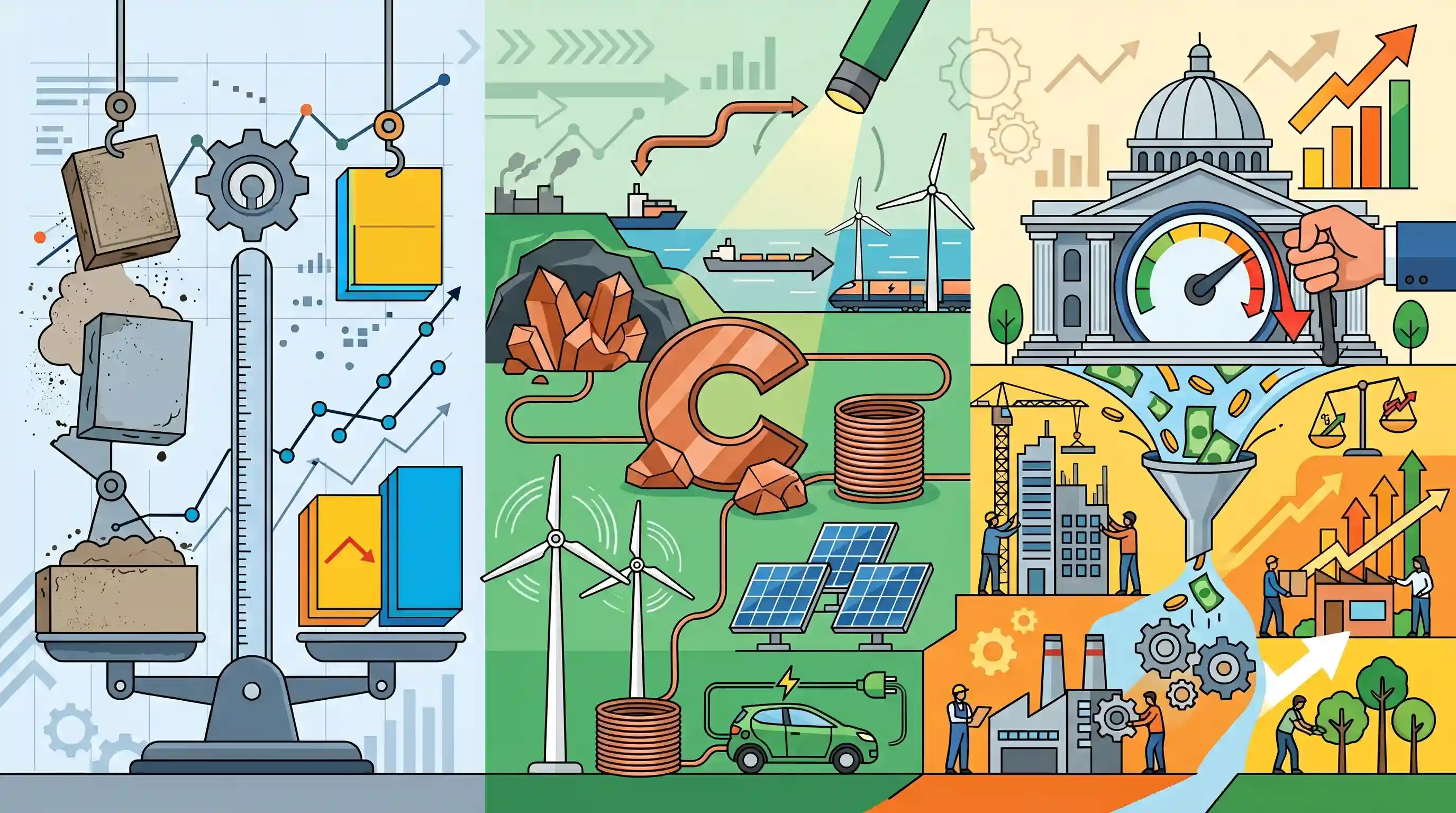
This compilation highlights three pivotal economic and resource-related themes: the revision of the base year for economic indicators, the strategic importance of copper, and the impact of an RBI repo rate reduction. Updating the base year ensures that macroeconomic data accurately reflects current economic realities and structural shifts. Copper is discussed as a critical mineral vital for India's green energy transition and industrial expansion, alongside the challenges of import dependence. Finally, the reduction in the repo rate is analyzed as a monetary policy tool to inject liquidity, lower borrowing costs, and stimulate economic growth while managing inflation.
Key Points
- The revision of the base year for macroeconomic indicators (like GDP, CPI, and WPI) is essential to capture updated consumption patterns and structural changes in the Indian economy.
- Copper is a highly strategic metal, critical for infrastructure development and the transition to green energy technologies, including electric vehicles and solar power.
- India's dependence on copper imports necessitates securing robust global supply chains and enhancing domestic mining operations.
- A reduction in the repo rate by the RBI lowers borrowing costs, aiming to stimulate economic growth, industrial investment, and consumer demand.
- The Monetary Policy Committee must carefully balance rate cuts to boost growth without stoking excessive inflationary pressures.
Important Terms
Repo Rate

The interest rate at which the Reserve Bank of India (RBI) lends money to commercial banks against government securities, used to control liquidity and inflation.
UPSC context
GS Paper 3 (Economy); tested under Monetary Policy tools, inflation management, and liquidity adjustment mechanisms.
Monetary Policy Committee (MPC)
A statutory six-member body chaired by the RBI Governor, responsible for determining the policy repo rate to achieve the government's inflation target.
UPSC context
GS Paper 3 (Economy); tested for its composition, mandate under the RBI Act, and role in macroeconomic stability.
Critical Minerals
Minerals essential for modern technologies, economic security, and the green energy transition, often characterized by supply chain vulnerabilities (e.g., copper, lithium, and rare earth elements).
UPSC context
GS Paper 3 (Environment/Economy); relevant to India's net-zero targets, strategic autonomy, and resource security.
Base Year
The reference year used as a benchmark for calculating economic indicators like GDP and CPI to measure real growth by removing the effect of inflation.
UPSC context
GS Paper 3 (Economy); important for understanding national income accounting, data reliability, and structural shifts in the economy.
Ministry of Statistics and Programme Implementation (MoSPI)
The nodal ministry in India responsible for the collection and dissemination of official statistics, including GDP estimates, IIP, and consumer price indices.
UPSC context
GS Paper 3 (Economy); tested regarding institutional frameworks for economic data and oversight of major development programs.
Reserve Bank of India (RBI)
India's central bank and regulatory body, responsible for issuing currency, managing monetary policy, and maintaining financial stability in the economy.
UPSC context
GS Paper 3 (Economy); fundamental to topics like banking regulation, inflation targeting, and external sector management.
Green Energy Transition
The shift from fossil-fuel-based energy systems to carbon-neutral sources like solar and wind to achieve climate goals and reduce greenhouse gas emissions.
UPSC context
GS Paper 3 (Environment); central to net-zero strategies, Panchamrit targets, and sustainable development.
Liquidity
The availability of cash or cash-equivalent assets in the financial system, influencing borrowing costs and the ability of markets to function smoothly.
UPSC context
GS Paper 3 (Economy); critical for understanding market stability, interest rate transmission, and central bank interventions.
Prelims Trap
"Reducing the repo rate is the RBI's primary tool for curbing high inflation in the economy."
Aspirants often invert monetary tools. A repo rate cut injects liquidity to stimulate growth, which can actually increase inflation. Rate hikes are used to curb inflation.
Static Concepts Connected
What is the rationale behind revising the base year for national macroeconomic indices?
- Capturing Structural Shifts: Incorporates emerging sectors like the digital economy that were negligible or non-existent in the previous base year.
- Updating Consumption Baskets: Reflects contemporary household spending patterns in indices like CPI, ensuring inflation data matches ground reality.
- Accurate Real GDP: Provides a realistic, updated reference point to eliminate recent price distortions and accurately calculate real economic growth.
Why is copper heavily prioritized in India's critical mineral strategy?
- Green Energy Transition: Crucial for solar grids, wind turbines, and EVs, which require 4-5 times more copper than traditional combustion vehicles.
- Import Vulnerability: Despite domestic reserves in Malanjkhand and Khetri, India faces massive import dependence for refined copper, exposing supply chains to global shocks.
- Urban Mining Potential: Its high value and recoverability in e-waste makes it a primary target for domestic recycling initiatives.
Cross-Topic Patterns
Urban Mining + E-Waste Rules
Heavy import dependence for copper drives India's focus on 'Urban Mining'—extracting strategic metals from e-waste leveraging the Extended Producer Responsibility (EPR) framework.
Inflation Targeting + MoSPI Data
The RBI's MPC relies heavily on MoSPI's CPI data. Outdated base years distort inflation metrics, risking miscalibrated repo rate decisions that could inadvertently stoke inflation or stifle growth.

Base year revisions coupled with the MPC's inflation-targeting framework will likely form a complex, multi-statement macro-economy question.
Linked PYQs · 4
Linked PYQs · 4
- 2022PrelimsGS1
With reference to the Indian economy, consider the following statements: 1. If the inflation is too high, Reserve Bank of India (RBI) is likely to buy government securities. 2. If the rupee is rapidly depreciating, RBI is likely to sell dollars in the market. 3. If interest rates in the USA or European Union were to fall, that is likely to induce RBI to buy dollars. Which of the statements given above are correct?
- 2019PrelimsGS1
Which one of the following is not the most likely measure the Government/RBI takes to stop the slide of Indian rupee?
- 2021PrelimsGS1
Which among the following steps is most likely to be taken at the time of an economic recession?
- 2021MainsGS3
Explain the difference between computing methodology of India's Gross Domestic Product (GDP) before the year 2015 and after the year 2015.
