REER Economics and Public Health Infrastructure Mission
Source:Indian Express ↗
Why It Matters
These topics form the core of GS-3 (Economy and Disaster Management) and GS-2 (Social Issues/Health). Grasping REER is essential for tracking currency valuation, while assessing PM-ABHIM and tsunami preparedness provides critical fodder for mains answers on governance and disaster mitigation.
Summary
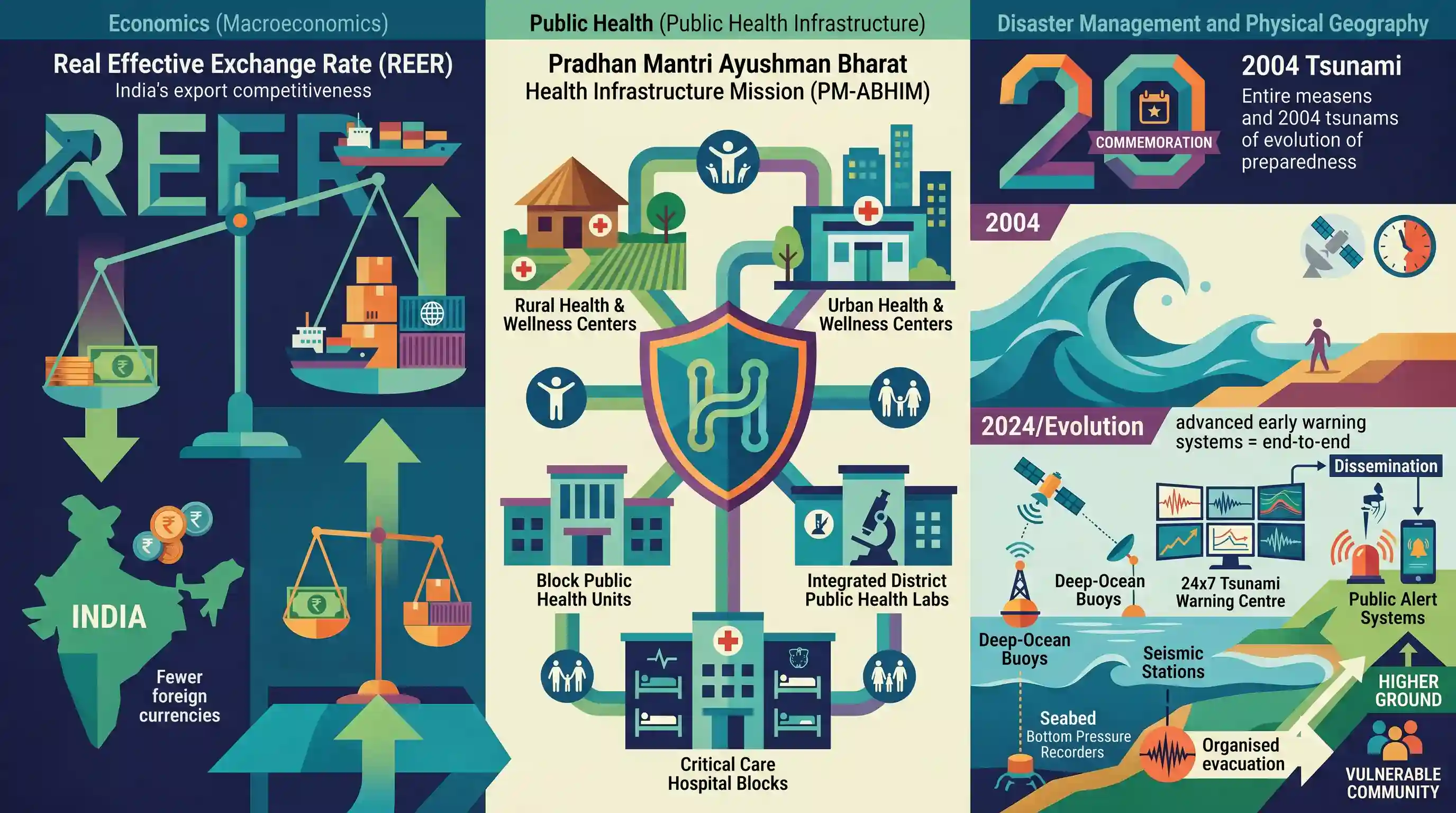
The article compiles key UPSC topics for December 26, 2024, focusing on three major areas: Economics, Public Health, and Disaster Management. It discusses the concept of the Real Effective Exchange Rate (REER) and its impact on India's export competitiveness. It also outlines the objectives of the Pradhan Mantri Ayushman Bharat Health Infrastructure Mission (PM-ABHIM) in strengthening grassroots healthcare facilities. Finally, commemorating 20 years of the 2004 Indian Ocean Tsunami, the article highlights the evolution of India's disaster preparedness, including the deployment of advanced early warning systems.
Key Points
- The Real Effective Exchange Rate (REER) is a weighted average of a country's currency in relation to a basket of major currencies; an increasing REER indicates a loss of trade competitiveness as exports become relatively more expensive.
- PM-ABHIM aims to accomplish a paradigm shift in healthcare delivery by building a robust public health infrastructure capable of handling future pandemics and bridging gaps in primary, secondary, and tertiary care.
- The devastating 2004 Indian Ocean Tsunami served as a watershed moment for India's disaster management, prompting the establishment of a dedicated institutional framework including the NDMA and the Indian Tsunami Early Warning System (ITEWS).
Important Terms
Real Effective Exchange Rate (REER)

A weighted average of a country's currency relative to a basket of major currencies, adjusted for inflation. It measures an economy's external trade competitiveness and reflects overvaluation or undervaluation.
UPSC context
GS-III (Economics). Tests understanding of currency valuation, trade competitiveness, and balance of payments.
PM Ayushman Bharat Health Infrastructure Mission (PM-ABHIM)
A pan-India health scheme launched in 2021 to strengthen primary, secondary, and tertiary healthcare infrastructure. It focuses on filling gaps in surveillance, research, and critical care for pandemic preparedness.
UPSC context
GS-II (Social Justice/Health). Tests knowledge of healthcare reforms and institutional capacity for crisis management.
National Disaster Management Authority (NDMA)
The apex statutory body for disaster management in India, established under the Disaster Management Act, 2005. Chaired by the Prime Minister, it formulates national policies and response plans.
UPSC context
GS-III (Disaster Management). Tests institutional frameworks for disaster mitigation and emergency response.
Indian National Centre for Ocean Information Services (INCOIS)
An autonomous body under the Ministry of Earth Sciences that provides ocean information and advisories. It operates the Indian Tsunami Early Warning Centre (ITEWC) and monitors sea-level changes.
UPSC context
GS-III (Science & Tech/Disaster Management). Tests knowledge of early warning systems and oceanographic research.
Reserve Bank of India (RBI)
India's central bank and regulatory body responsible for monetary policy, currency issuance, and banking supervision. It manages the rupee's exchange rate indices, including NEER and REER.
UPSC context
GS-III (Economics). Essential for understanding monetary policy, banking regulation, and external sector management.
Prelims Trap
"An increase in India's REER indicates that its exports have become more competitive globally."
A rising REER means the currency is appreciating in real terms relative to trading partners. This makes exports more expensive, thus REDUCING trade competitiveness.
Static Concepts Connected
What is the difference between NEER and REER?
- NEER: An unadjusted weighted average of the domestic currency against a basket of foreign currencies of major trading partners.
- REER: NEER adjusted for inflation differentials between the home country and its trading partners.
- Competitiveness Indicator: A REER above 100 implies overvaluation (exports dearer); below 100 implies undervaluation (exports cheaper).
How does India's Tsunami Early Warning System (ITEWS) function?
- Nodal Agency: Operated by the Indian National Centre for Ocean Information Services (INCOIS), Hyderabad, under the Ministry of Earth Sciences.
- Sensor Network: Relies on a real-time network of seismic stations, Bottom Pressure Recorders (BPRs), and tide gauges.
- Global Role: Designated as one of the Regional Tsunami Service Providers (RTSP) for the Indian Ocean region.
Cross-Topic Patterns
Tsunami to Sendai Framework
The 2004 Tsunami catalyzed India's DM Act 2005. UPSC often links such domestic legislative watersheds to India's international commitments like the Sendai Framework for Disaster Risk Reduction.
Exchange Rates and CAD
A high REER reduces export competitiveness, widening the trade deficit. UPSC questions frequently fuse exchange rate dynamics with their downstream impact on the Balance of Payments.
Health Infra & Local Governance
PM-ABHIM works alongside 15th Finance Commission health grants to local bodies, bridging Central health infrastructure schemes with fiscal federalism and decentralized primary care delivery.

Expect a 2026 multi-statement question linking REER's inflation-adjustment mechanics to its direct impact on India's export competitiveness.
Linked PYQs · 5
Linked PYQs · 5
- 2022PrelimsGS1
With reference to the Indian economy, consider the following statements: 1. An increase in Nominal Effective Exchange Rate (NEER) indicates the appreciation of rupee. 2. An increase in the Real Effective Exchange Rate (REER) indicates an improvement in trade competitiveness. 3. An increasing trend in domestic inflation relative to inflation in other countries is likely to cause an increasing divergence between NEER and REER. Which of the above statements are correct?
- 2024MainsGS2
In a crucial domain like the public healthcare system the Indian State should play a vital role to contain the adverse impact of marketisation of the system. Suggest some measures through which the State can enhance the reach of public healthcare at the grassroots level.
- 2021MainsGS2
“Besides being a moral imperative of a Welfare State, primary health structure is a necessary precondition for sustainable development.” Analyze.
- 2025MainsGS1
What are Tsunamis? How and where are they formed? What are their consequences? Explain with examples.
- 2023MainsGS1
Comment on the resource potentials of the long coastline of India and highlight the status of natural hazard preparedness in these areas.
