RBI Digital Fraud Compensation Rat Hole Mining and Russian Oil
Source:Indian Express ↗
Why It Matters
These topics span GS2 and GS3, addressing contemporary challenges in India's digital economy (fraud compensation), environmental regulation vs. disaster response (rat-hole mining), and strategic autonomy in foreign policy (Russian oil imports).
Summary
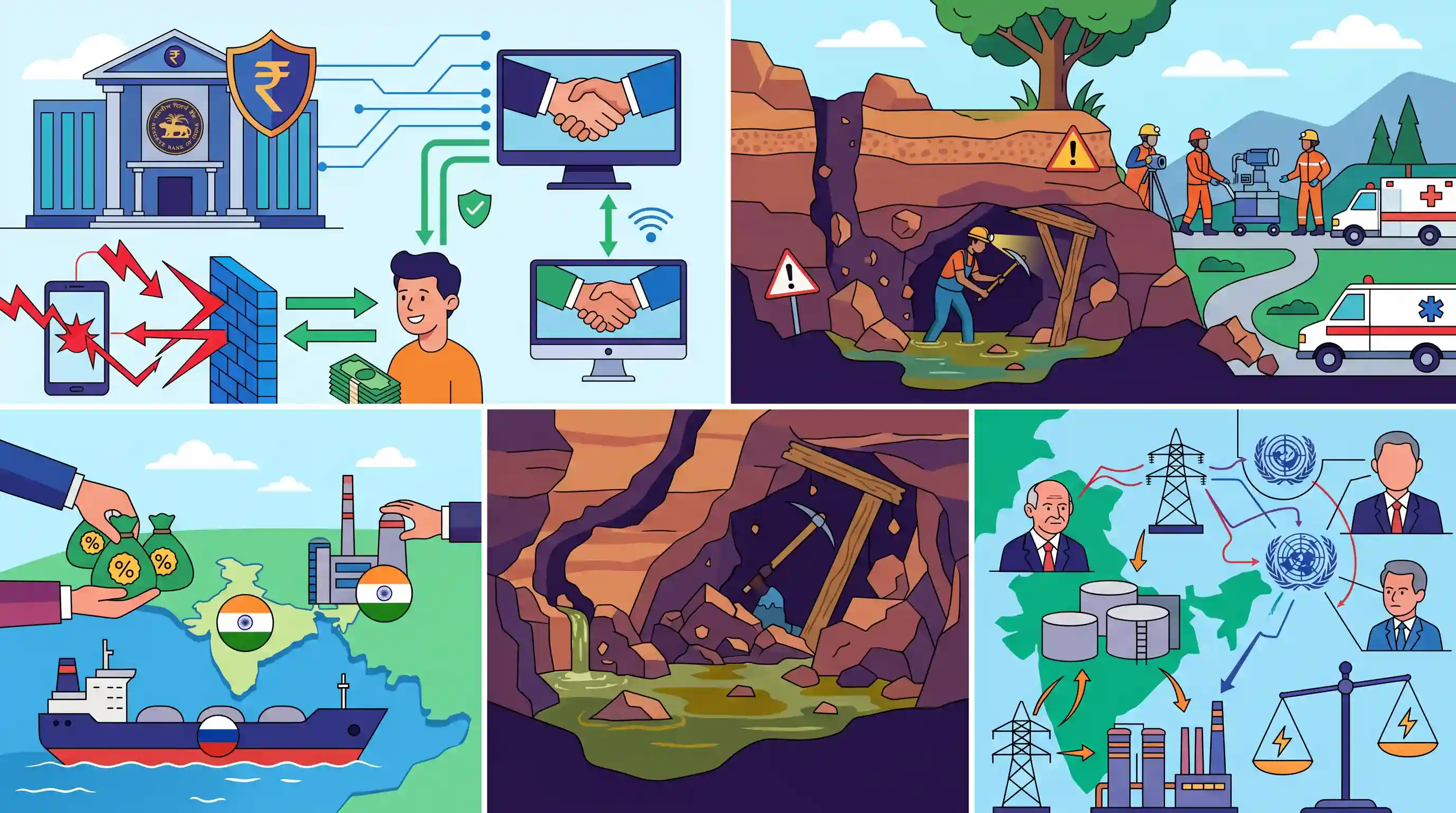
The article covers three key issues for UPSC aspirants: the RBI's initiative to compensate victims of digital financial frauds to boost cybersecurity and consumer trust, the environmental and disaster management concerns surrounding the banned practice of rat-hole mining (recently utilized in the Silkyara rescue), and the geopolitical implications of India's sustained imports of discounted Russian oil for energy security.
Key Points
- The RBI is working on a framework to compensate victims of digital payment frauds, enhancing consumer protection and trust in digital transactions.
- Rat-hole mining, an unscientific and hazardous coal extraction method banned by the NGT, gained attention due to the involvement of its experts in the Silkyara tunnel rescue, highlighting gaps between regulations and enforcement.
- India continues to import discounted Russian crude oil to secure its domestic energy needs, demonstrating a pragmatic foreign policy despite Western sanctions.
Important Terms
Reserve Bank of India (RBI)

India's central bank and regulatory body responsible for regulating the Indian banking system and managing the country's main payment systems and monetary policy.
UPSC context
GS Paper 3: Indian Economy; GS Paper 2: Statutory bodies and governance. Tests understanding of regulatory interventions for consumer protection and financial stability.
National Green Tribunal (NGT)
A statutory body established under the NGT Act (2010) for the effective and expeditious disposal of cases relating to environmental protection and conservation of forests.
UPSC context
GS Paper 3: Environment and Disaster Management. Tests knowledge of environmental jurisprudence and the role of quasi-judicial bodies in sustainable development.
Rat-hole Mining
A primitive and hazardous manual method of extracting coal through narrow tunnels, banned by the NGT in 2014 due to safety and environmental risks.
UPSC context
GS Paper 3: Environment, Internal Security, and Disaster Management. Relevant for topics on illegal mining, labor safety, and unconventional rescue operations.
Deposit Education and Awareness (DEA) Fund
An RBI-managed fund comprising unclaimed deposits (idle for 10+ years), now proposed to finance compensation for victims of small-value digital financial frauds.
UPSC context
GS Paper 3: Economy. Tests awareness of specific financial mechanisms for consumer welfare and banking regulation.
Strategic Autonomy
A foreign policy doctrine where a state makes independent decisions based on national interest, balancing competing geopolitical pressures while maintaining energy and economic security.
UPSC context
GS Paper 2: International Relations. Essential for discussing India's position on Russian oil imports and its interactions with global powers like the US.
Cybersecurity
Provisions and actions to protect computer systems and networks from information disclosure, theft, or damage; a key pillar of India's Digital India mission.
UPSC context
GS Paper 3: Internal Security and Science & Tech. Focuses on the challenges of a digital economy and the state's role in mitigating cyber-crimes.
Prelims Trap
RBI's Zero Liability Framework provides unconditional compensation to customers for any financial loss due to digital payment frauds.
Compensation is not unconditional. The customer is only fully shielded if they report the unauthorized transaction promptly (usually within 3 days) and there is no negligence (like sharing OTPs).
Static Concepts Connected
What is Rat-hole mining and why did the NGT ban it?
- Unscientific extraction: Manual extraction of coal from narrow, unengineered horizontal tunnels. It is primarily seen in Meghalaya due to extremely thin coal seams making open-cast mining unviable.
- Acid Mine Drainage: Causes severe ecological degradation, notably Acid Mine Drainage (AMD), which heavily pollutes local water bodies (like the Lukha and Kopili rivers) and degrades soil.
- Safety hazards: Poses extreme risks of roof collapse, asphyxiation, and flooding, operating entirely without standard mining safety protocols or environmental clearances.
What dictates customer liability in unauthorized digital transactions?
- Zero Liability Framework: A customer bears no loss if the deficiency is on the bank's part, or if a third-party fraud is reported to the bank within three working days.
- Customer Negligence: If the loss is due to customer negligence (e.g., sharing OTPs or payment credentials), the customer bears the entire loss until the unauthorized transaction is officially reported.
Cross-Topic Patterns
Rat-hole mining & Sixth Schedule rights
The persistence of illegal mining in Meghalaya highlights the governance friction between national environmental tribunals (NGT mandates) and community land ownership rights protected under the Sixth Schedule.
Discounted oil & Strategic Autonomy
India's continued purchase of Russian crude despite Western sanctions illustrates the doctrine of principled pragmatism, prioritizing domestic macroeconomic stability and energy security over bloc politics.

Expect a 2026 Prelims multi-statement question linking Rat-hole mining to Acid Mine Drainage and Sixth Schedule land ownership exemptions.
Linked PYQs · 3
Linked PYQs · 3
- 2020MainsGS3
Discuss different types of cyber crimes and measures required to be taken to fight the menace.
- 2025MainsGS3
Mineral resources are fundamental to the country's economy and these are exploited by mining. Why is mining considered an environmental hazard? Explain the remedial measures required to reduce the environmental hazard due to mining.
- 2025MainsGS2
"Energy security constitutes the dominant kingpin of India's foreign policy, and is linked with India's overarching influence in Middle Eastern countries.” How would you integrate energy security with India's foreign policy trajectories in the coming years?
