Defense Procurement and Carbon Markets in Indian Policy
Source:Indian Express ↗
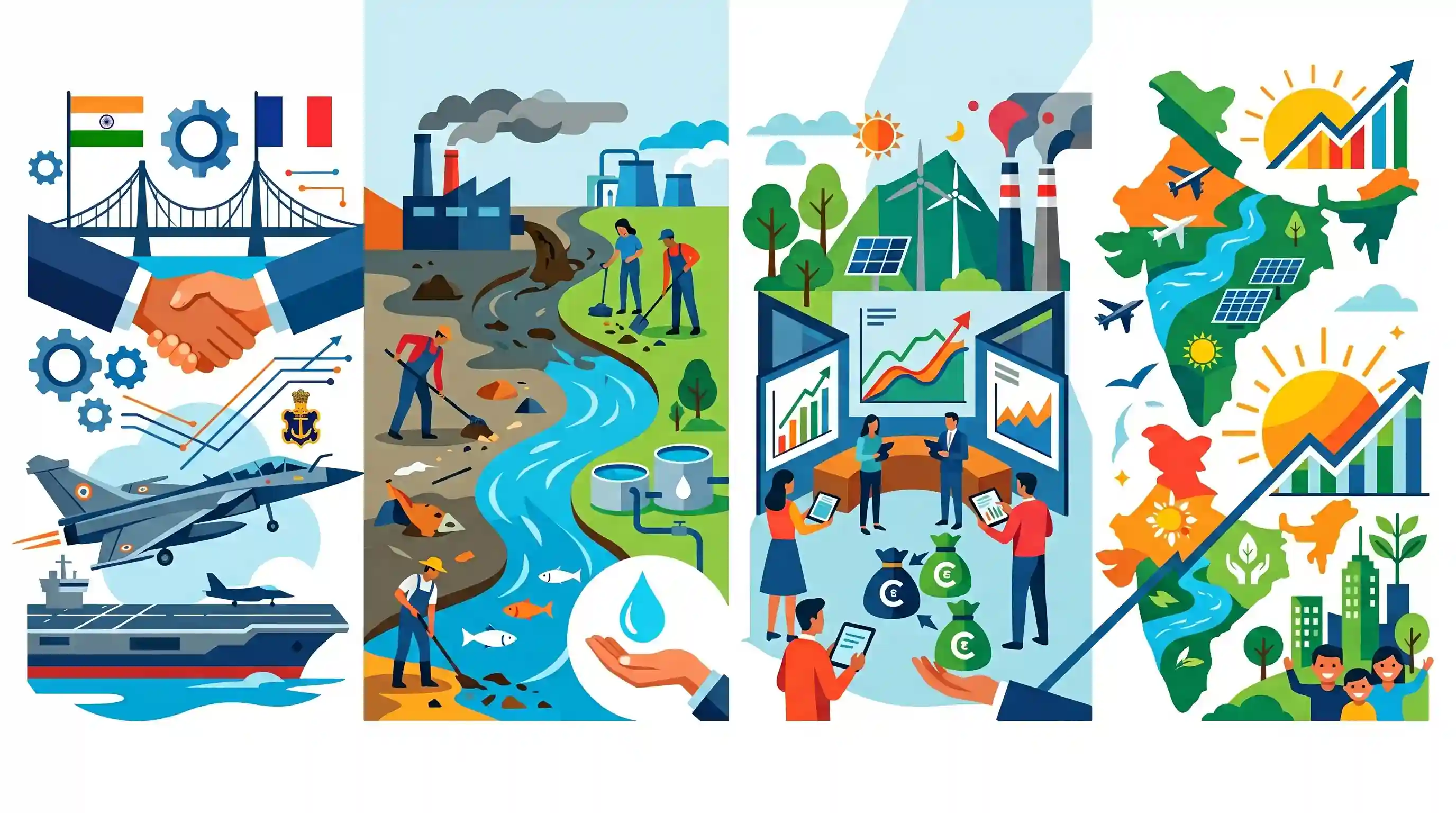
Why It Matters
These topics are highly relevant for UPSC as they cover crucial pillars of the GS Syllabus: defense modernization and self-reliance, environmental conservation efforts (cleaning major rivers), and contemporary climate strategies (carbon markets) needed to meet global commitments.
Summary
This edition of UPSC Key highlights three major topics: the strategic Rafale-M fighter jet deal for the Indian Navy signifying deep India-France defense ties, the role of the National Mission for Clean Ganga (NMCG) in mitigating river pollution under the Namami Gange initiative, and the institutional framework of the Carbon Credit Trading Scheme (CCTS) 2023 designed to create a domestic carbon market to meet India's climate targets.
Key Points
- The acquisition of Rafale-M fighters is expected to enhance the operational capabilities of the Indian Navy, furthering India's strategic defense partnership with France.
- The National Mission for Clean Ganga (NMCG) acts as the implementation wing of the National Ganga Council, focusing on pollution abatement and rejuvenation of the river Ganga through the Namami Gange programme.
- The Carbon Credit Trading Scheme (CCTS), 2023 was notified to establish a domestic carbon market in India, aiming to incentivize emissions reduction and help achieve India's Nationally Determined Contributions (NDCs) under the Paris Agreement.
Important Terms
Rafale-M Deal

A ₹63,000-crore Inter-Governmental Agreement between India and France for 26 naval fighter jets. These 4.5-generation aircraft will operate from INS Vikrant, supplementing the ageing MiG-29K fleet to enhance maritime strike capabilities.
UPSC context
GS Paper III: Internal Security/Defence. Tests knowledge of strategic partnerships, indigenization, and naval aviation modernization.
Carbon Credit Trading Scheme (CCTS), 2023
A market-based framework notified in 2023 to establish an Indian Carbon Market (ICM). It mandates energy-intensive industries to meet emission intensity targets through tradable Carbon Credit Certificates (CCC).
UPSC context
GS Paper III: Environment/Economy. Tests understanding of carbon pricing mechanisms and India's Net Zero 2070 strategy.
Namami Gange Programme
An integrated conservation mission launched in 2014 to achieve the twin objectives of effective pollution abatement and rejuvenation of the National River Ganga through sewage treatment and biodiversity restoration.
UPSC context
GS Paper III: Environmental Pollution/Degradation. Tests knowledge of integrated river basin management and flagship restoration missions.
National Mission for Clean Ganga (NMCG)
The implementation arm of the National Ganga Council, established in 2011. It manages the execution of projects under the Namami Gange Programme to restore the river's ecological health.
UPSC context
GS Paper II: Statutory/Regulatory Bodies. Tests understanding of the institutional framework for environmental governance.
Bureau of Energy Efficiency (BEE)
A statutory body under the Ministry of Power that promotes energy efficiency. It serves as the administrator for the CCTS, identifying eligible sectors and issuing carbon credit certificates.
UPSC context
GS Paper II/III: Governance and Environment. Tests knowledge of executive bodies implementing energy-climate policies.
Paris Agreement
A legally binding international treaty (2015) where Article 6 enables market-based cooperation between countries. This allows for trading carbon credits to help meet Nationally Determined Contributions (NDCs).
UPSC context
GS Paper III: Environment. Tests awareness of global climate treaties and the intersection of trade and environmental policy.
Ministry of Environment, Forest and Climate Change (MoEFCC)
The nodal ministry for India’s climate policy that co-chairs the Steering Committee for the carbon market. It is responsible for notifying specific greenhouse gas emission reduction targets for industries.
UPSC context
GS Paper II: Governance/Executive. Tests knowledge of ministerial roles in environmental law and international negotiations.
Prelims Trap
The Carbon Credit Trading Scheme 2023 derives its statutory mandate from the Environment Protection Act, 1986.
False. It is notified under the Energy Conservation Act, 2001 (amended in 2022) and administered by the Bureau of Energy Efficiency under the Ministry of Power.
Static Concepts Connected
How does the Carbon Credit Trading Scheme (CCTS) differ from the PAT scheme?
- PAT Scheme: Focused strictly on reducing Specific Energy Consumption (SEC) targets for specific energy-intensive industrial sectors.
- CCTS Shift: Transitions from merely improving energy efficiency to directly reducing overall Greenhouse Gas (GHG) emission intensity through tradable certificates.
- Statutory Link: Both operate under the framework of the Energy Conservation Act, 2001, utilizing the Bureau of Energy Efficiency (BEE).
What is the institutional hierarchy for river Ganga rejuvenation?
- Apex Body: The National Ganga Council (NGC), chaired by the Prime Minister, replaced the NGRBA and sets the overarching policy framework.
- Executing Wing: The National Mission for Clean Ganga (NMCG), registered as a society under the 1860 Act, acts as the implementation arm.
Cross-Topic Patterns
CCTS as a shield against EU CBAM
India's domestic carbon market is a strategic defense against the EU's Carbon Border Adjustment Mechanism (CBAM). Transparent domestic carbon pricing helps Indian exporters avoid punitive external carbon taxes.
Naval aviation and Quad interoperability
Procuring the Rafale-M signals India's shift from legacy Russian platforms (MiG-29K) toward Western carrier-borne fighters, enhancing maritime interoperability with French and Quad navies in the Indo-Pacific.

Expect a 2026 prelims question contrasting the statutory roots of CCTS (Energy Conservation Act) vs Green Credit Program (EPA 1986).
Linked PYQs · 5
Linked PYQs · 5
- 2015MainsGS3
Discuss the Namami Gange and National Mission for Clean Ganga (NMCG) programmes and causes of mixed results from the previous schemes. What quantum leaps can help preserve the river Ganga better than incremental inputs?
- 2024MainsGS3
Industrial pollution of river water is a significant environmental issue in India. Discuss the various mitigation measures to deal with this problem and also the government's initiatives in this regard.
- 2013MainsGS3
Enumerate the National Water Policy of India. Taking river Ganges as an example, discuss the strategies which may be adopted for river water pollution control and management. What are the legal provisions of management and handling of hazardous wastes in India?
- 2025PrelimsGS1
Consider the following statements : Statement I: Article 6 of the Paris Agreement on climate change is frequently discussed in global discussions on sustainable development and climate change. Statement II: Article 6 of the Paris Agreement on climate change sets out the principles of carbon markets. Statement III : Article 6 of the Paris Agreement on climate change intends to promote inter-country non-market strategies to reach their climate targets. Which one of the following is correct in respect of the above statements?
- 2014MainsGS3
Foreign Direct Investment (FDI) in the defence sector is now set to be liberalized. What influence this is expected to have on Indian defence and economy in the short and long run?
