Radiocarbon Dating Census Data and Workplace Justice
Source:Indian Express ↗
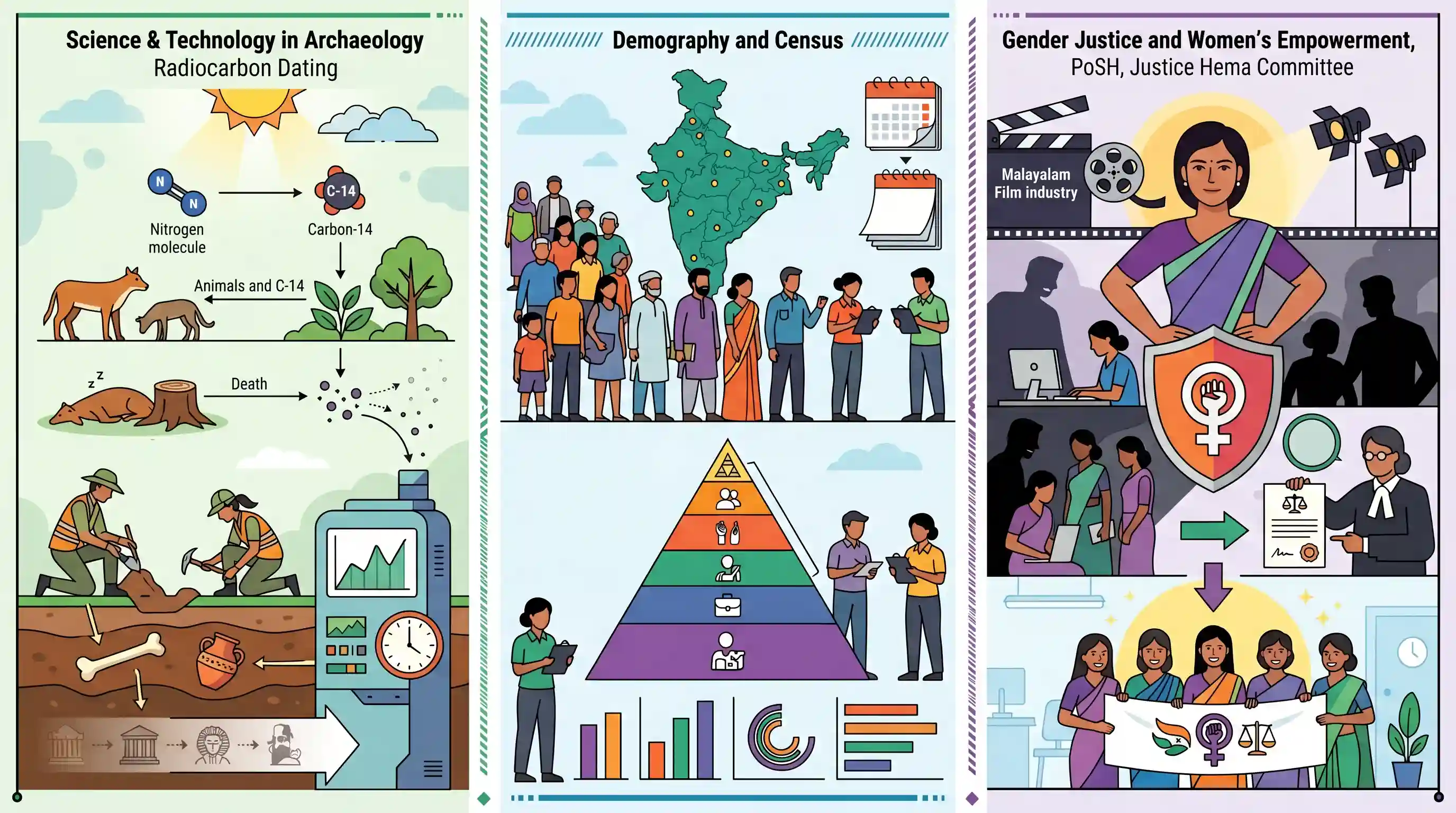
Why It Matters
Provides a multi-disciplinary perspective crucial for UPSC: scientific applications in history (Prelims/GS3), demographic and social data governance (GS1/GS2), and contemporary issues of women's safety and gender equity at the workplace (GS1/GS2/GS4).
Summary
The article covers three diverse and significant topics for UPSC preparation. First, it explores the scientific principles of Radiocarbon dating, a vital tool in archaeology for estimating the age of organic remains. Second, it highlights the importance of the decadal Census in India, touching upon demographic data collection and the socio-political demands for a caste census. Third, it examines the Justice Hema Committee report, which has brought to light the systemic sexual harassment, gender discrimination, and poor working conditions faced by women in the Malayalam film industry, raising critical questions about workplace safety and gender justice.
Key Points
- Radiocarbon dating (Carbon-14 dating) is a critical scientific method used in archaeology to determine the age of organic materials by measuring the decay of the radioactive isotope C-14.
- The decadal Census is fundamental for demographic analysis, delimitation, and welfare distribution, with ongoing debates emphasizing the need for a socio-economic caste census to ensure equitable resource allocation.
- The Justice Hema Committee report exposed deeply entrenched patriarchy, systemic sexual harassment, and the lack of basic workplace amenities for women in the Malayalam film industry.
- The findings from the Hema Committee underscore the urgent need for stringent enforcement of the PoSH Act and institutional mechanisms to ensure gender justice and safe working environments in unorganized and creative sectors.
Important Terms
PoSH Act (Sexual Harassment of Women at Workplace Act, 2013)

A 2013 law mandating workplaces to prevent and redress sexual harassment. It requires an Internal Complaints Committee (ICC) in organizations with 10+ employees, rooted in the Supreme Court's Vishakha Guidelines.
UPSC context
GS Paper 2 (Social Justice/Laws for Vulnerable Sections) and Paper 4 (Ethics). Tests understanding of workplace rights and statutory grievance mechanisms.
Justice Hema Committee
A three-member committee established by the Kerala government in 2017 to investigate sexual harassment and gender disparity in the Malayalam film industry; its 2024 release sparked national debate on workplace safety.
UPSC context
GS Paper 1 (Role of Women) and GS Paper 2 (Governance). Relevant for questions on gender justice and systemic workplace exploitation.
Registrar General and Census Commissioner of India
A statutory office under the Ministry of Home Affairs responsible for conducting the decennial Census and managing the Civil Registration System (births/deaths) under the Census Act, 1948.
UPSC context
GS Paper 2 (Governance/Statutory Bodies). Vital for questions on demography, data-driven policymaking, and the administrative machinery of the Census.
Radiocarbon dating
A scientific method using the decay of the radioactive isotope Carbon-14 to determine the age of organic materials. It is a key tool for dating archaeological finds like fossils.
UPSC context
GS Paper 3 (Science and Technology). Tests application of scientific methods in history and archaeology, including high-profile cases like the Gyanvapi mosque survey.
Caste Census
An enumeration of the population based on caste identities. While the decadal census traditionally counts only SCs and STs, there are rising socio-political demands for a comprehensive pan-India caste-wise headcount.
UPSC context
GS Paper 2 (Polity/Social Justice). Relates to affirmative action, reservation policies, and the debate over the Socio-Economic Caste Census (SECC).
Prelims Trap
Under the PoSH Act, unorganized sector workers must file sexual harassment complaints with the State Women's Commission.
The Act actually mandates a district-level Local Committee (LC) to handle complaints from the unorganized sector or workplaces with fewer than 10 employees.
Static Concepts Connected
How does Carbon-14 dating work and what are its limitations?
- Mechanism: Measures the ratio of unstable Carbon-14 to stable Carbon-12 in organic matter, which decays at a known, constant rate after an organism dies.
- Material limit: It can only date formerly living, organic materials (wood, bone, shells), not inorganic rocks or metals.
- Age limit: It is only reliable for dating objects up to approximately 50,000 years old, making it useless for dinosaur fossils.
What is the statutory framework and scope of the Indian Census?
- Statutory backing: Conducted under the Census Act of 1948. It is a Union Subject under Article 246 (Seventh Schedule of the Constitution).
- Caste data: Post-independence censuses enumerate only Scheduled Castes and Scheduled Tribes. The last comprehensive census counting all castes was in 1931.
- Confidentiality: Individual data collected under the Census Act is strictly confidential and cannot be used in courts or for targeted welfare delivery.
Cross-Topic Patterns
PoSH Act + Gig Economy Vulnerabilities
The Hema Committee's focus on the unorganized creative sector parallels growing concerns over female gig/platform workers who often fall outside traditional employer-employee definitions for PoSH Act enforcement.
Census Delays + Delimitation + Women's Quota
The ongoing delay in the decadal census directly stalls the constitutional delimitation exercise, which in turn postpones the implementation of the Nari Shakti Vandan Adhiniyam (Women's Reservation Act).

Expect a 2026 prelims statement testing the jurisdiction of Local Committees under the PoSH Act for unorganized sectors and gig workers.
Linked PYQs · 4
Linked PYQs · 4
- 2024PrelimsGS1
Consider the following information (Archaeological Site — State — Description): 1. Chandraketugarh — Odisha — Trading port town 2. Inamgaon — Maharashtra — Chalcolithic site 3. Mangadu — Kerala — Megalithic site 4. Salihundam — Andhra Pradesh — Rock-cut cave shrines In which of the above rows is the given information correctly matched?
- 2023MainsGS1
Why is caste identity in India both fluid and static?
- 2023MainsGS2
Explain the constitutional perspectives of Gender Justice with the help of relevant Constitutional Provisions and case laws.
- 2021MainsGS2
Discuss the desirability of greater representation to women in the higher judiciary to ensure diversity, equity and inclusiveness.
