UPSC Key Focus on Prambanan Temple and Indigenous Astra Missile
Source:Indian Express ↗
Why It Matters
The article serves as a high-yield composite revision tool bridging three major UPSC pillars: Art and Culture (influence of Indian temple architecture in Southeast Asia), Internal Security (the evolution of tactics and geographical shifts in proxy wars), and Science and Technology (indigenous missile programs and military self-reliance).
Summary
This article provides a multi-dimensional UPSC review of three distinct syllabus topics: the historic 9th-century Prambanan Hindu temple in Indonesia, representing ancient India's cultural outreach; the shifting dynamics of militancy in Jammu and Kashmir towards the rugged Jammu division; and the technical capabilities and strategic importance of India's indigenous Astra Beyond-Visual-Range Air-to-Air Missile (BVRAAM).
Key Points
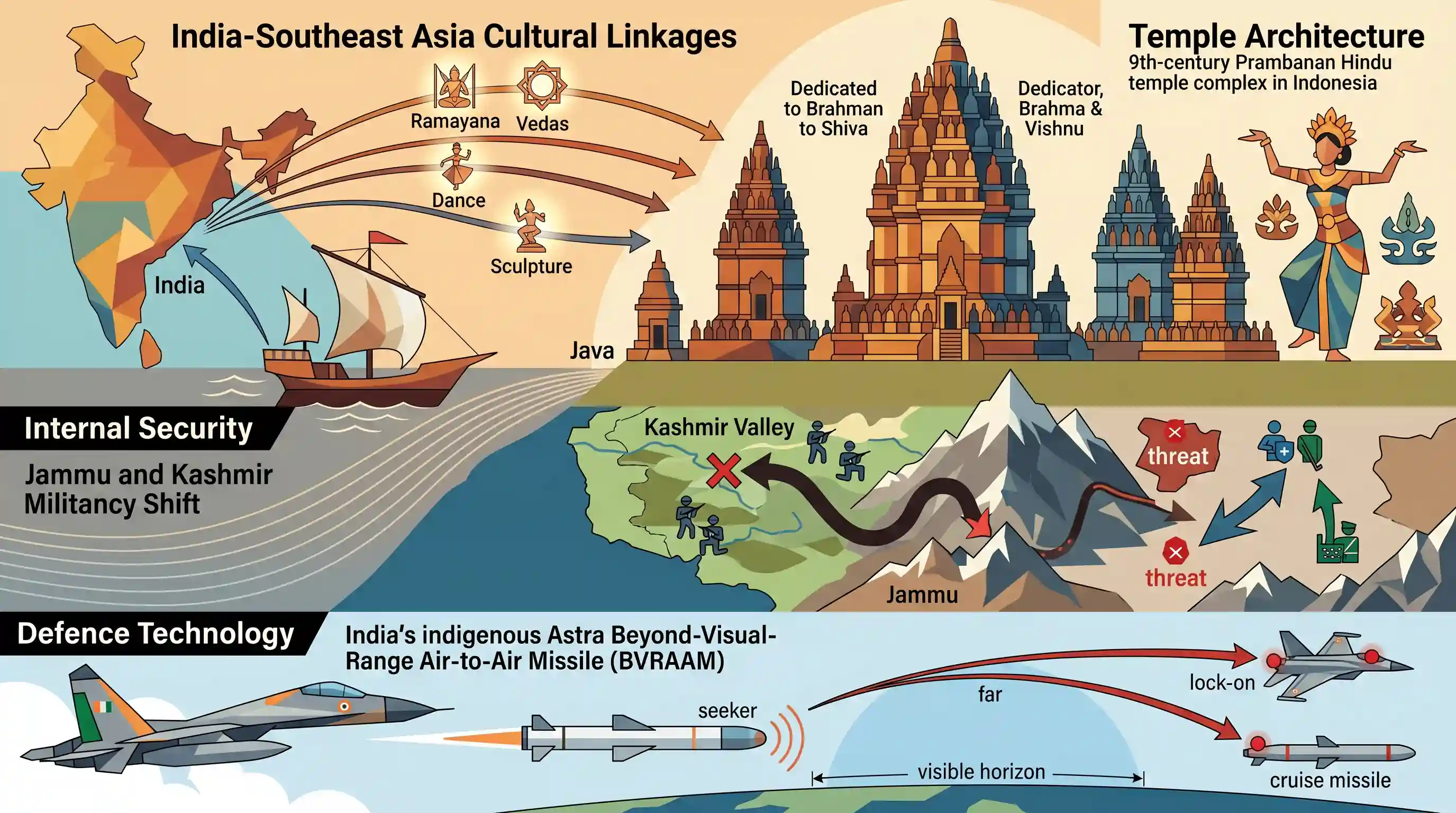
- Prambanan Temple (Art & Culture): Prambanan is a 9th-century Hindu temple compound in Central Java, Indonesia, dedicated to the Trimurti—Shiva, Vishnu, and Brahma. Built by the Sanjaya Dynasty (initiated by Rakai Pikatan and expanded by King Balitung), it represents the peak of Hindu temple architecture in Southeast Asia and is a UNESCO World Heritage Site. Its design follows a mandala plan and contains prominent bas-reliefs detailing the Ramayana and Bhagavata Purana.
- Kashmir's Changing Militancy Landscape (Internal Security): There is a strategic shift in militancy from the Kashmir Valley to the hilly, forested Jammu region (especially Poonch, Rajouri, and Doda). Highly trained foreign terrorists (FTs) equipped with US-made M4 carbines, steel-core armor-piercing bullets, and night-vision scopes are conducting high-altitude ambush operations. This shift seeks to thin out military presence, exploit the challenging terrain, and disrupt local communal harmony. Countermeasures include revitalizing Village Defence Groups (VDGs) and joint multi-agency intelligence grids.
- Astra Missile (Science & Technology / Defence): Astra is India's first indigenous Beyond-Visual-Range Air-to-Air Missile (BVRAAM), developed by DRDO and manufactured by BDL. Operating at supersonic speeds (up to Mach 4.5) with solid-fuel propulsion, it features mid-course inertial guidance and active radar terminal homing. It has been integrated into frontline fighter jets like the Sukhoi-30MKI and LCA Tejas, greatly enhancing stand-off combat capabilities and fostering domestic defense self-reliance (Atmanirbhar Bharat).
Important Terms
Atmanirbhar Bharat Initiative

A flagship government campaign launched in 2020 aiming to make India self-reliant across key sectors, particularly fostering domestic manufacturing, reducing import dependency, and boosting indigenisation in defence production.
UPSC context
GS Paper III (Economy & Security); tests concepts of self-reliance, indigenisation of technology, and domestic defence manufacturing.
Defence Research and Development Organisation (DRDO)
India's premier military research and development agency under the Ministry of Defence, responsible for designing and developing state-of-the-art indigenous defence systems, platforms, and technologies.
UPSC context
GS Paper III (Science & Technology); tests indigenisation of technology and development of indigenous military hardware.
Bharat Dynamics Limited (BDL)
A public sector undertaking under India's Ministry of Defence that manufactures guided weapon systems, missiles, and allied defence equipment for the Indian Armed Forces.
UPSC context
GS Paper III (Security & Defence); tests defence manufacturing, public sector contributions, and self-reliance in military hardware.
UNESCO
A specialized agency of the United Nations aimed at promoting world peace and security through international cooperation in education, arts, sciences, and culture, designating critical heritage sites globally.
UPSC context
GS Paper I (Art & Culture) and GS II; tests heritage protection and cultural diplomacy.
Indian Air Force (IAF)
The aerial warfare branch of the Indian Armed Forces, responsible for securing Indian airspace, conducting aerial operations, and integrating modern indigenous technologies.
UPSC context
GS Paper III (Security); tests mandates, modernisation, and air superiority capabilities of India's security forces.
Indian Army
The land-based branch of the Indian Armed Forces, responsible for guarding land borders and conducting counter-insurgency and counter-terrorism operations, particularly in sensitive regions like Jammu and Kashmir.
UPSC context
GS Paper III (Internal Security); tests roles, mandates, and operational challenges of security forces in border management.
Prelims Trap
The revamped Village Defence Guards (VDG) scheme only pays the leading Special Police Officer, leaving other members unpaid.
The 2022 scheme reformed the 1995 VDC model; now all armed civilian volunteers receive a regular monthly stipend of ₹4,000–₹4,500.
Static Concepts Connected
What are the structural similarities between Javanese and Indian Hindu temples?
- Mandala Alignment: Both Javanese candis (like Prambanan) and Indian temples utilize the cosmic Vastu Purusha Mandala layout to designate sacred spaces.
- Verticality: Prambanan features highly elevated central towers resembling Mount Meru, akin to the Nagara Shikhara, but exhibits distinct local Javanese step-pyramid styling.
- Iconography: Temples display classical Indian deities like Shiva Mahadeva and Durga, integrated with Javanese cultural styles and local stone-carving aesthetics.
What is the difference between active and passive missile guidance systems?
- Active Guidance: The missile carries its own radar transmitter and receiver to lock onto and track the target autonomously (fire-and-forget).
- Passive Guidance: The missile does not emit radiation; it homes in on external signatures like heat (infra-red) or radio emissions from the target.
- Semi-Active Guidance: The missile detects radar waves bounced off the target by the launch aircraft's radar, requiring continuous external illumination.
Cross-Topic Patterns
Chola maritime influence and Act East
Historical trade with Southeast Asia under the Cholas and Sailendras matches modern India's strategic push to leverage shared Buddhist-Hindu heritage for Indo-Pacific alignment.
Community policing and asymmetrical security
Leveraging local VDGs in difficult mountain terrains reflects similar community-based counter-insurgency tactics used in Northeast India's anti-separatist operations.

Astra's terminal active radar seeker technology and VDG's modified payment structures will likely be tested in 2026 Prelims.
Linked PYQs · 3
Linked PYQs · 3
- 2019MainsGS3
The banning of 'Jamaat-e-Islami' in Jammu and Kashmir brought into focus the role of over-ground workers (OGWs) in assisting terrorist organizations. Examine the role played by OGWs in assisting terrorist organizations in insurgency affected areas. Discuss measures to neutralize influence of OGWs.
- 2021MainsGS3
Analyse the multidimensional challenges posed by external state and non-state actors, to the internal security of India. Also discuss measures required to be taken to combat these threats.
- 2023PrelimsGS1
Consider the following statements: 1. Ballistic missiles are jet-propelled at subsonic speeds throughout their flights, while cruise missiles are rocket-powered only in the initial phase of flight. 2. Agni-V is a medium-range supersonic cruise missile, while BrahMos is a solid-fuelled intercontinental ballistic missile. Which of the statements given above is/are correct?
