Police Commemoration Day, Delhi smog and NCM mandate
Source:Indian Express ↗
Why It Matters
Connects critical current affairs across diverse GS domains—ranging from the operational history of internal security forces (GS3) and urban environmental crises (GS3) to the statutory protections available for minority communities (GS2).
Summary
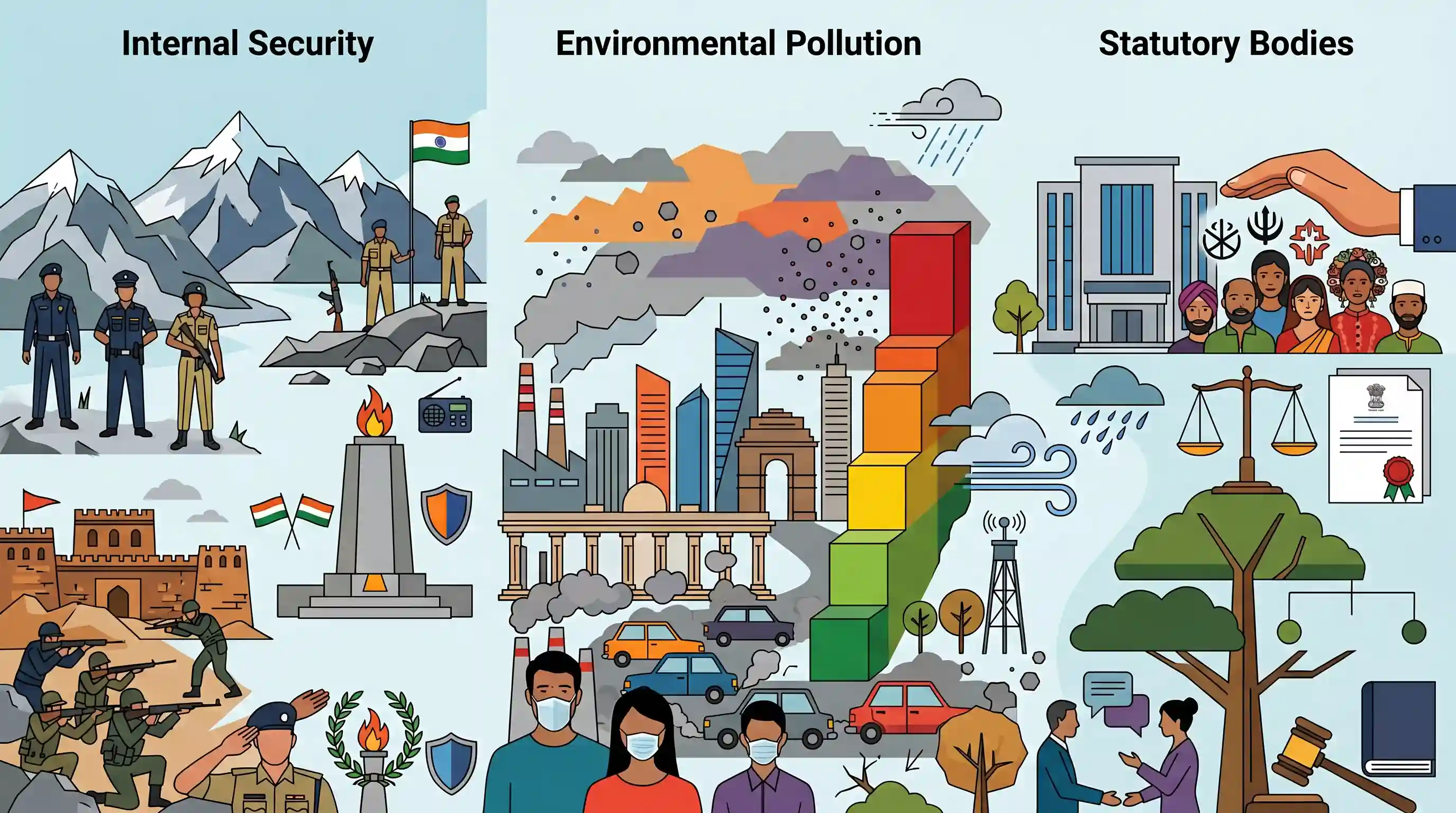
This edition covers three major themes across internal security, environment, and governance: Police Commemoration Day, Delhi's air pollution, and the National Commission for Minorities (NCM). It details the historical significance of the 1959 Hot Springs ambush in Ladakh, underlining the ongoing sacrifices of CAPF personnel in maintaining national security. On the environmental front, it explores the administrative measures, including the Graded Response Action Plan (GRAP), deployed to combat the severe smog and particulate matter spikes in Delhi during winter. Finally, it outlines the statutory framework of the NCM, highlighting its mandate to safeguard the rights of notified minority communities and comparing its powers with constitutional bodies.
Key Points
- Police Commemoration Day (October 21) honors the 1959 CRPF martyrs at Hot Springs, Ladakh, emphasizing the vital role of Central Armed Police Forces (CAPFs) in India's internal and border security.
- Delhi's recurring winter air pollution crisis triggers the Graded Response Action Plan (GRAP) overseen by CAQM, targeting vehicular emissions, dust, and agricultural stubble burning to manage deteriorating AQI.
- The National Commission for Minorities (NCM) functions as a statutory body under the NCM Act of 1992 to protect and evaluate the progress of India's six notified religious minorities.
- Unlike the NCSC or NCST, the NCM lacks constitutional status, which often limits its enforcement powers in addressing minority grievances.
Important Terms
Graded Response Action Plan (GRAP)

An incremental emergency framework activated in Delhi-NCR based on Air Quality Index (AQI) levels. It implements stage-wise measures, from dust control to banning construction, to prevent hazardous pollution spikes.
UPSC context
GS III (Environment); tests urban pollution management and executive-judiciary interaction in environmental governance.
National Commission for Minorities (NCM)
A statutory body established to safeguard the rights of six notified religious minorities. It evaluates development progress, monitors constitutional safeguards, and investigates complaints regarding the deprivation of rights.
UPSC context
GS II (Governance/Social Justice); concerns statutory vs. constitutional bodies and protections for vulnerable sections.
Commission for Air Quality Management (CAQM)
A statutory body created in 2021 for air quality management in Delhi-NCR and adjoining states. It has overarching authority to issue binding directions, override existing laws, and impose penalties.
UPSC context
GS III (Environment); relevant for legislative measures tackling transboundary pollution and centralized environmental administration.
Central Armed Police Forces (CAPF)
A group of seven central police organizations under the Ministry of Home Affairs (MHA) responsible for border guarding, internal security, and counter-insurgency across India.
UPSC context
GS III (Internal Security); essential for questions on security challenges and the role of central forces.
Central Reserve Police Force (CRPF)
India's largest CAPF, primarily tasked with assisting state/UT police in maintaining law and order, counter-insurgency (notably in Naxal-affected areas), and conducting counter-terrorism operations.
UPSC context
GS III (Internal Security); focuses on internal stability and specialized counter-insurgency roles.
Central Pollution Control Board (CPCB)
A statutory organization under MoEFCC, established in 1974. It monitors air and water quality, sets environmental standards, and provides technical services for pollution abatement nationwide.
UPSC context
GS III (Environment); key for understanding India's regulatory framework for pollution control and environmental monitoring.
Prelims Trap
The National Commission for Minorities (NCM) investigates grievances for both religious and linguistic minorities.
The NCM strictly safeguards notified religious minorities. Linguistic minorities are protected by the Special Officer for Linguistic Minorities (a constitutional body under Article 350B).
Static Concepts Connected
What is the institutional framework for minority protection in India?
- Fundamental Rights: Articles 29 and 30 of the Constitution protect the cultural and educational rights of both religious and linguistic minorities.
- Linguistic Minorities: Article 350B establishes a Constitutional Special Officer to investigate safeguards provided for linguistic minorities, distinct from the NCM.
- Religious Minorities: The statutory NCM (1992 Act) safeguards only six notified religious communities: Muslims, Christians, Sikhs, Buddhists, Parsis, and Jains (added in 2014).
How do CAQM's statutory powers differ from the traditional pollution boards?
- Overriding Authority: In case of conflict regarding air quality management in the National Capital Region, CAQM's orders supersede those of the CPCB and State Pollution Control Boards.
- Regional Jurisdiction: Unlike CPCB's nationwide mandate, CAQM explicitly targets the NCR and adjoining areas (Punjab, Haryana, UP, Rajasthan) for concentrated air quality coordination and stubble burning control.
Cross-Topic Patterns
CAQM and asymmetric federalism
CAQM represents a shift from state-centric pollution control boards (CPCB/SPCBs) to a centralized, multi-state statutory authority that overrides state jurisdictions in the NCR to enforce GRAP.
Hot Springs and Eastern Ladakh geography
The 1959 Hot Springs incident context aligns with recent Indo-China standoffs in Eastern Ladakh (Galwan, Pangong Tso, Gogra-Hot Springs), heavily tested in mapping and border infrastructure questions.

Expect a Prelims question contrasting the statutory status of NCM with the constitutional backing of NCBC (Art 338B) and Article 350B.
Linked PYQs · 5
Linked PYQs · 5
- 2023MainsGS3
What are the internal security challenges being faced by India? Give out the role of Central Intelligence and Investigative Agencies tasked to counter such threats.
- 2020MainsGS3
Analyze internal security threats and transborder crimes along Myanmar, Bangladesh and Pakistan borders including Line of Control (LoC). Also discuss the role played by various security forces in this regard.
- 2022PrelimsGS1
In the context of WHO Air Quality Guidelines, consider the following statements: 1. The 24-hour mean of PM2.5 should not exceed 15 µg/m³ and annual mean of PM2.5 should not exceed 5 µg/m³. 2. In a year, the highest levels of ozone pollution occur during the periods of inclement weather. 3. PM10 can penetrate the lung barrier and enter the bloodstream. 4. Excessive ozone in the air can trigger asthma. Which of the statements given above are correct?
- 2016PrelimsGS1
In the cities of our country, which among the following atmospheric gases are normally considered in calculating the value of Air Quality Index? 1. Carbon dioxide 2. Carbon monoxide 3. Nitrogen dioxide 4. Sulfur dioxide 5. Methane Select the correct answer using the code given below.
- 2022MainsGS2
Discuss the role of the National Commission for Backward Classes in the wake of its transformation from a statutory body to a constitutional body.
