CAPF history, Delhi pollution management and NCM framework
Source:Indian Express ↗
Why It Matters
These issues are highly recurrent in UPSC exams. Border skirmishes and the role of CAPFs tie directly into internal security (GS3). Delhi's air quality is a classic environment/governance case study for both Prelims and GS3. Understanding the statutory nature versus constitutional status of bodies like the NCM is a staple for GS2 and Prelims Polity.
Summary
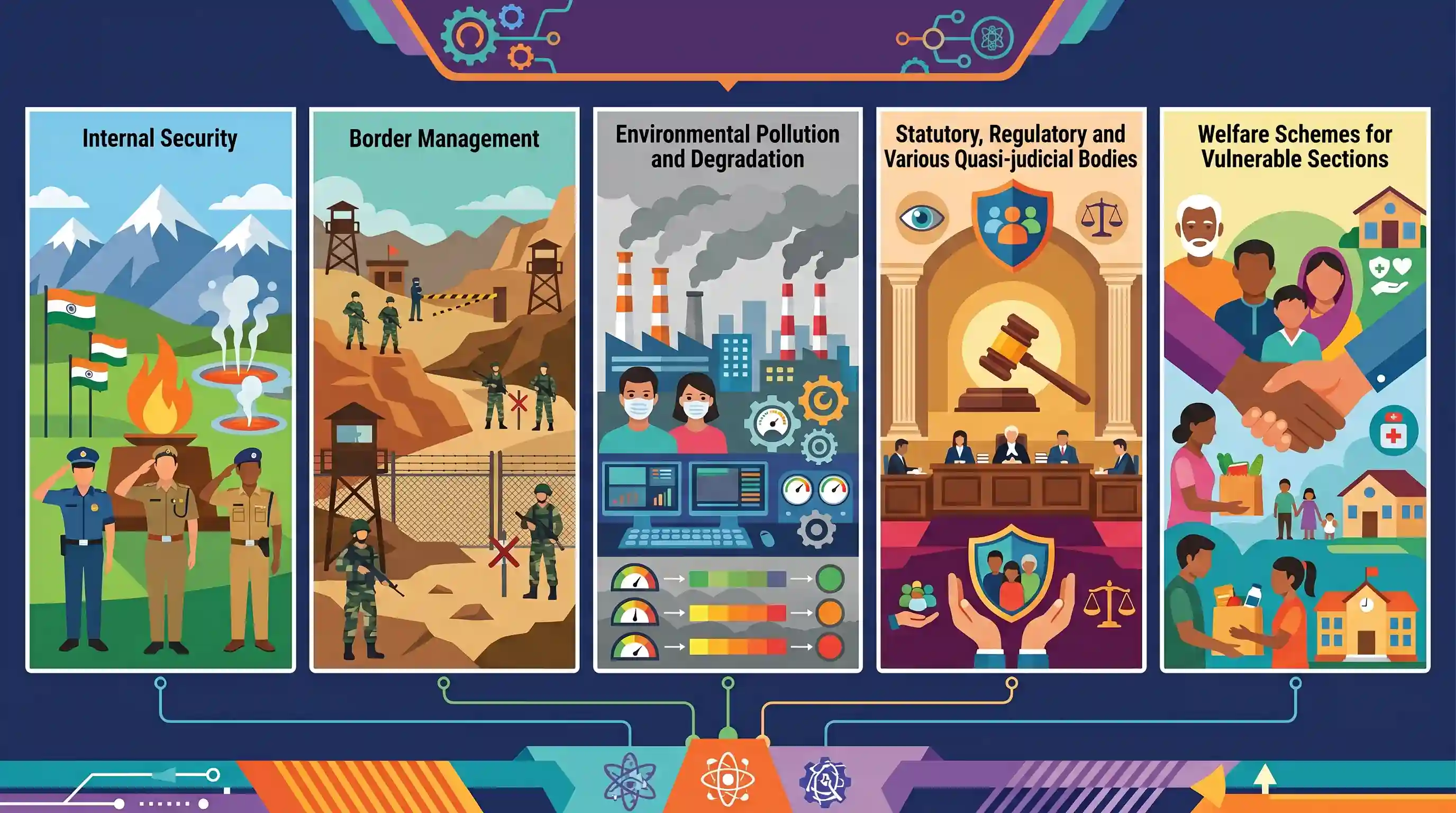
The article highlights key multi-disciplinary topics essential for UPSC preparation. It covers Police Commemoration Day, honoring the historical sacrifices of central and state police forces stemming from the 1959 Hot Springs incident in Ladakh. It also addresses the recurrent environmental crisis of Delhi-NCR air pollution, detailing the regulatory mechanisms of the CAQM and GRAP in mitigating seasonal smog. Furthermore, it outlines the mandate of the National Commission for Minorities (NCM), a statutory body responsible for protecting and advancing the rights of minority communities, bridging critical themes across GS3 (Internal Security, Environment) and GS2 (Governance, Statutory Bodies).
Key Points
- Police Commemoration Day (October 21) honors the sacrifices of police personnel. Its history traces back to a 1959 ambush by Chinese troops on a CRPF patrol at Hot Springs in Ladakh, underscoring border and internal security challenges.
- The recurring winter air pollution crisis in Delhi-NCR is managed by the Commission for Air Quality Management (CAQM), which enforces the Graded Response Action Plan (GRAP) to curb vehicular emissions and stubble burning.
- The National Commission for Minorities (NCM) is a critical statutory body established under the NCM Act of 1992. It is tasked with evaluating the progress and safeguarding the constitutional and legal rights of recognized minority communities in India.
Important Terms
Commission for Air Quality Management (CAQM)

A statutory body established in 2021 to coordinate and oversee air quality management in the National Capital Region (NCR) and adjoining areas, possessing overarching powers to issue binding directions.
UPSC context
Relevant for GS Paper III (Environment) and GS Paper II (Statutory Bodies); focuses on multi-state environmental governance.
Graded Response Action Plan (GRAP)
An emergency response framework for Delhi-NCR that activates specific restrictive measures (Stages I-IV) based on Air Quality Index (AQI) thresholds to prevent further atmospheric deterioration.
UPSC context
Crucial for GS Paper III (Pollution) and Prelims; tests understanding of administrative responses to seasonal environmental crises.
National Commission for Minorities (NCM)
A statutory body established under the 1992 Act to protect the interests and evaluate the development of six notified minority communities (Muslims, Christians, Sikhs, Buddhists, Parsis, and Jains).
UPSC context
Significant for GS Paper II (Governance and Statutory Bodies) and Social Justice topics.
National Clean Air Programme (NCAP)
India's first national framework (launched 2019) to tackle air pollution with time-bound targets, aiming for a 40% reduction in particulate matter concentration in 131 cities by 2026.
UPSC context
Key for GS Paper III (Sustainable Development) and government schemes; covers long-term national pollution strategies.
Central Armed Police Forces (CAPF)
The collective name for seven central security organizations (including BSF, CRPF, and ITBP) under the Ministry of Home Affairs, responsible for internal security and border guarding.
UPSC context
Vital for GS Paper III (Internal Security) and Border Management.
National Commission for Minorities Act, 1992
The legislative framework that transformed the non-statutory Minorities Commission into a statutory body, mandating it to safeguard rights and investigate complaints from minority communities.
UPSC context
Tests legal underpinnings of minority welfare in GS Paper II (Social Justice).
Central Reserve Police Force (CRPF)
India’s largest Central Armed Police Force, primarily tasked with internal security, counter-insurgency, and maintaining public order; its personnel were central to the 1959 Hot Springs incident.
UPSC context
Essential for GS Paper III (Internal Security) regarding the role of paramilitary forces.
Prelims Trap
"The Constitution of India defines 'minority' and establishes the National Commission for Minorities."
The Constitution mentions 'minorities' (Articles 29/30) but does not define the term. Furthermore, the NCM is a statutory body (NCM Act 1992), not a constitutional one.
Static Concepts Connected
What are the statutory powers and mandate of the CAQM?
- Overriding Authority: CAQM directives possess overriding effect over the orders of State Pollution Control Boards in the region.
- Jurisdiction: Its mandate covers the National Capital Region (NCR) and adjoining areas (Punjab, Haryana, Rajasthan, UP) concerning air quality.
- Penal Powers: It has the authority to issue directions, impose fines, and shut down non-compliant, polluting industries.
How are minorities legally recognized in India?
- Constitutional Silence: Articles 29 and 30 protect cultural and educational rights but the Constitution explicitly leaves the term 'minority' undefined.
- Statutory Notification: The Central Government notifies national minorities under the NCM Act 1992. Currently, there are 6 (Muslims, Christians, Sikhs, Buddhists, Parsis, Jains).
- Linguistic vs Religious: The NCM focuses primarily on religious minorities, whereas linguistic minorities are overseen by a Special Officer under Article 350B.
Cross-Topic Patterns
CAQM & Environmental Federalism
CAQM's statutory power to override state pollution control boards creates recurring federal friction between the Centre and NCR states over transboundary environmental regulation.
1959 Ambush & LAC Management
The 1959 Hot Springs incident connects post-independence border history (GS1) with the modern evolution of LAC militarization and the mandate of Central Armed Police Forces (GS3).

Expect a prelims question contrasting the statutory status of the NCM with the constitutional Special Officer for Linguistic Minorities.
Linked PYQs · 5
Linked PYQs · 5
- 2020MainsGS3
Analyze internal security threats and transborder crimes along Myanmar, Bangladesh and Pakistan borders including Line of Control (LoC). Also discuss the role played by various security forces in this regard.
- 2021MainsGS3
Describe the key points of the revised Global Air Quality Guidelines (AQGs) recently released by the World Health Organisation (WHO). How are these different from its last update in 2005? What changes in India's National Clean Air Programme are required to achieve these revised standards?
- 2022PrelimsGS1
In the context of WHO Air Quality Guidelines, consider the following statements: 1. The 24-hour mean of PM2.5 should not exceed 15 µg/m³ and annual mean of PM2.5 should not exceed 5 µg/m³. 2. In a year, the highest levels of ozone pollution occur during the periods of inclement weather. 3. PM10 can penetrate the lung barrier and enter the bloodstream. 4. Excessive ozone in the air can trigger asthma. Which of the statements given above are correct?
- 2022MainsGS2
Discuss the role of the National Commission for Backward Classes in the wake of its transformation from a statutory body to a constitutional body.
- 2023PrelimsGS1
Consider the following organizations/bodies in India: 1. The National Commission for Backward Classes 2. The National Human Rights Commission 3. The National Law Commission 4. The National Consumer Disputes Redressal Commission How many of the above are constitutional bodies?
