Protest regulations and trade agreements shape governance discourse
Source:Indian Express ↗
ఇది ఎందుకు ముఖ్యం
Understanding the limits of fundamental rights versus state police powers is crucial for governance. Multilateral institutions (WTO) and strategic dialogues (Quad) are high-yield areas for Mains GS2 and GS3 questions.
సారాంశం
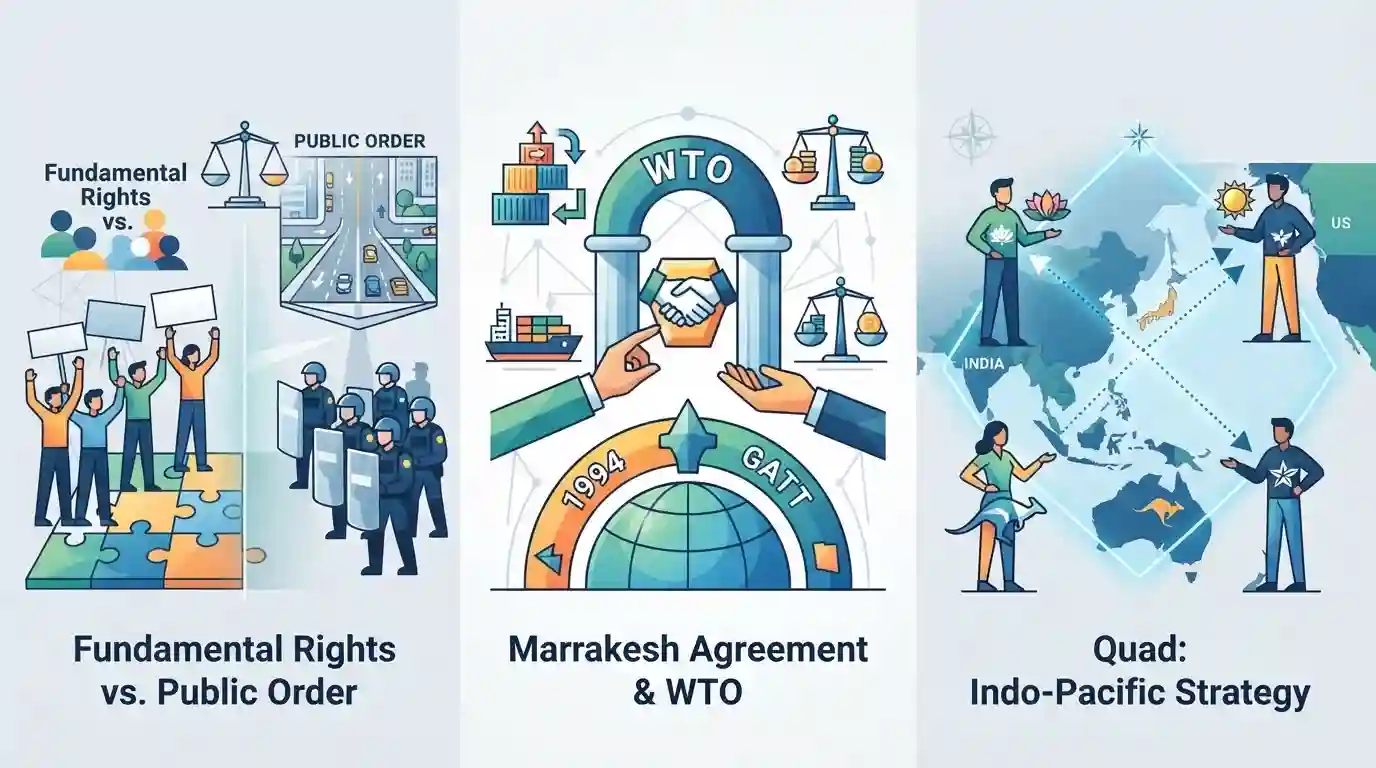
The article discusses three key themes for UPSC aspirants: the constitutional balance between the right to protest and police actions to maintain public order, the historical and economic significance of the Marrakesh Agreement in establishing the WTO, and the strategic evolution of the Quad in the Indo-Pacific region.
ముఖ్య అంశాలు
- The right to peaceful assembly is a fundamental right under Article 19(1)(b) of the Constitution, but it is subject to reasonable restrictions under Article 19(3) for maintaining public order.
- Police actions and Standard Operating Procedures (SOPs) dictate the use of proportional and non-lethal force to balance human rights with crowd control during protests.
- The Marrakesh Agreement primarily refers to the 1994 treaty that established the World Trade Organization (WTO), replacing the GATT framework, though it can also refer to the 2013 WIPO treaty for the visually impaired.
- The Quad (Quadrilateral Security Dialogue) has evolved from a maritime security grouping into a broader strategic partnership addressing critical technologies, supply chains, and a free and open Indo-Pacific.
ముఖ్యమైన పదాలు
Article 19 of the Indian Constitution

A fundamental constitutional provision guaranteeing key civil liberties, including freedom of speech and expression and peaceful assembly, which underpin the right to protest, subject to reasonable restrictions.
UPSC context
GS Paper II (Polity). Tests understanding of fundamental rights, civil liberties, and balancing the right to protest with public order.
Marrakesh Agreement
A multilateral treaty signed in Morocco in 1994, concluding the Uruguay Round of trade negotiations and formally establishing the World Trade Organization (WTO) on January 1, 1995.
UPSC context
GS Paper II/III (IR/Economy). Tests knowledge of WTO's origin, global trade governance, and the evolution of multilateral agreements.
Quad
An informal diplomatic and security partnership of India, the United States, Japan, and Australia, committed to fostering a free, open, stable, and prosperous Indo-Pacific region.
UPSC context
GS Paper II (Global Groupings). Tests understanding of Indo-Pacific geopolitics, maritime domain awareness, and strategic plurilateral alliances.
World Trade Organization (WTO)
An international organization established in 1995 that regulates, facilitates, and arbitrates global trade among nations, ensuring smooth and predictable trade flows based on multilateral agreements.
UPSC context
GS Paper II/III (International Institutions/Economy). Tests knowledge of trade disputes, global subsidies, and multilateral trading regimes.
WIPO
A specialized agency of the United Nations established to promote and protect intellectual property worldwide through multilateral cooperation and treaty administration.
UPSC context
GS Paper II/III (International Bodies/IPR). Tests understanding of global intellectual property standards, copyright exceptions, and international agreements.
ప్రిలిమ్స్ ఉచ్చు
The Marrakesh Agreement of 1994 was signed to facilitate copyright exemptions for visually impaired persons globally.
Aspirants frequently confuse the 1994 Marrakesh Agreement (which established the WTO under a 'single undertaking' framework) with the 2013 Marrakesh Treaty (a WIPO-administered treaty for visually impaired persons).
అనుసంధానమైన స్థిర భావనలు
What is the 'Single Undertaking' principle of the WTO?
- Definition: A rule stating that virtually every item of negotiation is part of an indivisible package; members cannot select agreements piecemeal.
- Legal Binding: Requires member countries to accept all constituent agreements annexed to the Marrakesh Agreement, including GATT, GATS, and TRIPS.
How does the Constitution limit restrictions on assembly?
- Narrow Grounds: Article 19(3) permits reasonable restrictions only on two grounds: sovereignty and integrity of India, and public order.
- Proportionality Test: Supreme Court mandates that any state restriction must pass the proportionality test, balancing public safety with fundamental rights.
అంతర-అంశ నమూనాలు
WIPO Marrakesh Treaty + Assistive Tech
Connects global IP frameworks to disability rights under GS2, highlighting how India leverages international treaty exceptions to drive domestic digital accessibility and social welfare programs.
Quad + Supply Chain Resilience
Connects security architecture (GS2) with critical mineral supply chains and tech standardisation (GS3), showcasing how geopolitical coalitions translate into economic decoupling strategies.

2026 Prelims will likely contrast the narrow restriction grounds of Article 19(3) with procedural powers under Section 163 of the new BNSS.
అనుసంధాన PYQలు · 3
అనుసంధాన PYQలు · 3
- 2020MainsGS2
Quadrilateral Security Dialogue (Quad)' is transforming itself into a trade bloc from a military alliance, in present times - Discuss.
- 2023MainsGS3
What are the direct and indirect subsidies provided to farm sector in India? Discuss the issues raised by the World Trade Organization (WTO) in relation to agricultural subsidies.
- 2020MainsGS2
What is the significance of Indo-US defence deals over Indo-Russian defence deals? Discuss with reference to stability in the Indo-Pacific region.
