Current Affairs Highlights Span Diplomacy and Demographics
Source:Indian Express ↗
Why It Matters
This collection bridges multiple high-priority areas of the UPSC syllabus: GS1 (Social Issues & Geography), GS2 (International Relations & Federal Water Disputes), and GS3 (Energy Security & Environmental Degradation), providing crucial multi-dimensional fodder for both Prelims and Mains.
Summary
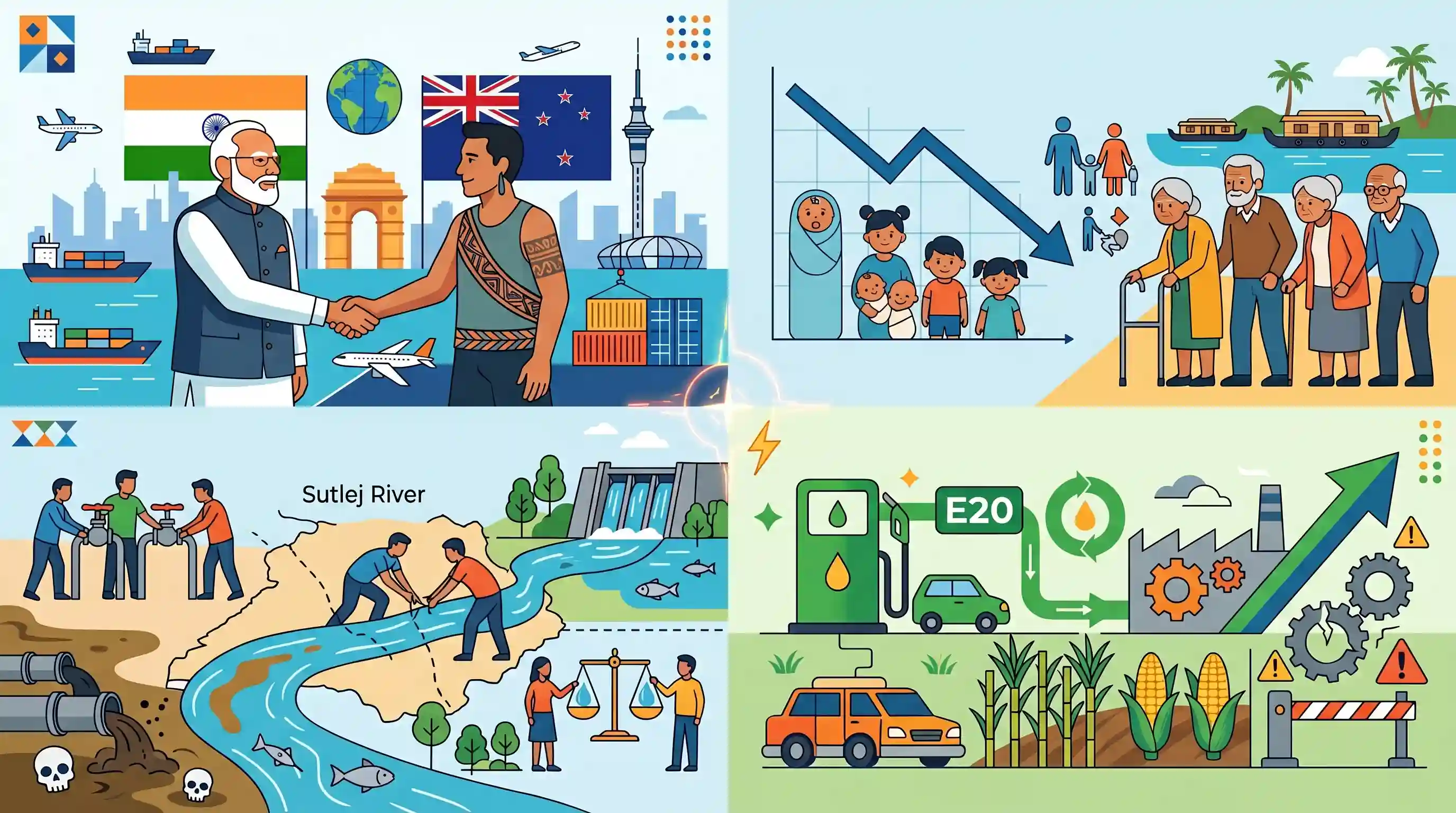
This article compiles crucial multi-dimensional topics for UPSC preparation, featuring PM Modi's diplomatic engagements with New Zealand, Kerala's rapid demographic transition with a declining birth rate, geographical and environmental issues concerning the Sutlej River, and the progress and bottlenecks of India's E20 (Ethanol Blended Petrol) target.
Key Points
- India-New Zealand Bilateral ties: Enhanced focus on trade, agricultural cooperation (dairy, horticulture), climate change, counter-terrorism, and leveraging the 2.4-lakh-strong Indian diaspora for a free and open Indo-Pacific.
- Kerala's Demographic Transition: A sharp decline in the birth rate and TFR below replacement levels (2.1) has accelerated demographic aging. Causes include high literacy, delayed marriages, high cost of living, and youth out-migration, presenting challenges like a shrinking workforce, higher dependency ratios, and geriatric care pressure.
- Sutlej River Issues: The river faces twin challenges of a major interstate water-sharing dispute (Sutlej-Yamuna Link Canal between Punjab and Haryana) and critical environmental degradation due to heavy industrial pollution (especially via Ludhiana's Buddha Nullah) and sewage.
- E20 (Ethanol Blended Petrol): India is advancing towards the 20% ethanol blending target (E20) by 2025-26. Benefits include energy security, reduced oil import bills, and lower emissions, while primary challenges include the 'food vs. fuel' debate (diverting grain/sugarcane) and the water footprint of feedstock crops.
Important Terms
Ethanol Blended Petrol (EBP) Programme

A Government of India initiative launched in 2003 to blend fuel-grade ethanol with petrol, aiming to reduce crude imports, lower vehicular emissions, and provide sugarcane and grain farmers with additional income streams.
UPSC context
GS Paper III (Economy & Environment); tests energy security, sustainable development, and agriculture-industry linkages in Prelims and Mains.
National Policy on Biofuels 2018
A policy framework notified by the Ministry of Petroleum and Natural Gas categorizing biofuels to extend financial incentives, expand raw material sources, and advance ethanol blending targets.
UPSC context
GS Paper III (Environment & Technology); tests classification of biofuels, feedstock regulations, and carbon emission targets.
Sutlej-Yamuna Link (SYL) Canal Project
A proposed 214-kilometer-long canal connecting the Sutlej and Yamuna rivers to share water between Punjab and Haryana, remaining a subject of major inter-state legal disputes.
UPSC context
GS Paper II (Polity & Governance); tests federal water disputes, constitutional provisions (Article 262), and river-linking geography.
Free Trade Agreement (FTA)
A pact between countries to reduce or eliminate tariffs and non-tariff barriers, facilitating cross-border trade, investment protection, and economic integration in goods and services.
UPSC context
GS Paper II (International Relations) & III (Economy); tests trade diplomacy, rules of origin, and global supply chains.
Prelims Trap
Article 262 completely bars the Supreme Court from entertaining any litigation related to inter-state river water disputes or canal construction.
Article 262 bars adjudication of the water sharing dispute itself. However, the Supreme Court retains jurisdiction to enforce past decrees, direct canal construction (like the SYL canal), or hear suits under Article 131.
Static Concepts Connected
What is an antecedent river, and which major Indian rivers fall under this category?
- Definition: Rivers that existed before the mountainous relief was uplifted and maintained their course by cutting deep gorges through the rising landform.
- Mechanism: Vertical erosion by the river keeps pace with the tectonic uplift of the mountain range (e.g., Himalayas).
- Key Examples: The Indus, Sutlej, Brahmaputra, Kosi, and Gandak are classic examples of antecedent drainage in India.
What are the different generations of biofuels under the National Policy on Biofuels?
- 1G Biofuels: Produced directly from food sources like sugarcane juice, molasses, starch, corn, and damaged foodgrains.
- 2G Biofuels: Derived from non-food biomass, agricultural residues (stubble, bagasse), and lingo-cellulosic materials.
- 3G & 4G Biofuels: 3G uses microalgae to produce fuels, while 4G employs genetically engineered crops and advanced carbon capture technologies.
Cross-Topic Patterns
Biofuels vs Food Security
Diverting food grains for E20 targets directly impacts buffer stock management, food price inflation, and distribution under the National Food Security Act.
Demography and Fiscal Federalism
States with rapidly declining TFRs face twin challenges: potential loss of parliamentary representation post-delimitation and reduced tax allocations under Finance Commission criteria.

Constitutional bar under Art 262 vs Supreme Court's power to enforce SYL construction under Art 131 is prime for 2026 multi-statement format.
Linked PYQs · 5
Linked PYQs · 5
- 2024MainsGS3
Industrial pollution of river water is a significant environmental issue in India. Discuss the various mitigation measures to deal with this problem and also the government's initiatives in this regard.
- 2013MainsGS1
Critically examine the effect of globalization on the aged population in India.
- 2022MainsGS3
Do you think India will meet 50 percent of its energy needs from renewable energy by 2030 ? Justify your answer. How will the shift of subsidies from fossil fuels to renewables help achieve the above objective ? Explain.
- 2021PrelimsGS1
With reference to the Indus river system, of the following four rivers, three of them pour into one of them which joins the Indus direct. Among the following, which one is such river that joins the Indus direct?
- 2026PrelimsGS1
Identify the river of the Indian sub-continent on the basis of the following information : 1. It has an antecedent drainage system. 2. It flows through three countries. 3. It originates in the Tibetan Plateau and is an important river for irrigation. 4. It does not form distributaries. Select the answer from the following :
