Deep Ocean Mission and Jurisprudential Framework in India
Source:Indian Express ↗
Why It Matters
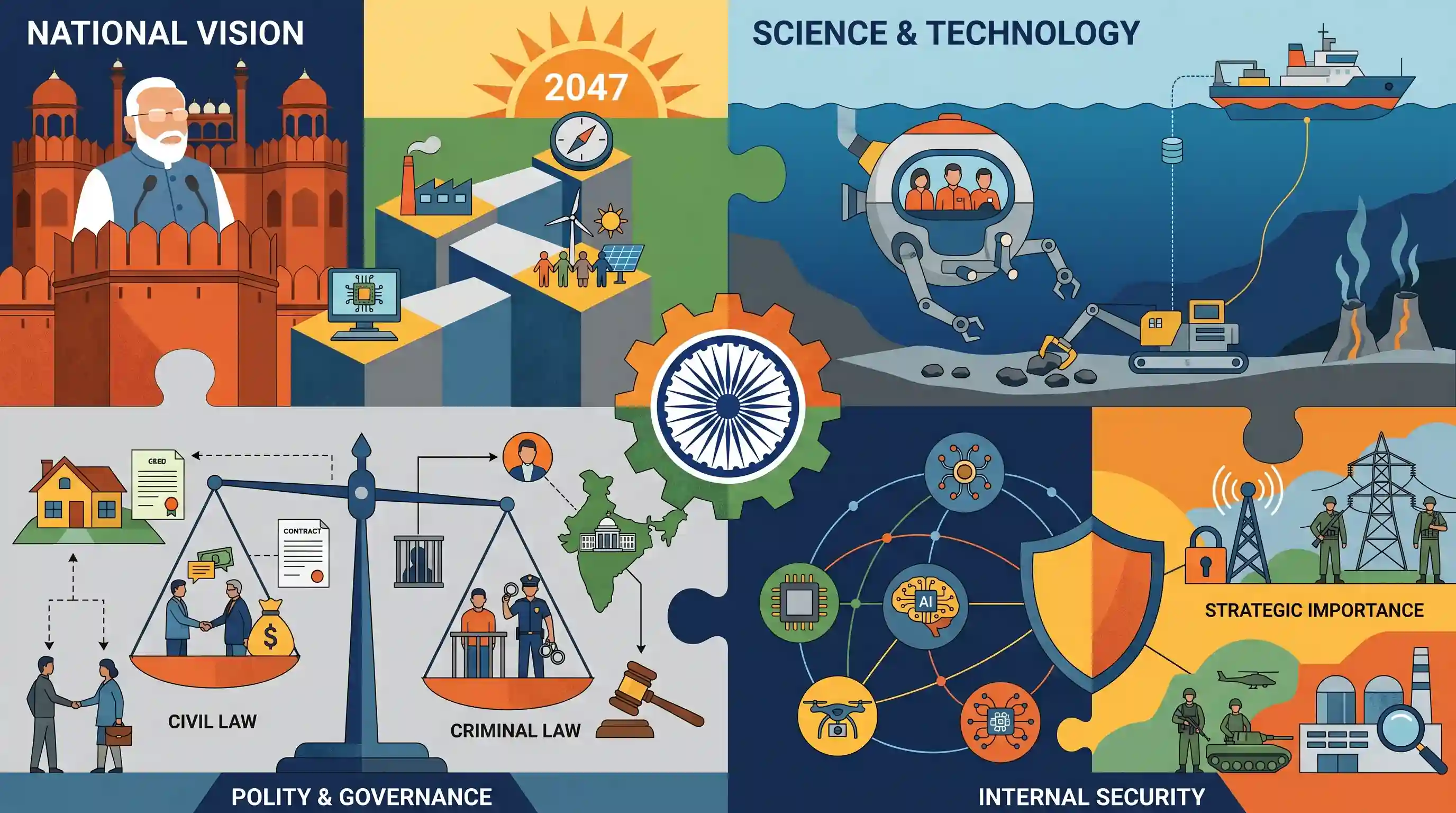
The compilation touches on cross-cutting UPSC themes: the Deep Ocean Mission and critical tech are direct GS3 S&T topics, while the distinction between civil and criminal laws and the Prime Minister's policy addresses feed into GS2 Governance and Essay writing.
Summary
This UPSC Key current affairs article highlights several core topics for civil services aspirants. It covers the developmental vision outlined in the Prime Minister's Independence Day speech. It also details the Deep Ocean Mission (including the Samudrayaan project) for underwater exploration and mining. Furthermore, the article provides a conceptual breakdown of the differences between civil and criminal laws in India, and touches upon the strategic importance of critical and emerging technologies.
Key Points
- The Prime Minister's Independence Day address established key developmental goals and a national vision toward a 'Viksit Bharat' (Developed India).
- The Deep Ocean Mission aims to explore deep-sea resources, including polymetallic nodules, using manned submersibles like MATSYA 6000 under the Samudrayaan initiative.
- The article delineates the foundational differences between civil law (addressing private disputes over property or contracts) and criminal law (handling offenses against society and the state).
- Critical and emerging technologies are positioned as vital drivers for both economic advancement and national security.
Important Terms
Deep Ocean Mission

A flagship initiative by the Ministry of Earth Sciences to explore deep-sea resources and develop indigenous technologies like submersibles for sustainable underwater mining and biodiversity research.
UPSC context
GS Paper 3 (Science & Tech); tests understanding of resource security and India's 'Blue Economy' strategic goals.
Bharatiya Nyaya Sanhita
India’s new penal code that replaced the colonial-era Indian Penal Code (IPC), introducing updated definitions for terrorism, mob lynching, and organized crime.
UPSC context
GS Paper 2 (Polity); evaluates knowledge of major legal reforms and the modernization of the criminal justice system.
Bharatiya Nagarik Suraksha Sanhita
The procedural law replacing the CrPC, aimed at modernizing criminal investigations through technology, time-bound trials, and mandatory forensic examinations for serious crimes.
UPSC context
GS Paper 2 (Governance); tests awareness of judicial efficiency and the digital transformation of legal procedures.
Bharatiya Sakshya Adhiniyam
The new legislation replacing the Indian Evidence Act, which expands the scope of secondary evidence and treats electronic/digital records as primary evidence.
UPSC context
GS Paper 2 (Judiciary); focuses on decolonizing legal frameworks and adapting evidence law to the digital age.
Samudrayaan Project
A component of the Deep Ocean Mission featuring the Matsya 6000 submersible, designed to carry humans to a depth of 6,000 meters for deep-sea exploration.
UPSC context
GS Paper 3 (Science & Tech); highlights India's indigenous deep-sea capabilities and status among elite maritime nations.
Blue Economy
An economic model focusing on the sustainable use of ocean resources for growth, improved livelihoods, and jobs while preserving the health of the ocean ecosystem.
UPSC context
GS Paper 3 (Economy/Environment); central to discussions on sustainable development and maritime resource management.
Prelims Trap
India holds exclusive sovereign rights over all Polymetallic Nodules found in the Indian Ocean.
Deep seabed minerals in international waters are the 'Common Heritage of Mankind'. India holds a specific exploration contract from the International Seabed Authority (ISA), not blanket sovereign ownership.
Static Concepts Connected
What governs deep seabed mining and polymetallic nodule exploration?
- UNCLOS Mandate: Governed by the United Nations Convention on the Law of the Sea (UNCLOS), which designates the international seabed as the common heritage of mankind.
- Role of ISA: The International Seabed Authority (ISA) regulates all mineral-related activities in the international seabed area beyond the limits of national jurisdiction.
- India's Status: India has an ISA contract granting exclusive rights to explore PMN in an allocated 75,000 sq km area within the Central Indian Ocean Basin.
How does the burden of proof differ between Civil and Criminal law?
- Criminal Law: Requires proof "beyond a reasonable doubt," as the state prosecutes offenses against society, and personal liberty or life is at stake.
- Civil Law: Relies on the "balance of probabilities" (preponderance of evidence), where a judge decides based on whose evidence is comparatively stronger in private disputes.
Cross-Topic Patterns
Deep Sea Mining & EV Transition
Polymetallic nodules contain critical minerals like nickel and cobalt, directly linking the Deep Ocean Mission's success to India's electric vehicle battery manufacturing goals and reducing import reliance.
Decolonization of the Justice System
The shift to the Bharatiya Nyaya Sanhita ties closely into the PM's 'Panch Pran' (Five Resolves) vision of erasing colonial mindsets and updating governance frameworks.

Expect a Prelims question integrating ISA regulations, PMN mineral composition (Ni, Co, Cu), and MATSYA-6000's operating capabilities.
Linked PYQs · 4
Linked PYQs · 4
- 2024MainsGS2
Explain and distinguish between Lok Adalats and Arbitration Tribunals. Whether they entertain civil as well as criminal cases ?
- 2025MainsGS3
Mineral resources are fundamental to the country's economy and these are exploited by mining. Why is mining considered an environmental hazard? Explain the remedial measures required to reduce the environmental hazard due to mining.
- 2021MainsGS3
Discuss how emerging technologies and globalisation contribute to money laundering. Elaborate measures to tackle the problem of money laundering both at national and international levels.
- 2015MainsEssay
Dreams which should not let India sleep.
