Piprahwa Buddhist Relics POSH Act and Arya Samaj Marriage Laws
Source:Indian Express ↗
Why It Matters
It bridges ancient historical discoveries (Piprahwa) with modern socio-legal reforms (POSH Act, Arya Samaj marriages), helping aspirants link static syllabus topics in history, culture, and society to current legal and social developments.
Summary
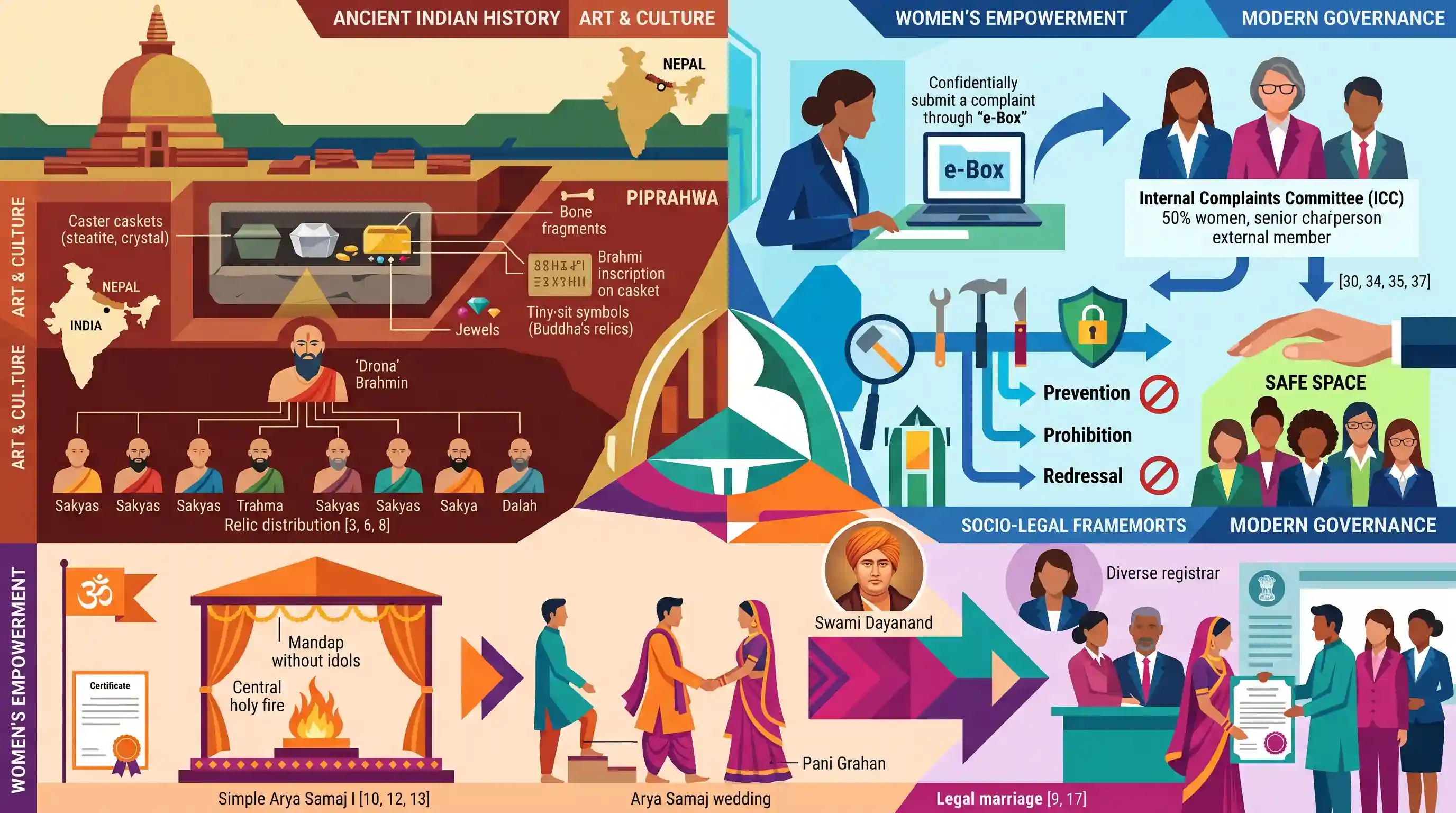
This UPSC Key article highlights three distinct subjects: historical Buddhist relics discovered at Piprahwa, the legal mechanisms of the POSH Act for workplace safety, and the historical and legal aspects of Arya Samaj marriages. Piprahwa is significant in ancient Indian history as a major stupa site containing what are believed to be Buddha's relics. The POSH Act remains a critical governance and social justice topic, establishing grievance redressal via ICCs. Lastly, Arya Samaj marriages touch upon modern Indian history's social reform movements and current socio-legal frameworks regarding marriage registration.
Key Points
- The Piprahwa stupa in Uttar Pradesh is historically significant for yielding soapstone caskets containing relics and gems believed to belong to Lord Buddha.
- The POSH Act 2013, rooted in the Supreme Court's Vishaka Guidelines, mandates the constitution of Internal Complaints Committees (ICCs) to ensure women's safety and address sexual harassment at the workplace.
- The Arya Samaj, founded by Swami Dayanand Saraswati in 1875, continues to be relevant due to its simplified marriage rituals, whose legal validity involves the Hindu Marriage Act and the Arya Marriage Validation Act.
Important Terms
Piprahwa Relics

Historical Buddhist relics discovered in 1898 at Piprahwa Stupa, Uttar Pradesh. They include bone fragments and gemstones attributed to the Sakya clan, marking the site as ancient Kapilavastu.
UPSC context
GS Paper I (Art & Culture); tests knowledge of ancient Buddhist sites, stupa architecture, and archaeological excavations.
Vishaka Guidelines
Landmark 1997 Supreme Court guidelines established in the Vishaka v. State of Rajasthan case to address workplace sexual harassment, serving as a legal stopgap until 2013.
UPSC context
GS Paper II (Polity & Governance); tests understanding of judicial activism and fundamental rights (Articles 14, 19, 21).
Internal Complaints Committee (ICC)
A mandatory grievance redressal body required under the POSH Act, 2013, for any workplace with 10 or more employees to address sexual harassment complaints.
UPSC context
GS Paper II (Governance); tests institutional mechanisms for social justice and women's empowerment.
POSH Act 2013
Legislation providing a statutory framework to prevent and redress sexual harassment of women at workplaces, replacing the judicial Vishaka Guidelines with binding legal obligations for employers.
UPSC context
GS Paper II (Social Justice); critical for topics on vulnerable sections and workplace safety legislation.
Arya Samaj
A Hindu revivalist reform movement founded by Swami Dayanand Saraswati in 1875, advocating for a return to Vedic authority and the abolition of idol worship and caste-based discrimination.
UPSC context
GS Paper I (Modern Indian History); central to 19th-century socio-religious reform movements and the "Back to Vedas" call.
Arya Marriage Validation Act 1937
A colonial-era law that legally validates marriages conducted according to Arya Samaj rituals, specifically allowing inter-caste and inter-religious unions provided the parties identify as Arya Samajis.
UPSC context
GS Paper I & II (Social Issues/Polity); tests the evolution of personal laws and social reform through legislation.
Prelims Trap
"The POSH Act mandates an Internal Complaints Committee (ICC) for every workplace, regardless of employee count."
The POSH Act mandates an ICC only for workplaces with 10 or more employees. Smaller workplaces or the unorganized sector fall under the Local Complaints Committee (LCC).
Static Concepts Connected
What is the historical significance of the Piprahwa archaeological site?
- Location & Identity: Located in Uttar Pradesh (Siddharthnagar district), it is frequently identified by archaeologists as the ancient city of Kapilavastu.
- Buddha's Relics: Yielded inscribed soapstone caskets containing bone relics and gems that are widely believed to belong to Lord Gautama Buddha.
What were the core tenets of the Arya Samaj founded in 1875?
- Vedic Authority: Declared the Vedas as infallible and the ultimate source of all knowledge, rejecting post-Vedic texts like Puranas.
- Social Reform: Opposed orthodox practices such as idolatry, polytheism, untouchability, and child marriage while promoting widow remarriage.
- Shuddhi Movement: Initiated the reconversion of people who had converted to Islam or Christianity back to the Hindu fold.
Cross-Topic Patterns
Mapping Buddhist Archaeological Sites
UPSC frequently tests the mapping of lesser-known Buddhist stupas (Piprahwa, Kesaria, Bhattiprolu) to their modern states or historical kingdoms.
Socio-Religious Reforms to Modern Law
The Arya Samaj's historical push for simplified marriages connects directly to ongoing contemporary debates around the Special Marriage Act, UCC, and interfaith union legality.
Informal Sector & POSH Act
The 10-employee ICC threshold links the POSH Act directly to debates on women's safety in India's growing informal sector and gig economy (which rely on LCCs).

With rising female workforce participation, a 2026 prelims question contrasting ICCs and LCCs under the POSH Act is highly probable.
Linked PYQs · 4
Linked PYQs · 4
- 2023PrelimsGS1
With reference to ancient India, consider the following statements: 1. The concept of Stupa is Buddhist in origin. 2. Stupa was generally a repository of relics. 3. Stupa was a votive and commemorative structure in Buddhist tradition. How many of the statements given above are correct?
- 2016MainsGS1
Early Buddhist Stupa-art, while depicting folk motifs and narratives successfully expounds Buddhist ideals. Elucidate.
- 2018PrelimsGS1
Which among the following events happened earliest ?
- 2023MainsGS2
Explain the constitutional perspectives of Gender Justice with the help of relevant Constitutional Provisions and case laws.
