Semiconductor Geopolitics and Pharmaceutical Sector Vulnerabilities
Source:Indian Express ↗
Why It Matters
The intersection of strategic technologies (semiconductors) and vital industries (pharmaceuticals) with global geopolitics forms the core of India's pursuit of self-reliance. This strongly aligns with GS2 IR and GS3 Economy/S&T, particularly regarding supply chain resilience and industrial policy.
Summary
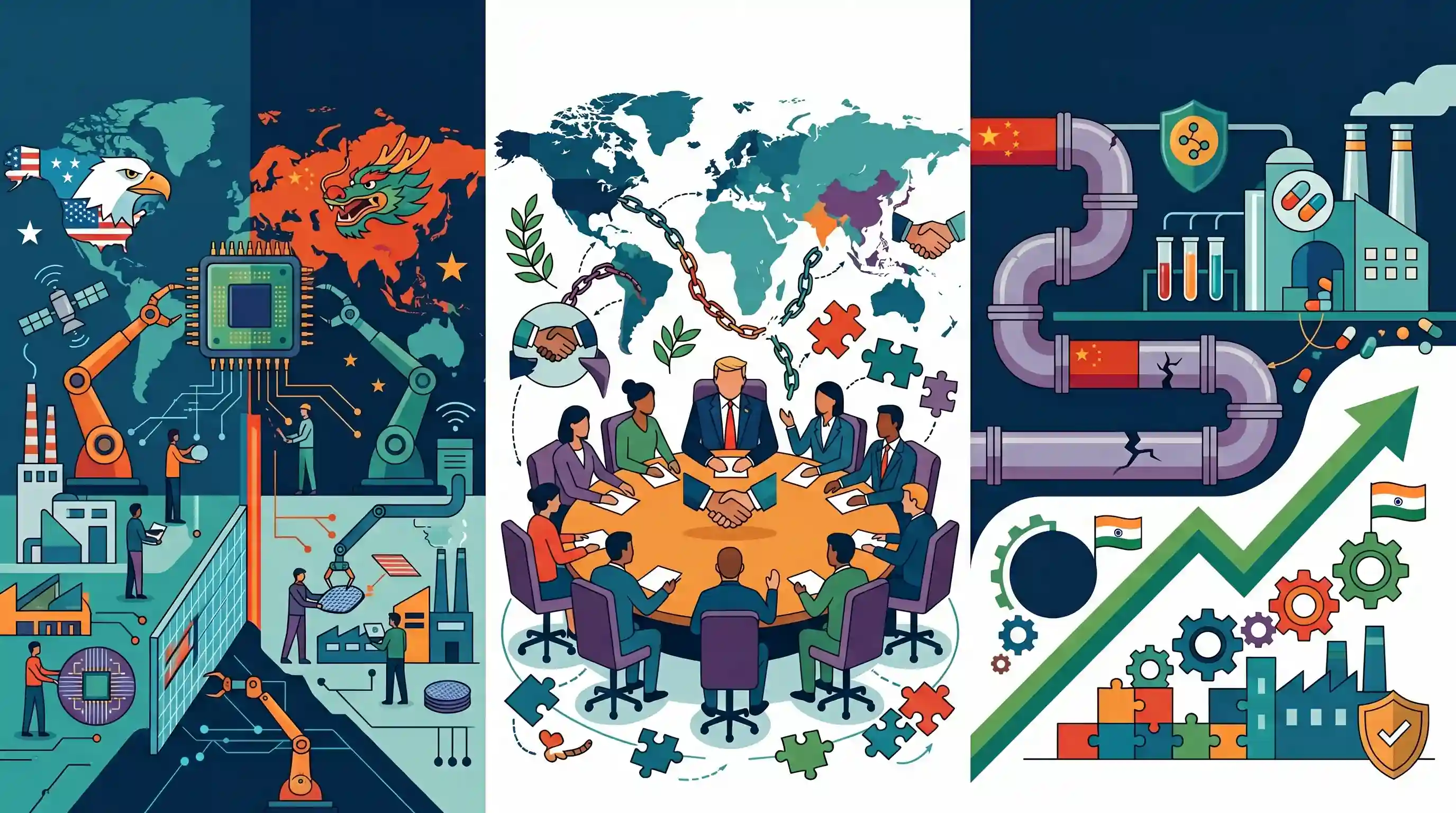
This UPSC Key article explores three critical themes: 'Pax Silica', detailing the geopolitics of technology, the US-China tech war, and the race for semiconductor manufacturing dominance; Donald Trump’s 'Board of Peace' proposal and its implications for international conflict resolution and shifting global alliances; and the structural vulnerabilities of the Indian Pharmaceutical industry, specifically its over-reliance on Chinese Active Pharmaceutical Ingredients (APIs) and the role of the PLI scheme in building domestic resilience.
Key Points
- Pax Silica refers to the emerging geopolitical paradigm where global power and stability are increasingly tied to the control of semiconductor supply chains and silicon chip manufacturing.
- Donald Trump's proposed 'Board of Peace' highlights potential shifts in US foreign policy and multilateral diplomacy, especially regarding the Russia-Ukraine conflict.
- While India is a global leader in generic medicine exports, its pharmaceutical industry remains critically vulnerable due to heavy reliance on imported Active Pharmaceutical Ingredients (APIs) from China.
- Domestic initiatives like the PLI scheme and the India Semiconductor Mission are pivotal strategies to counter supply chain vulnerabilities and foster Atmanirbharta in both high-tech and healthcare sectors.
Important Terms
Pax Silica

A US-led strategic initiative aimed at securing global semiconductor, AI, and critical mineral supply chains. It seeks to build a trusted ecosystem among allies to counter Chinese technological dominance.
UPSC context
GS Paper II (International Relations). Tests knowledge of technology-driven geopolitics and India’s strategic positioning in emerging Western-led tech alliances.
Board of Peace
A US-led intergovernmental body proposed by Donald Trump to oversee global conflict resolution and post-war reconstruction, beginning with the Israel-Gaza ceasefire and Gaza's transitional administration.
UPSC context
GS Paper II (International Relations). Relevant for topics on parallel multilateralism, global governance reforms, and India’s policy of strategic autonomy.
Active Pharmaceutical Ingredients (APIs)
The biologically active components in pharmaceutical drugs responsible for the intended therapeutic effects. They are the primary raw materials used to manufacture finished medicinal products like tablets.
UPSC context
GS Paper III (Economy/S&T). Crucial for understanding India’s pharmaceutical supply chain vulnerabilities and its dependence on imports, especially from China.
Production Linked Incentive (PLI) Scheme
A Government of India scheme providing financial incentives to domestic manufacturers based on incremental sales. It aims to boost manufacturing, enhance exports, and achieve self-reliance across 14 key sectors.
UPSC context
GS Paper III (Indian Economy). Tests understanding of industrial policy, 'Make in India' initiatives, and strategies to improve global manufacturing competitiveness.
India Semiconductor Mission (ISM)
A nodal agency under the Digital India Corporation established to implement the 'Semicon India' program. It provides fiscal support for building a sustainable semiconductor and display manufacturing ecosystem.
UPSC context
GS Paper III (Science & Technology/Economy). Focuses on India's roadmap for high-end technology manufacturing and reducing reliance on critical electronic imports.
Prelims Trap
India is a global net exporter of Active Pharmaceutical Ingredients (APIs) due to the PLI scheme.
India exports finished formulations (generics) but heavily imports (70-80%) APIs/Key Starting Materials from China. PLI aims to reduce import dependence, but India is not a net API exporter.
Static Concepts Connected
What differentiates APIs, Excipients, and Final Formulations in drug manufacturing?
- API (Active Ingredient): The biologically active chemical compound in a pharmaceutical drug that produces the intended therapeutic effect.
- Excipients: Inactive carrier substances (like solvents, binders, or coatings) used to deliver the API safely and effectively.
- Formulation: The final consumable product (tablet, capsule, syrup) created by combining the API with excipients.
What are the three core stages of the semiconductor value chain?
- Fabless Design: Designing the complex architecture of integrated circuits (Intel, ARM). This stage is heavily dominated by the US and UK.
- Fabrication (Foundries): The highly capital-intensive manufacturing of physical chips on silicon wafers. Currently dominated by Taiwan (TSMC) and South Korea.
- OSAT / ATMP: Outsourced Semiconductor Assembly and Test (OSAT) or ATMP. The final packaging and testing of chips before commercial use.
Cross-Topic Patterns
Minilaterals bypassing UN frameworks
Trump's 'Board of Peace' and tech-alliances like 'Pax Silica' reflect a shift from universal UN bodies to ad-hoc, US-led minilaterals designed to bypass geopolitical vetoes.
Selective Alignment via Observer Status
India joining Pax Silica but remaining an observer in the Board of Peace mirrors its approach to the IPEF trade pillar—balancing economic partnerships with strategic autonomy.

Expect a multi-statement prelims question comparing India's structural import dependencies in APIs vs semiconductors and respective PLI goals.
Linked PYQs · 3
Linked PYQs · 3
- 2025MainsGS3
India aims to become a semiconductor manufacturing hub. What are the challenges faced by the semiconductor industry in India? Mention the salient features of the India Semiconductor Mission.
- 2025MainsGS3
Discuss the rationale of the Production Linked Incentive (PLI) scheme. What are its achievements? In what way can the functioning and outcomes of the scheme be improved?
- 2025MainsGS2
"The reform process in the United Nations remains unresolved, because of the delicate imbalance of East and West and entanglement of the USA vs. Russo-Chinese alliance.” Examine and critically evaluate the East-West policy confrontations in this regard.
