Integral Humanism Monetary Policy and India EV Strategy
Source:Indian Express ↗
Why It Matters
This synthesis covers high-yield areas across multiple UPSC papers: GS1/GS4 (political thinkers and ethics of governance), GS3 Economy (RBI's monetary tools are a staple in Prelims and Mains), and GS3 Environment (EVs and energy transition are critical to India's climate commitments like Panchamrit). Mastering these topics builds a strong foundation for interdisciplinary answers.
Summary
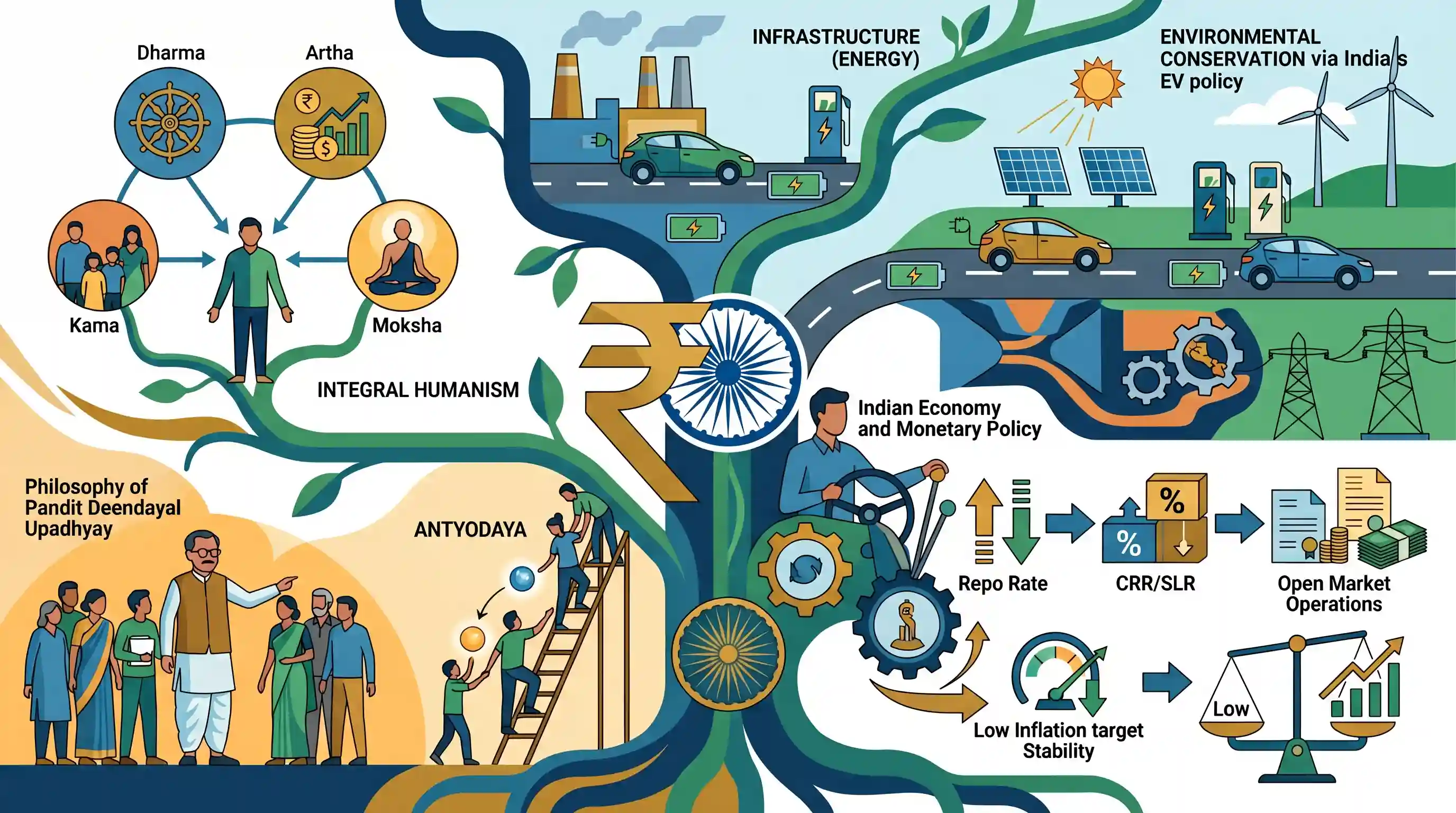
The article highlights three critical themes for UPSC aspirants: the political and ethical philosophy of Pandit Deendayal Upadhyay, the mechanics of India's monetary policy, and the strategic push towards electric mobility. Upadhyay's concepts of Integral Humanism and Antyodaya offer an indigenous framework for inclusive development and welfare governance. On the economic front, understanding the Reserve Bank of India's monetary policy instruments—such as repo rates, CRR, SLR, and Open Market Operations—is vital for analyzing macroeconomic stability and inflation targeting. Finally, India's EV policy is examined as a pivotal component of the nation's energy transition strategy, aimed at reducing greenhouse gas emissions and fossil fuel dependence, while navigating infrastructural and supply chain bottlenecks.
Key Points
- Pandit Deendayal Upadhyay championed the philosophy of 'Integral Humanism', which envisions a holistic socio-economic model integrating the individual, society, and nature, rejecting purely materialist Western ideologies.
- His principle of 'Antyodaya'—the upliftment of the most marginalized—forms the ethical basis for various modern welfare schemes.
- The RBI employs quantitative tools like the Repo Rate, Cash Reserve Ratio (CRR), Statutory Liquidity Ratio (SLR), and Open Market Operations (OMOs) to manage market liquidity and anchor inflation expectations.
- Effective transmission of monetary policy is essential to balance India's growth objectives with price stability, especially concerning persistent food inflation.
- India's EV policy framework, driven by schemes like FAME, aims to accelerate the transition to electric mobility to cut carbon emissions and reduce crude oil import dependency.
- Challenges to EV adoption include establishing a robust charging infrastructure network and securing the supply chain for critical battery minerals like lithium.
Important Terms
Integral Humanism

An indigenous philosophy by Deendayal Upadhyay emphasizing holistic human development—balancing material, spiritual, social, and intellectual needs—to achieve individual and collective harmony while rejecting western materialism.
UPSC context
GS Paper I (Thinkers) and IV (Ethics); tests knowledge of indigenous political philosophies and their application to inclusive governance.
Antyodaya
Meaning 'upliftment of the last person,' it is a governance principle prioritizing the welfare and development of the poorest and most marginalized sections of society.
UPSC context
GS Paper II (Social Justice); critical for analyzing welfare schemes and the ethical basis of inclusive development strategies.
Repo Rate
The interest rate at which the RBI lends money to commercial banks against government securities to manage liquidity and control inflation in the economy.
UPSC context
GS Paper III (Economy); fundamental for understanding inflation targeting and the mechanics of the Monetary Policy Committee (MPC).
Cash Reserve Ratio (CRR)
A mandatory percentage of a bank's total deposits (NDTL) that must be maintained as cash reserves with the RBI, without earning any interest.
UPSC context
GS Paper III (Economy); tests conceptual clarity on liquidity control and the Reserve Bank's quantitative credit control tools.
Statutory Liquidity Ratio (SLR)
The minimum percentage of deposits that commercial banks are required to maintain in the form of liquid assets like gold, cash, or approved government securities.
UPSC context
GS Paper III (Economy); relevant for questions on credit availability, bank solvency, and the government's internal debt management.
Open Market Operations (OMO)
The buying and selling of government securities by the central bank in the open market to regulate the money supply and liquidity levels.
UPSC context
GS Paper III (Economy); key for analyzing indirect monetary interventions and their impact on bond yields and market interest rates.
FAME Scheme
A flagship government initiative aimed at providing subsidies to increase the adoption and domestic manufacturing of hybrid and electric vehicles (EVs) in India.
UPSC context
GS Paper III (Infrastructure & Environment); crucial for topics on energy transition, pollution control, and the 'Make in India' initiative.
Prelims Trap
The FAME scheme for electric vehicle adoption is administered by the Ministry of Road Transport and Highways.
FAME is actually administered by the Ministry of Heavy Industries, not MoRTH. UPSC frequently swaps nodal ministries in Prelims statements to confuse aspirants.
Static Concepts Connected
What are the primary quantitative tools of RBI's Monetary Policy?
- LAF (Repo/Reverse Repo): Tools used by the RBI to lend or borrow funds from commercial banks to manage short-term liquidity.
- Reserve Ratios (CRR/SLR): Mandatory reserves kept with RBI (cash) or held in liquid assets (gold/G-secs) to regulate banks' credit creation capacity.
- Open Market Operations: Outright buying and selling of government securities to permanently inject or absorb market liquidity, often for sterilization.
What are the core tenets of Pandit Deendayal Upadhyay's 'Integral Humanism'?
- Holistic Integration: Focuses on the harmony between the individual, society, and nature, rejecting fragmented and purely materialist Western worldviews.
- Antyodaya: Translates to the upliftment of the last person, prioritizing the most marginalized in socio-economic planning and welfare governance.
- Dharma-driven Economy: Asserts that economic and political systems must be guided by ethical principles (Dharma) rather than sheer profit motive.
Cross-Topic Patterns
EV Policy + Critical Minerals Geopolitics
India's EV ambitions directly tie into GS2 IR themes like the Minerals Security Partnership and securing lithium/cobalt supply chains against Chinese monopolies.
Monetary Policy + Supply-Side Shocks
The RBI's struggle with persistent food inflation highlights the limits of repo rate hikes against supply-side agricultural shocks, a classic GS3 debate.
Antyodaya + GS4 Compassion/Tolerance
Upadhyay's Antyodaya provides an indigenous ethical framework for GS4 answers on compassion and foundational values of civil services towards weaker sections.

Expect a 2026 multi-statement question combining EV FAME scheme details, nodal ministries, and lithium supply chain vulnerabilities.
Linked PYQs · 5
Linked PYQs · 5
- 2024MainsGS3
What are the causes of persistent high food inflation in India? Comment on the effectiveness of the monetary policy of the RBI to control this type of inflation.
- 2024PrelimsGS1
With reference to the Indian economy, "Collateral Borrowing and Lending Obligations" are the instruments of:
- 2023PrelimsGS1
Which one of the following activities of the Reserve Bank of India is considered to be part of 'sterilization'?
- 2016PrelimsGS1
What is/are the purpose/purposes of the 'Marginal Cost of Funds based Lending Rate (MCLR)' announced by RBI? 1. These guidelines help improve the transparency in the methodology followed by banks for determining the interest rates on advances. 2. These guidelines help ensure availability of bank credit at interest rates which are fair to the borrowers as well as the banks. Select the correct answer using the code given below.
- 2023MainsGS3
The adoption of electric vehicles is rapidly growing worldwide. How do electric vehicles contribute to reducing carbon emissions and what are the key benefits they offer compared to traditional combustion engine vehicles?
