SIR Registry and Environmental Constitutionalism for UPSC Aspirants
Source:Indian Express ↗
Why It Matters
Provides foundational knowledge and recent current affairs updates on internal security (cybercrime registries), judicial activism regarding the environment, and labor welfare bodies.
Summary
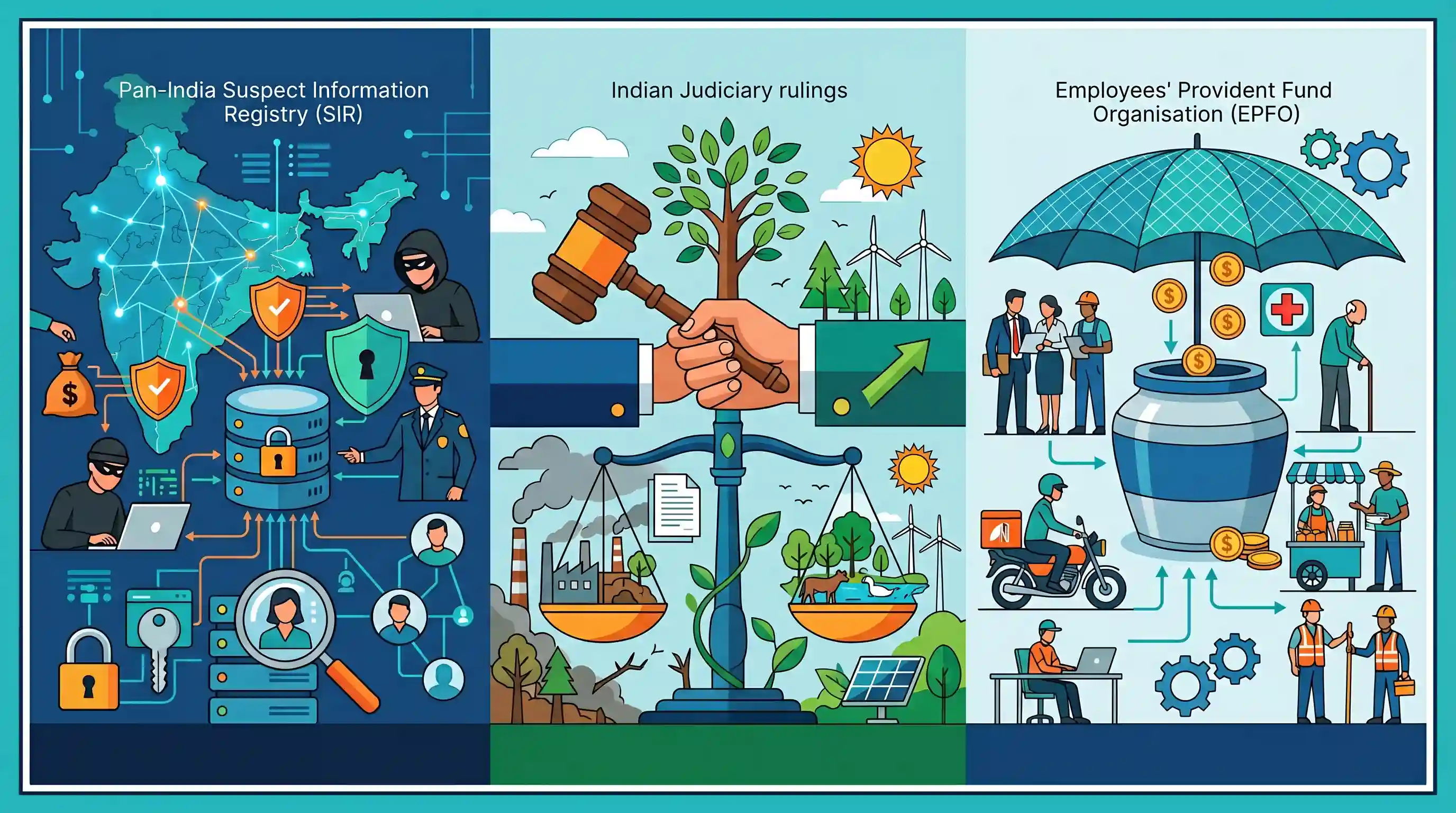
The article covers three distinct subjects highly relevant to the UPSC syllabus: the launch of the Pan-India Suspect Information Registry (SIR) to combat cybercrimes, the evolution of environmental constitutionalism through Supreme Court rulings, and the social security mandate of the Employees' Provident Fund Organisation (EPFO). It highlights how I4C's registry tackles financial fraud, how the judiciary interprets climate and ecological rights under Article 21, and the ongoing labor challenges of expanding EPFO coverage to non-traditional workers.
Key Points
- The Pan-India Suspect Information Registry (SIR), spearheaded by the Indian Cyber Crime Coordination Centre (I4C), is a centralized database to track cybercriminals and prevent financial frauds by monitoring mule accounts.
- Environmental constitutionalism refers to the Supreme Court's judicial innovation of integrating environmental protection into fundamental rights, primarily expanding Article 21 to include the right to a clean, healthy environment and protection against climate change.
- The Employees' Provident Fund Organisation (EPFO) is India's principal statutory body for social security, but it faces policy challenges in expanding provident fund and pension coverage to gig and unorganized sector workers.
- Integration of the SIR with banking institutions helps create a systemic defense against cybercrimes, aligning with the national cyber security strategy.
Important Terms
Suspect Information Registry (SIR)

A national database managed by I4C containing identifiers of cybercriminals (e.g., SIMs, bank accounts) to help financial institutions block fraudulent transactions in real-time.
UPSC context
GS Paper 3: Cyber Security. Relevant for internal security, digital sovereignty, and institutional measures against financial fraud.
Indian Cyber Crime Coordination Centre (I4C)
A nodal agency under the Ministry of Home Affairs (MHA) that provides a coordinated framework for Law Enforcement Agencies (LEAs) to combat cybercrime comprehensively.
UPSC context
GS Paper 3: Internal Security. Tests knowledge of specialized bodies and coordination mechanisms for 21st-century threats.
Environmental Constitutionalism
The legal doctrine where environmental rights and protections are recognized as constitutional principles, often through judicial expansion of fundamental rights like the Right to Life.
UPSC context
GS Paper 2: Judiciary & Constitution. Relevant for Judicial Activism and the evolution of Fundamental Rights.
Article 21 of the Indian Constitution
A fundamental right guaranteeing that no person shall be deprived of life or personal liberty except according to procedure established by law; interpreted to include clean environment.
UPSC context
GS Paper 2: Indian Constitution. Core topic for understanding the expansive nature of Part III rights.
Employees' Provident Fund Organisation (EPFO)
A statutory body under the Ministry of Labour and Employment that administers mandatory social security schemes like Provident Funds, Pensions, and Life Insurance for the organized workforce.
UPSC context
GS Paper 2: Statutory Bodies/Welfare Schemes. Tests understanding of social security architecture and labor reforms.
Employees’ Provident Funds and Miscellaneous Provisions Act, 1952
The primary legislation governing social security for Indian workers, mandating contributions from both employers and employees to ensure financial stability during retirement or emergencies.
UPSC context
GS Paper 2: Social Justice & Welfare. Focuses on legislative frameworks for labor protection and formalization of economy.
Prelims Trap
The Indian Cyber Crime Coordination Centre (I4C) operates under the Ministry of Electronics and Information Technology (MeitY).
I4C is an initiative of the Ministry of Home Affairs (MHA), not MeitY, designed to deal with cybercrime in a coordinated and comprehensive manner.
Static Concepts Connected
How is Environmental Protection embedded in the Indian Constitution?
- Fundamental Rights: The Supreme Court has expanded Article 21 to include the right to a clean environment and, recently, protection from the adverse impacts of climate change.
- Directive Principles: Article 48A mandates the State to endeavor to protect and improve the environment, forests, and wildlife of the country.
- Fundamental Duties: Article 51A(g) places a duty on every citizen of India to protect and improve the natural environment.
What is the statutory basis and administrative structure of the EPFO?
- Statutory Origin: Established under the Employees’ Provident Funds and Miscellaneous Provisions Act, 1952.
- Nodal Ministry: It functions under the administrative control of the Union Ministry of Labour and Employment.
- Tripartite Governance: Administered by the Central Board of Trustees (CBT), a tripartite body comprising representatives of the Government, employers, and employees.
Cross-Topic Patterns
SIR & Financial Regulation
Integrating the Suspect Information Registry with banking bridges internal security (MHA/I4C) with economic regulation (RBI), highlighting a cross-domain approach to tackling GS3 systemic financial fraud.
Gig Workers & Social Security Code
The challenge of extending EPFO coverage to platform workers connects statutory welfare limitations directly to the provisions of the yet-to-be-implemented Code on Social Security, 2020.
Judicial Innovation in Climate Governance
Reading climate rights into Article 21 merges GS2 judicial activism with GS3 environmental conservation, signaling a shift from statutory laws (EPA 1986) to rights-based constitutional jurisprudence.

Expect a 2026 Prelims multi-statement question testing I4C's nodal ministry (MHA vs MeitY) alongside the statutory mandate of EPFO.
Linked PYQs · 5
Linked PYQs · 5
- 2022MainsGS2
“The most significant achievement of modern law in India is the constitutionalization of environmental problems by the Supreme Court.” Discuss this statement with the help of relevant case laws.
- 2015MainsGS2
Does the right to clean environment entail legal regulations on burning crackers during Diwali? Discuss in the light of Article 21 of the Indian Constitution and Judgement(s) of the Apex Court in this regard.
- 2021PrelimsGS1
With reference to casual workers employed in India, consider the following statements : 1. All casual workers are entitled for Employees Provident Fund coverage. 2. All casual workers are entitled for regular working hours and overtime payment. 3. The government can by a notification specify that an establishment or industry shall pay wages only through its bank account. Which of the above statements are correct?
- 2020MainsGS3
Discuss different types of cyber crimes and measures required to be taken to fight the menace.
- 2022MainsGS3
What are the different elements of cyber security ? Keeping in view the challenges in cyber security, examine the extent to which India has successfully developed a comprehensive National Cyber Security Strategy.
