Pakistan-Afghanistan Border Tensions and New GDP Series
Source:Indian Express ↗
Why It Matters
The article intersects three major UPSC syllabus areas: International Relations (Neighborhood First policy and regional security), Economy (GDP calculation methodologies and base year revisions), and Environment (climate change-induced disaster management). Understanding the nuances of these topics is crucial for both Prelims and Mains answers.
Summary
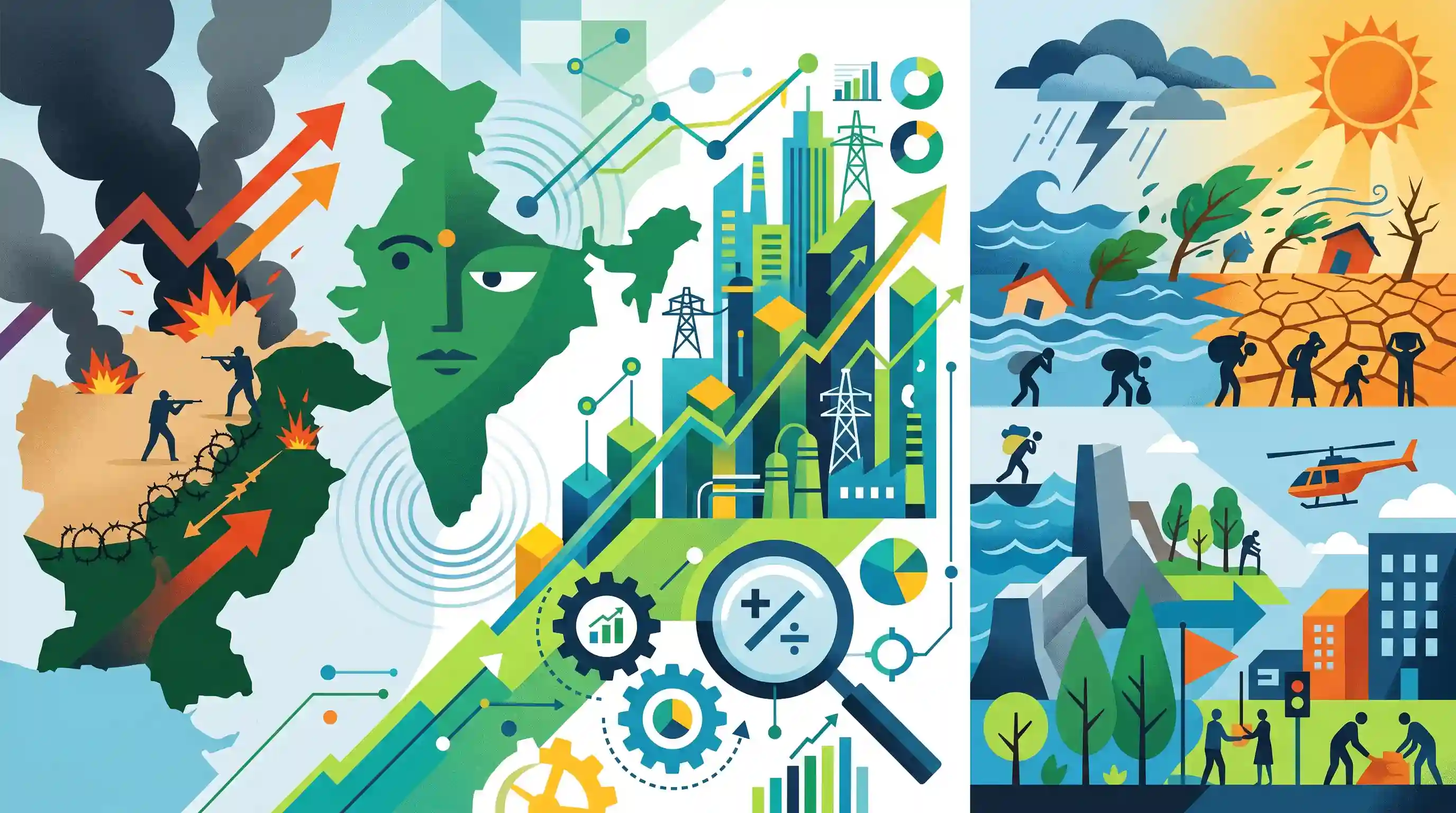
This edition of UPSC Key addresses three critical, diverse themes: geopolitics, macroeconomics, and disaster management. It highlights the deteriorating relations and potential for an 'open war' between Pakistan and Afghanistan, primarily fueled by border disputes (Durand Line) and terror outfits like the TTP, which hold significant security implications for the broader region. Economically, it delves into the proposed new GDP series, emphasizing the importance of base year revisions to ensure accurate national income accounting. Additionally, the article discusses 'disaster fatigue'—the phenomenon where the increasing frequency of climate-related natural disasters overwhelms response capabilities and public resilience, calling for more proactive disaster risk reduction strategies.
Key Points
- The escalating border tensions and 'open war' rhetoric between Pakistan and the Taliban-led Afghanistan underscore regional instability, raising concerns over cross-border terrorism and its implications for South Asian security.
- Discussions surrounding a new GDP series highlight the necessity of revising the base year and macroeconomic methodologies to accurately capture the structural changes in the modern Indian economy.
- The concept of 'disaster fatigue' points to the socio-economic and psychological exhaustion of communities and relief systems due to the rising frequency of climate-induced extreme events, necessitating a shift towards robust disaster resilience.
Important Terms
Sendai Framework for Disaster Risk Reduction

A 15-year (2015–2030) international agreement adopted by UN members to reduce disaster risk and losses. It shifts the focus from reactive disaster response to proactive disaster risk management.
UPSC context
GS Paper III (Disaster Management); tests knowledge of global DRR standards and India's shift toward proactive mitigation strategies.
National Disaster Management Authority (NDMA)
The apex statutory body for disaster management in India, established under the Disaster Management Act, 2005. Chaired by the Prime Minister, it formulates national policies and guidelines for effective disaster response.
UPSC context
GS Paper III (Disaster Management); essential for understanding India’s institutional framework and policy-making for crises.
Tehrik-i-Taliban Pakistan (TTP)
An umbrella organization of various militant factions operating primarily along the Pakistan-Afghanistan border. It seeks to overthrow the Pakistani state and impose its interpretation of Sharia law.
UPSC context
GS Paper III (Internal Security) and GS Paper II (India and Neighborhood); tests knowledge of regional terror threats.
Ministry of Statistics and Programme Implementation (MoSPI)
The central ministry responsible for India's official statistics and monitoring program implementation. It oversees the National Statistical Office (NSO) and conducts periodic GDP base year revisions.
UPSC context
GS Paper III (Indian Economy); tests understanding of national income accounting, data integrity, and macroeconomic indicators.
Taliban
A Sunni Islamist movement and military organization currently ruling Afghanistan. It returned to power in August 2021, significantly impacting regional stability and India's neighborhood policy.
UPSC context
GS Paper II (International Relations); critical for assessing geopolitical shifts and their security implications for India.
Prelims Trap
"India's headline GDP is currently measured and reported at factor cost."
Since the 2015 methodology revision, India measures headline GDP at market prices (GVA at basic prices + Net Product Taxes), aligning with global UN-SNA standards.
Static Concepts Connected
How is India's GDP calculated under the post-2015 methodology?
- Headline GDP: Measured at market prices, shifting away from factor cost to better reflect what consumers actually pay and to align with global UN-SNA standards.
- GVA vs GDP: GVA at basic prices measures sector-wise value addition (supply side); GDP adds net indirect taxes (taxes minus subsidies) to this GVA.
- MCA-21 Database: The methodology integrated the Ministry of Corporate Affairs' MCA-21 database to comprehensively capture the value addition of the formal corporate sector.
Why does Afghanistan dispute the 1893 Durand Line?
- Colonial Origins: Drawn in 1893 by British civil servant Sir Mortimer Durand and Afghan Emir Abdur Rahman Khan to demarcate respective spheres of influence.
- Ethnic Division: It arbitrarily bisected contiguous Pashtun and Baloch tribal homelands. Consequently, modern Afghanistan rejects its legitimacy as a formal international boundary.
- Militant Safe Havens: The porous border allows militant groups like the TTP to operate transnationally, severely straining Kabul-Islamabad relations despite previous ideological alliances.
Cross-Topic Patterns
Base Year & HCES Linkage
The new GDP series relies heavily on the recent Household Consumption Expenditure Survey (HCES) to update inflation weights and accurately capture post-pandemic and post-GST consumption shifts.
Climate extremes & Fiscal federalism
Frequent disasters drain State Disaster Response Funds (SDRF), linking 'disaster fatigue' directly to center-state financial relations and the recommendations of the Finance Commission.
Af-Pak Vacuum & J&K Security
The collapse of Pak-Afghan ties over the TTP creates regional security vacuums. UPSC often connects such geopolitical instability to the spillover of narco-terrorism into Jammu & Kashmir.

Expect a 2026 Prelims question comparing GVA at basic prices vs GDP at market prices, tied to the rationale for base year revisions.
Linked PYQs · 5
Linked PYQs · 5
- 2021MainsGS3
Explain the difference between computing methodology of India's Gross Domestic Product (GDP) before the year 2015 and after the year 2015.
- 2024MainsGS3
What is disaster resilience? How is it determined? Describe various elements of a resilience framework. Also mention the global targets of Sendai Framework for Disaster Risk Reduction (2015–2030).
- 2024MainsGS3
Flooding in urban areas is an emerging climate-induced disaster. Discuss the causes of this disaster. Mention the features of two such major floods in the last two decades in India. Describe the policies and frameworks in India that aim at tackling such floods.
- 2016MainsGS2
Increasing cross-border terrorist attacks in India and growing interference in the internal affairs of several member-states by Pakistan are not conducive for the future of SAARC (South Asian Association for Regional Cooperation)." Explain with suitable examples.
- 2019MainsGS3
Disaster preparedness is the first step in any disaster management process. Explain how hazard zonation mapping will help disaster mitigation in the case of landslides.
