Af-Pak conflict new GDP series base year and disaster fatigue
Source:Indian Express ↗
Why It Matters
The calculation of GDP using a new base year is a fundamental macroeconomic concept frequently tested by UPSC. Additionally, the evolving security dynamics on the Af-Pak border have direct implications for India's neighborhood policy, while 'disaster fatigue' introduces a behavioral and resilience dimension to standard disaster management answers.
Summary
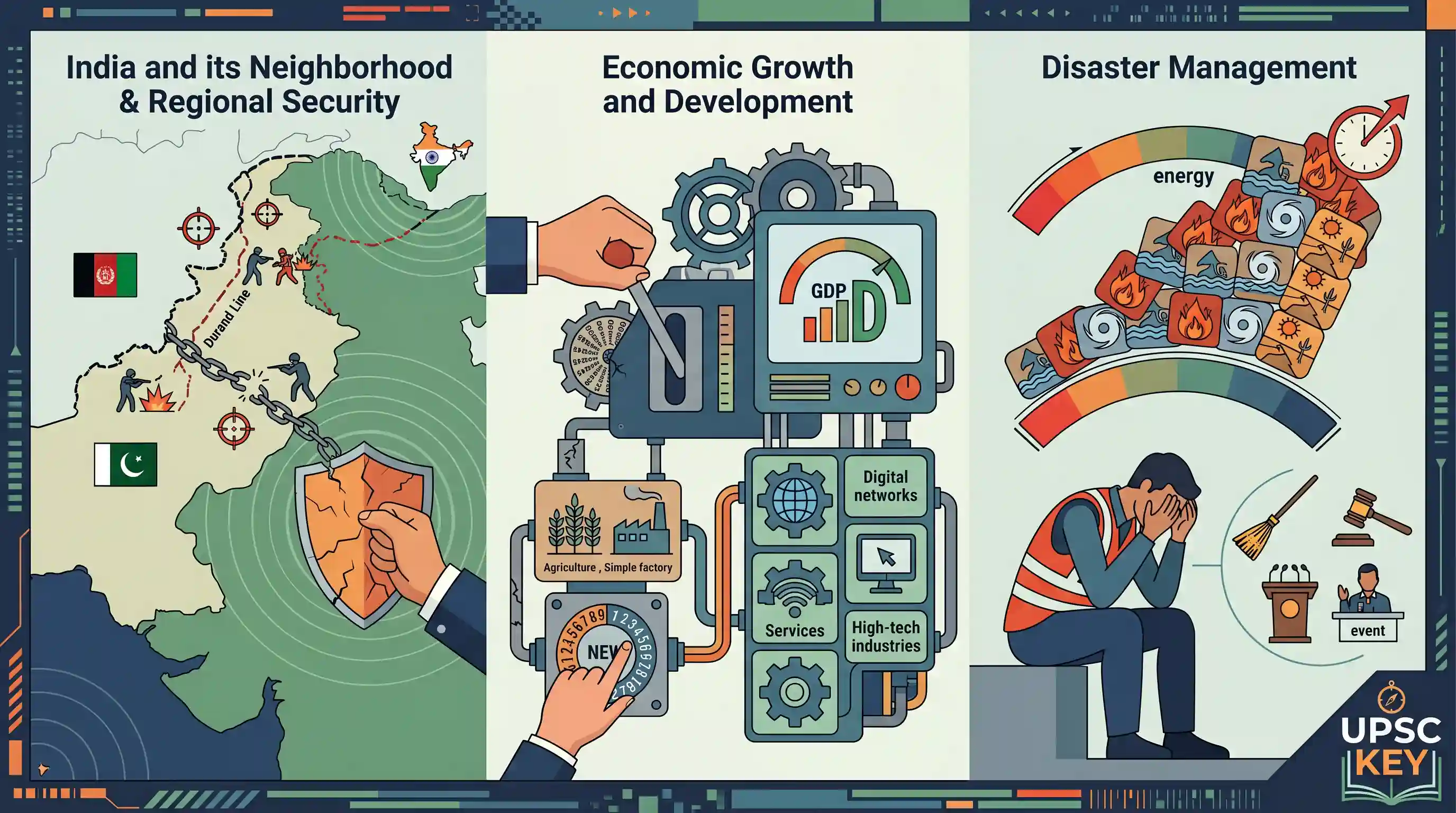
This edition of the UPSC Key examines multiple pressing issues across domains. Geopolitically, it analyzes the deteriorating relations between Pakistan and Afghanistan, driven by border contestations along the Durand Line and TTP militancy, which pose broader regional security challenges. Economically, it discusses the rationale behind updating the base year for the new GDP series to ensure macroeconomic indicators accurately reflect India's evolving economic structure. The article also addresses 'disaster fatigue' as a growing concern in disaster management due to the rising frequency of climate disasters, alongside recent political events involving Arvind Kejriwal.
Key Points
- Escalating tensions between Pakistan and Afghanistan over the Durand Line and cross-border terrorism by the TTP threaten to spark an 'open war' with significant regional security implications.
- The emerging concept of 'disaster fatigue' underscores the compounding psychological and economic toll of recurring climate-induced extreme events on vulnerable populations.
- The proposed transition to a new GDP series with a revised base year aims to capture modern structural shifts and formalization in the Indian economy.
- Recent political developments surrounding Arvind Kejriwal highlight ongoing debates around governance, federalism, and law enforcement agencies.
Important Terms
Tehrik-i-Taliban Pakistan (TTP)

An umbrella organization of militant groups operating along the Afghanistan-Pakistan border. It seeks to overthrow the Pakistani state to establish a strict Sharia-based governance system through armed insurgency.
UPSC context
GS Paper 2/3: Neighborhood relations and internal security. Critical for understanding regional militancy and its impact on India's western frontier.
National Disaster Management Authority (NDMA)
India's apex statutory body for disaster management, established under the Disaster Management Act, 2005. Chaired by the Prime Minister, it coordinates disaster risk reduction, mitigation, and response.
UPSC context
GS Paper 3: Disaster Management. Tests knowledge of India's institutional framework for managing frequent climate-induced and man-made disasters.
Durand Line
A 2,640 km boundary between Afghanistan and Pakistan established in 1893. While Pakistan recognizes it as an international border, successive Afghan governments have disputed its legitimacy.
UPSC context
GS Paper 2: International Relations. Essential for analyzing Pakistan-Afghanistan border disputes and their geopolitical implications for South Asian stability.
GDP Base Year Revision
A specific reference year used to calculate real economic growth by filtering out inflation. India is currently updating this base from 2011-12 to 2022-23.
UPSC context
GS Paper 3: Indian Economy. Relevant for questions on national income accounting, structural economic shifts, and accurate macroeconomic measurement.
Ministry of Statistics and Programme Implementation (MoSPI)
The nodal Indian ministry for statistics and planning. It manages GDP estimation through the National Statistical Office (NSO) and oversees the implementation of large-scale infrastructure projects.
UPSC context
GS Paper 3: Economic Development. Tests understanding of the administrative machinery responsible for India's official data and performance indicators.
Disaster Fatigue
The psychological and operational exhaustion resulting from the increasing frequency of climate disasters, leading to reduced public empathy, donor apathy, and administrative burnout.
UPSC context
GS Paper 3: Disaster Management. A contemporary challenge for policy-makers regarding community resilience and sustainable humanitarian response in a warming world.
Prelims Trap
The Durand Line is the mutually recognized international boundary between Pakistan and Afghanistan.
Afghanistan has historically rejected the 1893 British-drawn Durand Line, refusing to recognize it as a legitimate boundary because it artificially divides ethnic Pashtun populations.
Static Concepts Connected
Why does MoSPI periodically revise the base year for GDP calculations?
- Captures structural shifts: Accounts for new economic activities, emerging sectors (e.g., gig economy), and shifts from the informal to the formal sector.
- Real GDP accuracy: Adjusts the weightage of goods and services to strip out inflation, ensuring Real GDP metrics accurately reflect physical output.
- Global alignment: Ensures India's macroeconomic indicators remain compliant with the latest United Nations System of National Accounts (SNA) guidelines.
What is the historical and geographic significance of the Durand Line?
- Colonial legacy: Drawn in 1893 by British diplomat Mortimer Durand and Afghan Amir Abdur Rahman Khan to demarcate British India's limits.
- Ethnic division: The 2,640 km line bisects traditional Pashtun and Baloch tribal areas, fueling localized insurgency, cross-border terrorism (TTP), and Kabul's non-recognition.
- India's claim: Technically, India considers Afghanistan a contiguous neighbor due to PoK (Gilgit-Baltistan) sharing a short border (Wakhan corridor) along this alignment.
Cross-Topic Patterns
Disaster Fatigue & Social Capital
Recurring climate disasters erode local economic resilience and donor generosity, linking GS3 Disaster Management with GS1 Society (erosion of social capital) and GS2 NGO funding constraints.
GDP metrics & Fiscal Policy (FRBM)
A revised GDP base year shifts nominal and real GDP absolute numbers, directly impacting the denominator for FRBM fiscal deficit ratios and center-state debt indicators.

Expect a 2026 Prelims question linking MoSPI's GDP base-year methodology with its direct cascading effects on FRBM fiscal deficit ratios.
Linked PYQs · 5
Linked PYQs · 5
- 2021MainsGS3
Explain the difference between computing methodology of India's Gross Domestic Product (GDP) before the year 2015 and after the year 2015.
- 2024MainsGS3
What is disaster resilience? How is it determined? Describe various elements of a resilience framework. Also mention the global targets of Sendai Framework for Disaster Risk Reduction (2015–2030).
- 2019MainsGS3
Vulnerability is an essential element for defining disaster impacts and its threat to people. How and in what ways can vulnerability to disasters be characterized? Discuss different types of vulnerability with reference to disasters.
- 2022PrelimsGS1
Consider the following countries: 1. Azerbaijan 2. Kyrgyzstan 3. Tajikistan 4. Turkmenistan 5. Uzbekistan Which of the above have borders with Afghanistan ?
- 2015PrelimsGS1
With reference to Indian economy, consider the following statements : 1. The rate of growth of Real Gross Domestic Product has steadily increased in the last decade. 2. The Gross Domestic Product at market prices (in rupees) has steadily increased in the last decade. Which of the statements given above is/are correct?
