Bilateral Pacts, AI Hallucination, and Iran Political Structure
Source:Indian Express ↗
Why It Matters
Understanding Iran's internal power dynamics is essential for analyzing West Asian geopolitics. AI hallucination is a highly relevant Science & Technology topic due to the rapid adoption of generative AI. The India-Canada diplomatic row highlights the practical applications of international legal frameworks like extradition treaties.
Summary
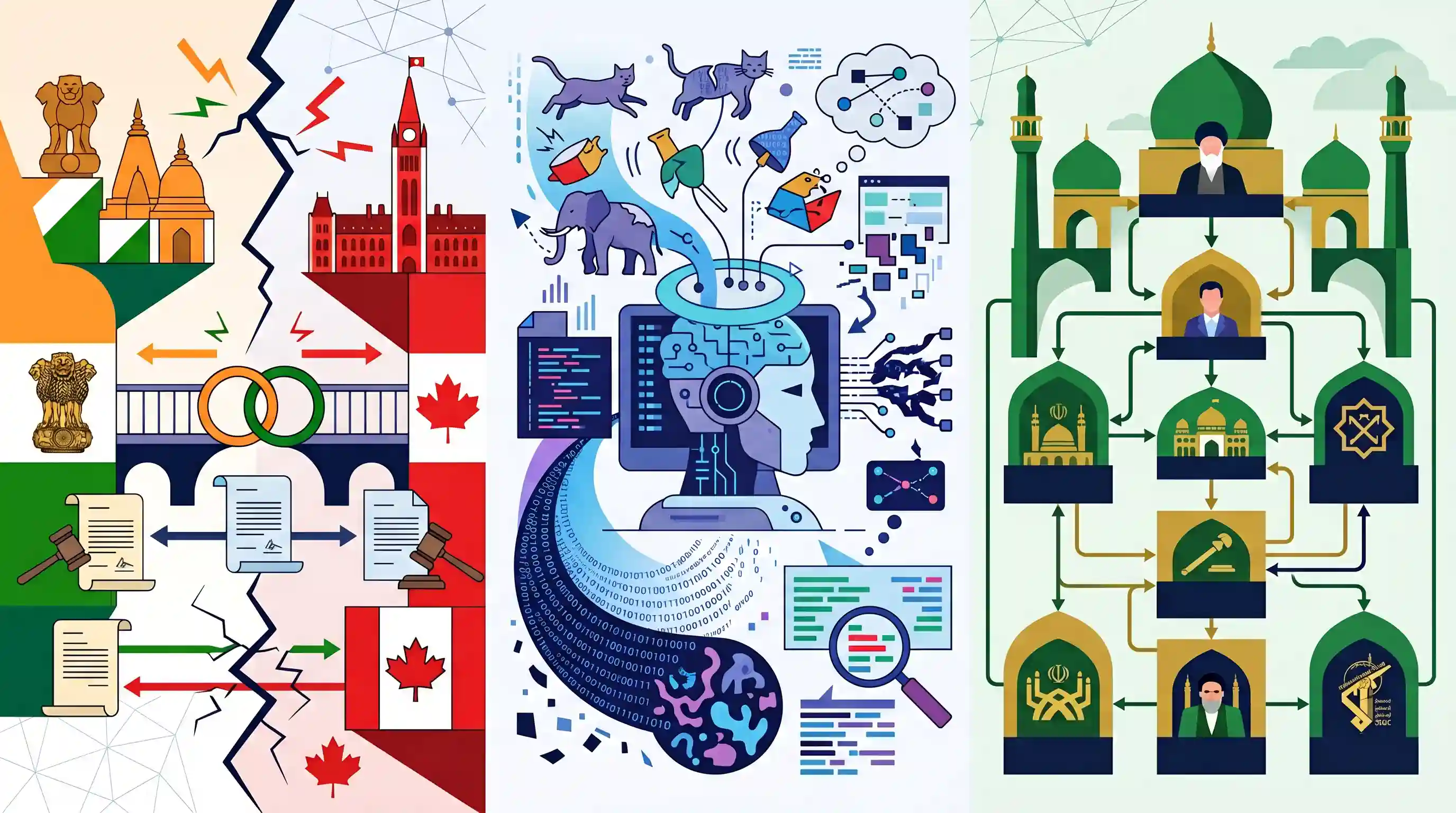
This UPSC Key article analyzes three distinct current affairs topics: the bilateral legal pacts between India and Canada amid diplomatic friction, the technological challenge of 'AI hallucination' in generative models, and the complex institutional power structure of Iran's political system.
Key Points
- The ongoing diplomatic row between India and Canada underscores the significance of bilateral legal frameworks, particularly Extradition Treaties and Mutual Legal Assistance Treaties (MLAT), in managing transnational crime and security issues.
- 'AI Hallucination' is a critical flaw in generative Artificial Intelligence and Large Language Models (LLMs) where the system produces confident but factually incorrect or illogical information, raising concerns over misinformation.
- Iran operates under a unique dual political structure combining a republic with a theocracy, where the Supreme Leader sits at the apex of the power pyramid, wielding ultimate authority over the President, the Guardian Council, and the armed forces.
Important Terms
Extradition Treaty

A formal bilateral agreement for the reciprocal transfer of individuals accused or convicted of serious crimes to face trial or punishment in the requesting state.
UPSC context
GS Paper II/III: Crucial for international legal cooperation, internal security, and understanding principles like dual criminality and rule of specialty.
Mutual Legal Assistance Treaty (MLAT)
A formal agreement between nations to cooperate in criminal investigations by exchanging information, evidence, and providing legal assistance to combat transnational crimes.
UPSC context
GS Paper II/III: Tests knowledge of international law enforcement frameworks and the role of the Ministry of Home Affairs.
Guardian Council
A 12-member Iranian constitutional body that vets parliamentary legislation against Islamic law and the constitution while overseeing election candidate approvals.
UPSC context
GS Paper II: International Relations; essential for understanding theocratic power structures and governance in West Asia.
Assembly of Experts
An 88-member body of Islamic scholars in Iran tasked with appointing, supervising, and having the constitutional authority to dismiss the Supreme Leader.
UPSC context
GS Paper II: Vital for analyzing political transitions and the institutional hierarchy of the Islamic Republic of Iran.
Islamic Revolutionary Guard Corps (IRGC)
An elite branch of Iran’s military, independent of the regular army, dedicated to safeguarding the Islamic Revolution and projecting regional influence.
UPSC context
GS Paper II: Key for studying West Asian geopolitics, security dynamics, and ideological military forces.
AI Hallucination
A phenomenon where generative AI models produce false or nonsensical information that is presented as factual truth.
UPSC context
GS Paper III: Science & Technology; relevant for AI ethics, data reliability, and regulatory challenges in digital governance.
Prelims Trap
"The Ministry of External Affairs is the nodal central authority for all Mutual Legal Assistance Treaty (MLAT) requests."
While the MEA administers the Extradition Act, the Ministry of Home Affairs (MHA) is the designated Central Authority for Mutual Legal Assistance Treaties (MLATs) in criminal matters.
Static Concepts Connected
What is the 'Principle of Dual Criminality' in extradition law?
- Core principle: The underlying act must be recognized as a punishable criminal offense in both the requesting country and the requested country.
- Underlying objective: It ensures a sovereign state is not forced to arrest and deport an individual for an act it does not legally recognize as a crime.
- Legal backing: This principle is a mandatory, foundational requirement for extradition under the Indian Extradition Act of 1962.
What causes 'AI Hallucination' in Large Language Models (LLMs)?
- Probabilistic generation: LLMs do not query factual databases; they merely predict the next statistically likely word based on mathematical patterns in their training data.
- Data gaps: When forced to respond to prompts outside their training, models confidently fabricate information to fill the gaps.
- No truth-grounding: Generative AI inherently lacks real-world contextual understanding or built-in factual verification mechanisms.
Cross-Topic Patterns
MLATs + FATF terror financing mandate
Bilateral friction hindering MLAT execution directly impacts India's FATF obligations to curb transnational terror financing, especially regarding overseas separatist networks.
Iran's IRGC + Regional proxy warfare
The Supreme Leader's direct control over the IRGC bypasses the elected President, driving Iran's autonomous funding of the 'Axis of Resistance' proxies across West Asia.

Expect a 2026 Prelims statement testing the 'Dual Criminality' principle or differentiating the nodal ministries for Extradition and MLATs.
Linked PYQs · 4
Linked PYQs · 4
- 2025MainsGS2
"Energy security constitutes the dominant kingpin of India's foreign policy, and is linked with India's overarching influence in Middle Eastern countries.” How would you integrate energy security with India's foreign policy trajectories in the coming years?
- 2023MainsGS3
Introduce the concept of Artificial Intelligence (AI). How does Al help clinical diagnosis? Do you perceive any threat to privacy of the individual in the use of Al in healthcare?
- 2020PrelimsGS1
With the present state of development, Artificial Intelligence can effectively do which of the following? 1. Bring down electricity consumption in industrial units 2. Create meaningful short stories and songs 3. Disease diagnosis 4. Text-to-Speech Conversion 5. Wireless transmission of electrical energy Select the correct answer using the code given below:
- 2024PrelimsGS1
Consider the following statements: I. It is expected that Majorana 1 chip will enable quantum computing. II. Majorana 1 chip has been introduced by Amazon Web Services (AWS). III. Deep learning is a subset of machine learning. Which of the statements given above are correct?
