UPSC Key Analysis on OBCs SIPRI Yearbook and Bonn Climate Talks
Source:Indian Express ↗
Why It Matters
These themes are highly relevant across multiple UPSC papers. OBC sub-categorisation addresses intra-group inequalities and constitutional mechanisms for social justice (GS2). The SIPRI report's findings on nuclear modernization directly tie into global security dynamics and India's strategic neighborhood (GS2/GS3). The Bonn climate talks frame the ongoing struggle of developing nations to secure adequate climate finance from developed nations (GS3).
Summary
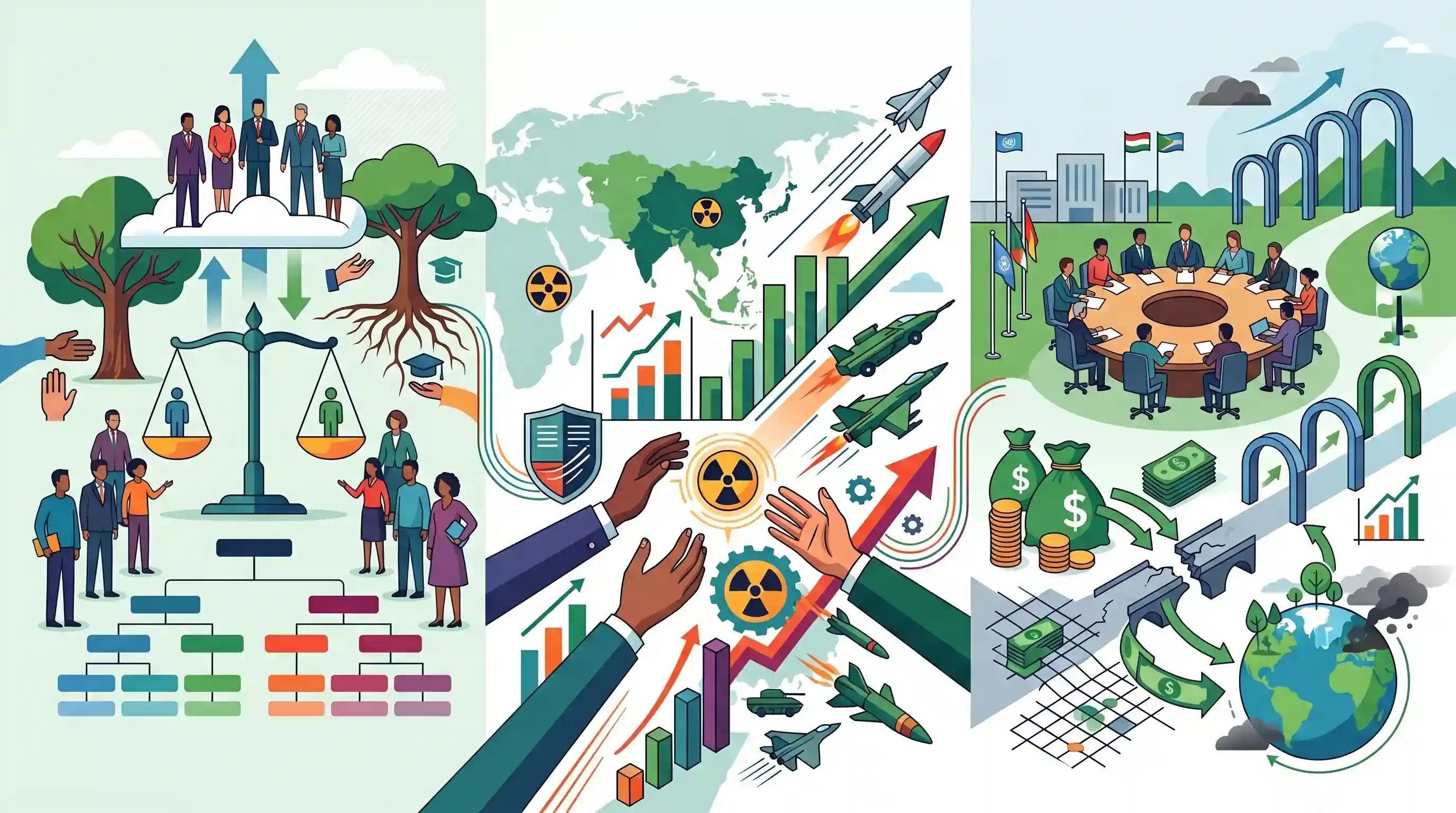
This UPSC Key analysis covers three crucial domains: Social Justice, International Relations, and Environment. It explores the ongoing debates around the equitable distribution of reservation benefits for Other Backward Classes (OBCs) through sub-categorisation and the creamy layer concept. Globally, it reviews the latest findings from the SIPRI Yearbook, which warns of increasing nuclear arsenals and rapid military modernization, particularly in Asia. Finally, it highlights the technical negotiations at the Bonn Climate Change Conference, which sets the foundation for future UN COP summits by attempting to resolve contentions over climate finance, specifically the New Collective Quantified Goal (NCQG).
Key Points
- The SIPRI Yearbook highlights a global trend of continuous modernization and expansion of nuclear arsenals, with significant focus on the increasing stockpiles of China, India, and Pakistan.
- The Bonn Climate Change Conference serves as a critical intermediary negotiation ahead of the annual COP, with a primary focus on establishing a New Collective Quantified Goal (NCQG) for climate finance.
- The discourse on Other Backward Classes (OBCs) emphasizes sub-categorisation to ensure equitable distribution of reservation benefits, underpinned by findings of the Justice Rohini Commission.
- The concept of the 'creamy layer' remains central to OBC reservation policies, aiming to prevent socially and economically advanced individuals from monopolizing affirmative action quotas.
Important Terms
National Commission for Backward Classes (NCBC)

A constitutional body under Article 338B established to safeguard the interests of socially and educationally backward classes, monitor welfare measures, and investigate complaints related to OBC rights.
UPSC context
GS Paper 2: Polity/Social Justice. Tests knowledge of constitutional bodies and affirmative action frameworks.
New Collective Quantified Goal (NCQG)
A post-2025 climate finance target being negotiated under the UNFCCC to replace the previous $100 billion annual pledge from developed to developing nations.
UPSC context
GS Paper 3: Environment/Climate Change. Crucial for understanding global climate finance and North-South negotiations.
UNFCCC
A 1992 international treaty aimed at stabilizing greenhouse gas concentrations to prevent dangerous human interference with the climate system; it is the parent treaty of the Paris Agreement.
UPSC context
GS Paper 3: Environment. Essential for tracking international climate governance and India's commitments.
Paris Agreement
A 2015 legally binding international treaty aimed at limiting global warming to well below 2°C, preferably 1.5°C, through self-determined climate targets called Nationally Determined Contributions (NDCs).
UPSC context
GS Paper 3: Environment. High frequency topic regarding mitigation, adaptation, and global climate equity.
SIPRI (Stockholm International Peace Research Institute)
An independent international institute in Sweden that publishes an annual yearbook tracking global military expenditure, arms trade, and the status of world nuclear arsenals.
UPSC context
GS Paper 2 & 3: IR/Security. Useful for data on regional arms races and nuclear security.
Treaty on the Non-Proliferation of Nuclear Weapons (NPT)
A 1968 landmark treaty aimed at preventing nuclear weapons spread and promoting disarmament; it distinguishes between Nuclear-Weapon States (pre-1967 tests) and Non-Nuclear-Weapon States.
UPSC context
GS Paper 2: International Relations. Tests understanding of global security architecture and India's "discriminatory" stance.
Prelims Trap
The Justice Rohini Commission for the sub-categorisation of OBCs was established under Article 338B of the Constitution.
Article 338B establishes the National Commission for Backward Classes (NCBC). However, specific commissions to investigate conditions of backward classes (like Rohini or Mandal) are appointed under Article 340.
Static Concepts Connected
Which Constitutional provisions govern the welfare and identification of Backward Classes?
- Art 15(4) & 16(4): Empower the State to make special provisions and reservations in appointments for socially and educationally backward classes.
- Article 340: Grants the President the power to appoint a commission to investigate the conditions of backward classes and recommend ameliorative steps.
- Article 338B: Inserted by the 102nd Amendment, it confers constitutional status and investigative powers on the National Commission for Backward Classes (NCBC).
What is the New Collective Quantified Goal (NCQG) under the UNFCCC?
- Post-2025 Target: It is the new global climate finance target meant to succeed the 2009 Copenhagen commitment of $100 billion per year, kicking in post-2025.
- Paris Agreement Origin: Mandated by the 2015 Paris Agreement to reflect the growing, trillions-of-dollars needs of developing countries for climate mitigation and adaptation.
- Floor Value: The NCQG negotiations stipulate that the new financial target must have a floor (minimum baseline) of at least $100 billion annually.
Cross-Topic Patterns
Sub-categorisation & the 105th Amendment
The debate over Central OBC sub-categorisation directly connects to the 105th Constitutional Amendment, which restored the power of states to maintain their own separate lists of backward classes.
Nuclear Posturing & NFU Doctrine
India's growing nuclear stockpile, as tracked by SIPRI, brings its 'No First Use' (NFU) doctrine and the credibility of its nuclear triad into focus for Mains IR.

NCQG is highly probable in 2026 Prelims Environment; expect statements contrasting it with the older $100B Copenhagen pledge and the GCF.
Linked PYQs · 5
Linked PYQs · 5
- 2022MainsGS2
Discuss the role of the National Commission for Backward Classes in the wake of its transformation from a statutory body to a constitutional body.
- 2021MainsGS3
Describe the major outcomes of the 26th session of the Conference of the Parties (COP) to the United Nations Framework Convention on Climate Change (UNFCCC). What are the commitments made by India in this conference?
- 2025MainsGS3
Write a review on India's climate commitments under the Paris Agreement (2015) and mention how these have been further strengthened in COP26 (2021). In this direction, how has the first Nationally Determined Contribution intended by India been updated in 2022?
- 2015PrelimsGS1
Consider the following countries: 1. China 2. France 3. India 4. Israel 5. Pakistan Which among the above are Nuclear Weapons States as recognized by the Treaty on the Non-Proliferation of Nuclear Weapons, commonly known as Nuclear Non-Proliferation Treaty (NPT)?
- 2018PrelimsGS1
What is/are the consequence/consequences of a country becoming the member of the 'Nuclear Suppliers Group'? 1. It will have access to the latest and most efficient nuclear technologies. 2. It automatically becomes a member of "The Treaty on the Non-Proliferation of Nuclear Weapons (NPT)". Which of the statements given above is/are correct?
