One Nation One Election UAV Security and Yatra Routes
Source:Indian Express ↗
Why It Matters
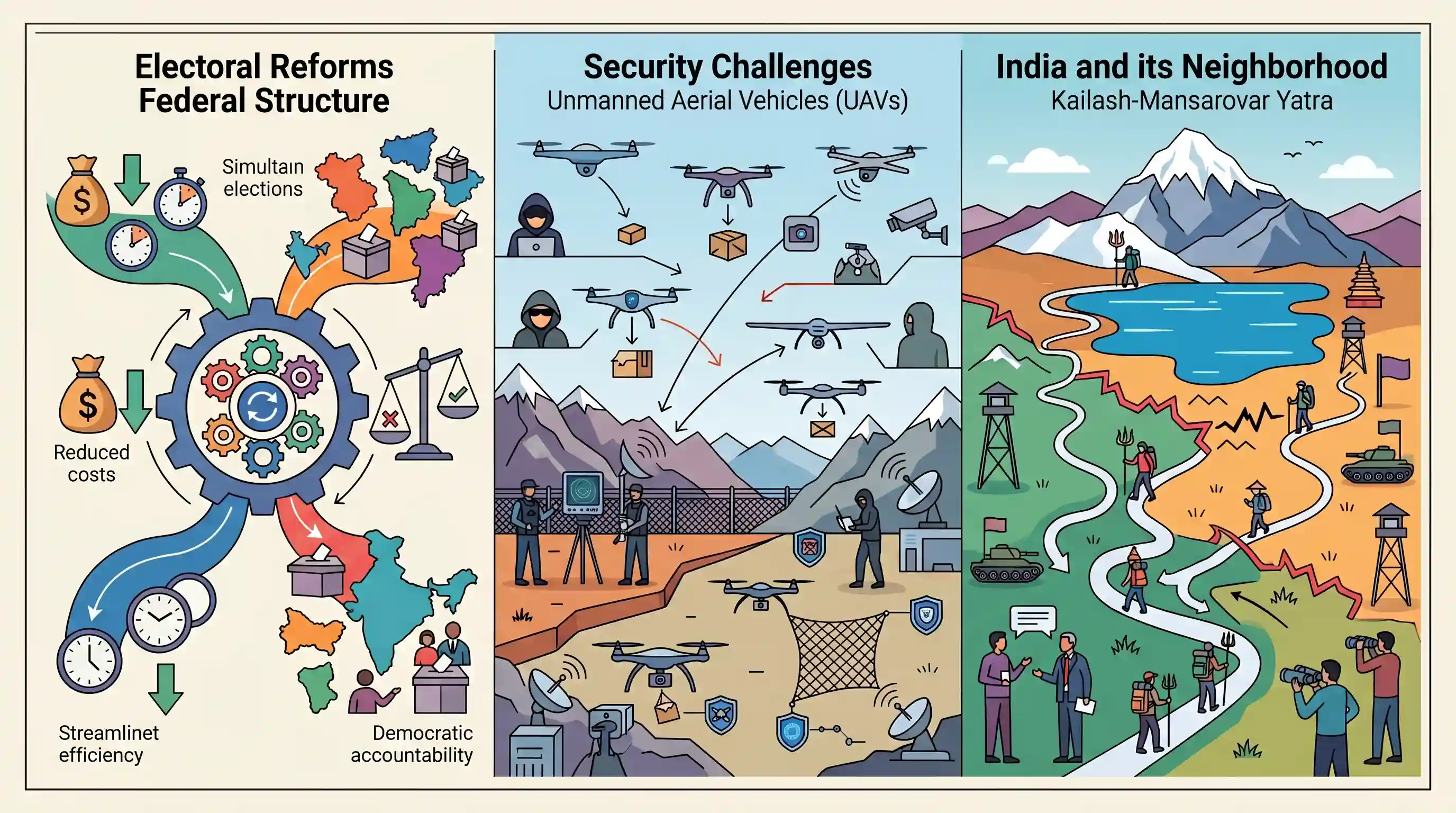
These topics intersect directly with the core UPSC syllabus. 'One Nation, One Election' is a recurring theme in GS2 pertaining to electoral reforms and federalism. UAVs are a modern security threat highlighted in GS3 border management, while the Kailash-Mansarovar Yatra provides essential geographical and diplomatic context for India-China bilateral relations.
Summary
This UPSC Key compilation explores three critical topics: the 'One Nation, One Election' proposal, the security implications of Unmanned Aerial Vehicles (UAVs), and the geographical and diplomatic context of the Kailash-Mansarovar Yatra. It evaluates the debate surrounding simultaneous elections, including its potential to reduce costs versus concerns over federalism and democratic accountability. The article also highlights the growing threat of drones in border management and cross-border smuggling. Lastly, it touches upon the religious and strategic significance of the Kailash-Mansarovar Yatra routes amidst ongoing India-China border dynamics.
Key Points
- The 'One Nation, One Election' initiative aims to synchronize Lok Sabha and State Assembly elections to minimize election expenditure and the disruption of governance caused by the Model Code of Conduct.
- While simultaneous elections can streamline administration, critics argue they may overshadow regional issues with national narratives and impact the accountability of elected governments.
- Unmanned Aerial Vehicles (UAVs) and drones present significant internal security challenges, particularly due to their use by adversaries for cross-border smuggling of arms, ammunition, and narcotics.
- The Kailash-Mansarovar Yatra holds profound religious significance and its traditional routes navigate strategically sensitive border areas, reflecting the nuanced diplomatic and territorial dynamics between India and China.
Important Terms
One Nation, One Election

A proposal to synchronize elections for the Lok Sabha and all State Legislative Assemblies, aiming to hold them simultaneously every five years to reduce expenditure and prevent frequent governance disruptions.
UPSC context
GS Paper 2: Electoral Reforms; tests understanding of federalism, constitutional amendments, and administrative efficiency in India's democracy.
Unmanned Aerial Vehicles (UAVs)
Remotely piloted or autonomous aircraft used for surveillance and combat. In India, they present growing internal security threats like cross-border smuggling of narcotics, weapons, and gathering of sensitive intelligence.
UPSC context
GS Paper 3: Internal Security; evaluates threats from non-state actors and technological challenges in border area management.
Representation of the People Act, 1951
A parliamentary act governing the actual conduct of elections, qualifications/disqualifications of candidates, registration of political parties, and the mechanism for resolving election-related disputes.
UPSC context
GS Paper 2: Salient features of RPA; tests knowledge of the statutory framework ensuring free and fair elections.
Election Commission of India (ECI)
An autonomous constitutional body established under Article 324 to superintend, direct, and control the election process for Parliament, State Legislatures, and the offices of President and Vice-President.
UPSC context
GS Paper 2: Constitutional Bodies; tests understanding of the guardian of electoral democracy and its administrative powers.
Kailash-Mansarovar Yatra
A high-altitude spiritual pilgrimage to Mount Kailash and Lake Mansarovar in Tibet. It holds immense religious significance for multiple faiths and serves as a tool for cultural diplomacy.
UPSC context
GS Paper 1 (Geography/Culture) and GS Paper 2 (International Relations); tests knowledge of trans-Himalayan geography and India-China relations.
Model Code of Conduct (MCC)
A set of guidelines issued by the Election Commission of India to regulate the conduct of political parties and candidates during elections to ensure a level playing field.
UPSC context
GS Paper 2: Polity; tests knowledge of the Election Commission’s role in ensuring ethical campaigning and governance during polls.
Prelims Trap
All constitutional amendments required to implement 'One Nation, One Election' require ratification by 50% of the states.
The Kovind Committee clarified that synchronizing Lok Sabha and State Assemblies does not require state ratification. Only the subsequent synchronization of local body elections requires it.
Static Concepts Connected
Which Constitutional Articles dictate the tenure and dissolution of Parliament and State Legislatures?
- Articles 83 & 172: Prescribe the normal five-year duration of the Lok Sabha and State Legislative Assemblies, respectively.
- Articles 85 & 174: Empower the President and Governors to dissolve the Lok Sabha and State Assemblies before their five-year terms expire.
- Article 356: Allows the imposition of President's Rule, which frequently disrupts the standard five-year state election cycle.
What is the geographical and strategic significance of Lipulekh and Nathu La passes?
- Lipulekh Pass: Located in Uttarakhand, it forms a highly sensitive strategic tri-junction connecting India, Nepal, and the Tibet Autonomous Region of China.
- Nathu La Pass: Located in Sikkim, this fully motorable corridor was part of the ancient Silk Road and connects India to the Chumbi Valley in Tibet.
Cross-Topic Patterns
Anti-Drone Tech + Narco-Terrorism
Low-flying UAVs circumventing radar directly link border management vulnerabilities with India's proximity to the Golden Crescent, exacerbating cross-border narco-terrorism in border states like Punjab.
ONOE + Asymmetric Federalism
Synchronized elections spark debates on whether national narratives will overshadow regional issues, directly linking GS2 electoral reforms to the basic structure doctrine and the health of Indian federalism.

ONOE's staggered transition—specifically which amendments need 50% state ratification—is highly probable as a multi-statement Prelims trap.
Linked PYQs · 3
Linked PYQs · 3
- 2024MainsGS2
Examine the need for electoral reforms as suggested by various committees with particular reference to "one nation one election" principle.
- 2017MainsGS2
Simultaneous election to the Lok Sabha and the State Assemblies will limit the amount of time and money spent in electioneering but it will reduce the government's accountability to the people." Discuss.
- 2023MainsGS3
The use of unmanned aerial vehicles (UAVs) by our adversaries across the borders to ferry arms/ammunitions, drugs, etc., is a serious threat to the internal security. Comment on the measures being taken to tackle this threat.
