Judicial impeachment procedures and foreign contribution regulations
Source:Indian Express ↗
Why It Matters
These are recurring themes in UPSC examinations. Understanding the ecological impact of oil pollution is crucial for GS3, while the intricate procedures for judicial impeachment and the regulation of foreign funding to NGOs are foundational for GS2 Polity and Governance.
Summary
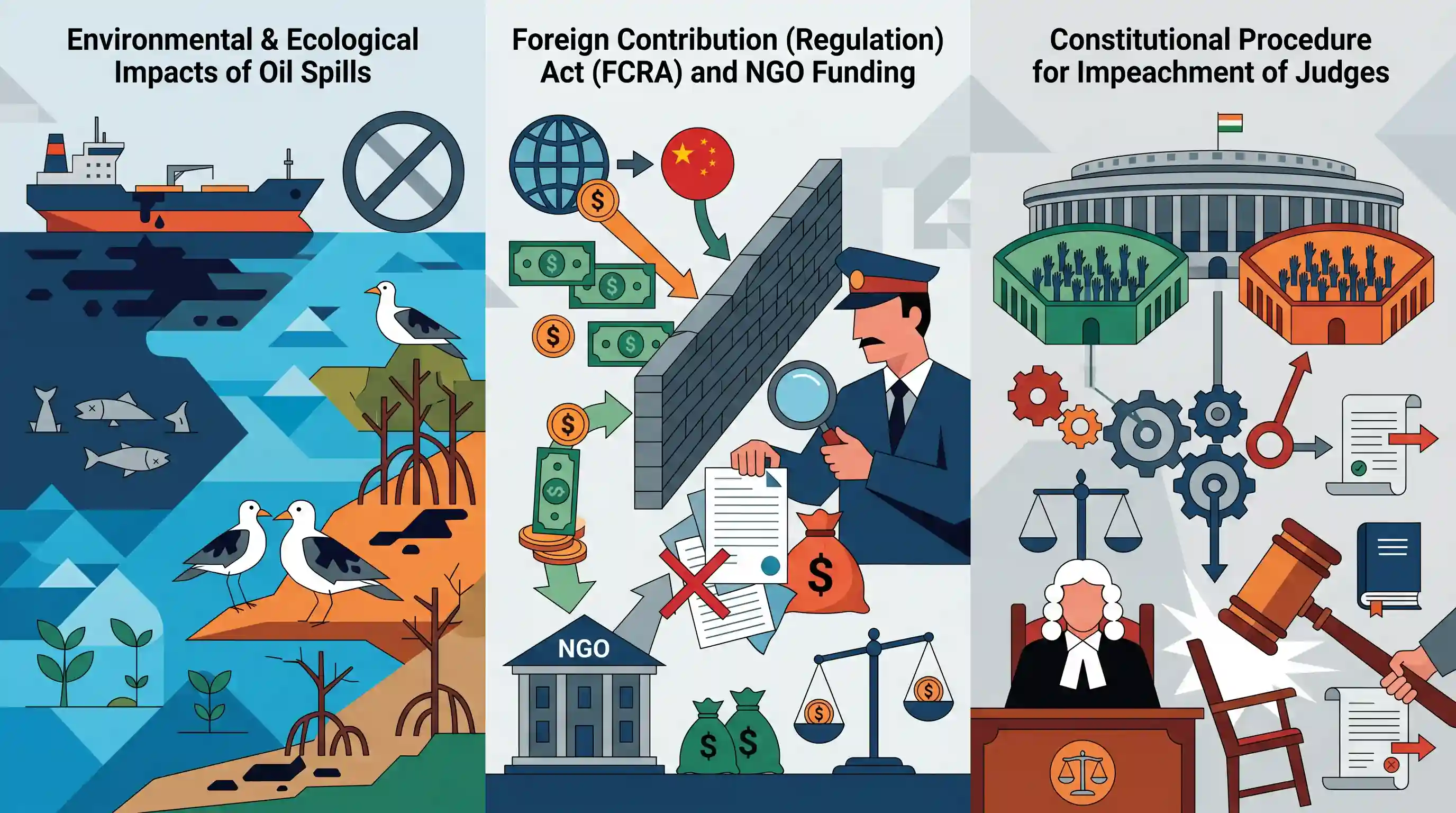
The article highlights essential UPSC topics: the environmental and ecological impacts of oil spills, the regulatory framework and recent stringencies of the Foreign Contribution (Regulation) Act (FCRA) regarding NGO funding, and the constitutional procedure for the impeachment of judges in India.
Key Points
- Oil spills pose severe threats to marine ecosystems and coastal livelihoods, making bioremediation and strict maritime regulations crucial for disaster management.
- The FCRA regulates foreign donations to NGOs to safeguard internal security, with stringent compliance norms leading to recent license cancellations.
- The impeachment of judges in India is a rigorous constitutional process under Article 124(4) and the Judges (Inquiry) Act, 1968, requiring a special majority in Parliament on grounds of proved misbehaviour or incapacity.
Important Terms
Foreign Contribution (Regulation) Act (FCRA)

A 1976 law (amended in 2010 and 2020) that regulates foreign donations to individuals and NGOs to prevent foreign influence in India's internal affairs and safeguard national security.
UPSC context
GS Paper 2 (Governance) and GS Paper 3 (Internal Security); tests regulatory frameworks and NGO oversight.
Judges (Inquiry) Act 1968
The statutory law that operationalizes Article 124(5) by prescribing the specific procedure for investigating allegations of misbehavior or incapacity against Supreme Court and High Court judges.
UPSC context
GS Paper 2 (Judiciary); tests constitutional procedures for judicial accountability and independence.
Oil Spill
The accidental release of petroleum hydrocarbons into marine or coastal environments, leading to severe ecological damage, biodiversity loss, and economic disruption for fishing and tourism communities.
UPSC context
GS Paper 3 (Environment/Disaster Management); covers environmental pollution and mitigation technologies.
NGOs (Non-Governmental Organizations)
Voluntary, non-profit organizations independent of government that advocate for social changes, provide services, and act as pressure groups to bridge gaps in governance.
UPSC context
GS Paper 2 (Governance/Social Justice); tests the role of civil society and development processes.
Impeachment of Judges
The constitutional process (Articles 124 and 217) for removing higher judiciary judges for proved misbehavior or incapacity, requiring a special majority in both Houses of Parliament.
UPSC context
GS Paper 2 (Polity); evaluates knowledge of checks and balances and parliamentary procedures.
Prelims Trap
"A Supreme Court judge can be removed on grounds of violation of the Constitution."
Only the President is impeached for "violation of the Constitution" (Article 61). Judges are removed exclusively on grounds of "proved misbehaviour or incapacity" under Article 124(4).
Static Concepts Connected
What is the constitutional procedure for removing a Supreme Court Judge?
- Initiation: A removal motion requires the signatures of 100 Lok Sabha members or 50 Rajya Sabha members before submission to the respective presiding officer.
- Investigation: The Speaker or Chairman forms a three-member committee (an SC judge, an HC Chief Justice, and a distinguished jurist) to investigate the charges.
- Special Majority: If proven, both Houses must pass the motion by a majority of the total membership and two-thirds of members present and voting.
How does bioremediation mitigate marine oil spills?
- Oilzapper Technology: Developed by TERI, this specific microbial consortium feeds on crude oil spills, degrading toxic petroleum hydrocarbons into non-toxic carbon dioxide and water.
- Marine Ecosystem Restoration: By clearing oil slicks rapidly, bioremediation restores surface sunlight penetration, which is absolutely critical for phytoplankton photosynthesis and sustaining marine food webs.
Cross-Topic Patterns
FCRA & Internal Security overlaps
UPSC often links FCRA stringency (like the SBI-only account mandate) directly to internal security, specifically curbing foreign funding of anti-development protests or Left Wing Extremism.
Judicial Independence vs Accountability
The rigorous removal process under the Judges (Inquiry) Act balances judicial independence with accountability, a frequent analytical theme in GS-2 Mains questions.

Expect a multi-statement Prelims question mixing FCRA's strict SBI-branch mandate with the absolute ban on sub-granting to other entities.
Linked PYQs · 3
Linked PYQs · 3
- 2023MainsGS3
What is oil pollution? What are its impacts on the marine ecosystem? In what way is oil pollution particularly harmful for a country like India?
- 2015MainsGS2
Examine critically the recent changes in the rules governing foreign funding of NGOs under the Foreign Contribution (Regulation) Act (FCRA), 1976.
- 2019PrelimsGS1
Consider the following statements: 1. The motion to impeach a Judge of the Supreme Court of India cannot be rejected by the Speaker of the Lok Sabha as per the Judges (Inquiry) Act, 1968. 2. The Constitution of India defines and gives details of what constitutes 'incapacity and proved misbehaviour' of the Judges of the Supreme Court of India. 3. The details of the process of impeachment of the Judges of the Supreme Court of India are given in the Judges (Inquiry) Act, 1968. 4. If the motion for the impeachment of a Judge is taken up for voting, the law requires the motion to be backed by each House of the Parliament and supported by a majority of total membership of that House and by not less than two-thirds of total members of that House present and voting. Which of the statements given above is/are correct?
