Parliamentary Motions Speaker Removal and SC ST Sub Classification
Source:Indian Express ↗
Why It Matters
These topics form the core of GS Paper 2 (Polity and Social Justice) and GS Paper 3 (Economy). The Speaker's removal process is a frequent Prelims testing area. SC/ST sub-classification is a monumental shift in affirmative action jurisprudence, vital for Mains GS2. The India-US trade deal reflects shifting geopolitical economic strategies, relevant for both Mains GS2 (IR) and GS3 (Economy).
Summary
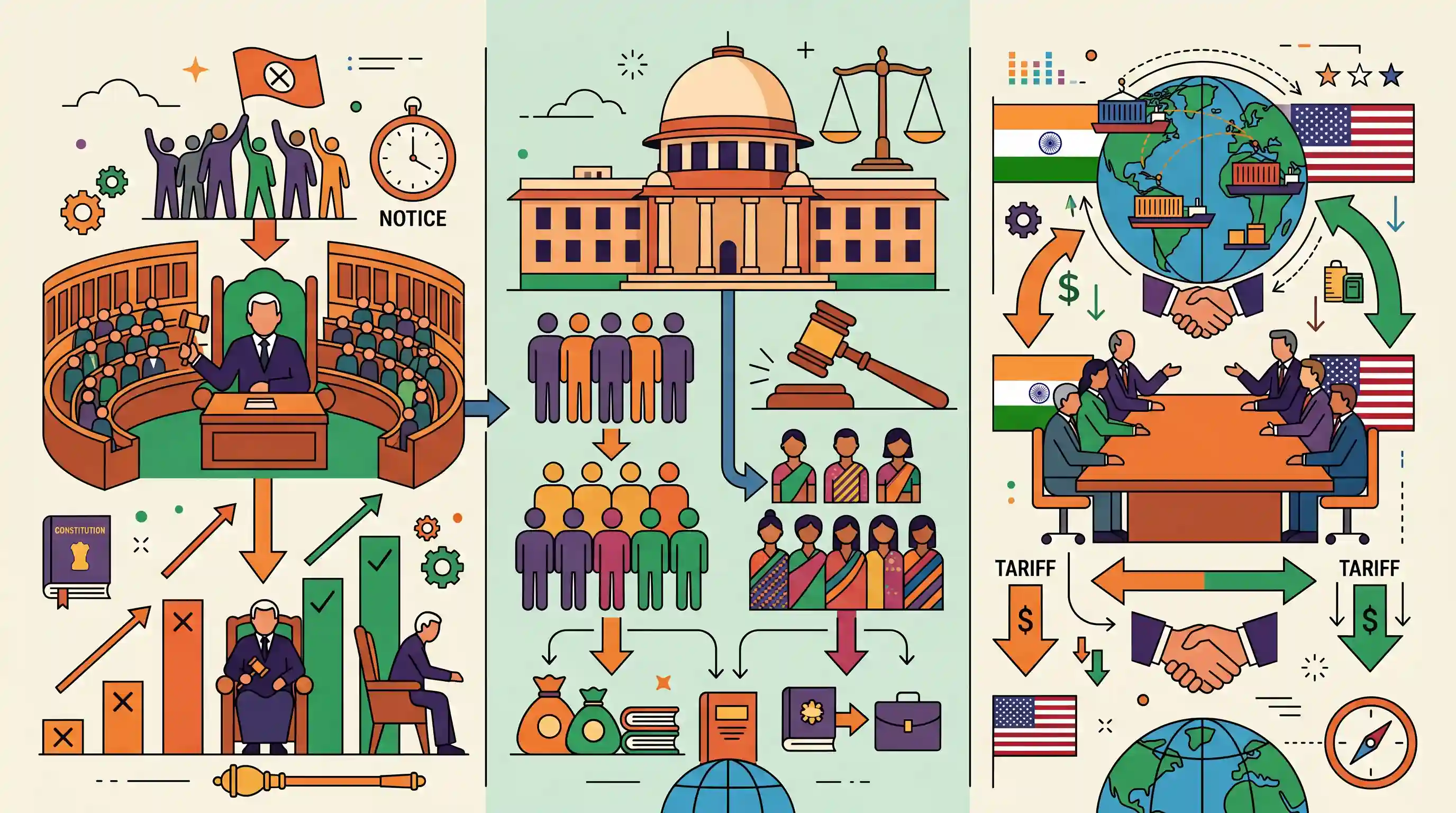
This UPSC Key edition highlights three critical developments: the constitutional provisions and parliamentary procedures for moving a no-confidence motion against the Lok Sabha Speaker, the Supreme Court's landmark ruling authorizing states to sub-classify SCs and STs for equitable reservation distribution, and the ongoing discussions for an India-US interim trade deal. The topics intersect Indian Polity, Social Justice, and International Trade dynamics.
Key Points
- The removal of the Lok Sabha Speaker is governed by Constitutional Articles 94 and 96, requiring a 14-day advance notice and a resolution passed by an effective majority (majority of all the then members).
- During a resolution for their removal, the Speaker cannot preside over the House but retains the right to speak, participate in proceedings, and vote in the first instance (but not a casting vote).
- A Constitution bench of the Supreme Court has permitted the sub-classification of Scheduled Castes and Scheduled Tribes by states to provide targeted reservation to the most marginalized sub-groups, overruling the 2004 E.V. Chinnaiah judgment.
- India and the US are exploring an interim bilateral trade deal to ease tariff barriers and secure market access, navigating a global shift toward protectionism and bilateral agreements.
Important Terms
Sub-classification (SC/ST)

The process of categorizing Scheduled Castes or Tribes into subgroups to provide targeted reservation benefits to the most disadvantaged among them, based on varying levels of backwardness.
UPSC context
GS II (Social Justice/Judiciary); tests understanding of Article 341 and the evolving nature of affirmative action policy.
Article 94
The constitutional provision outlining the removal of the Lok Sabha Speaker or Deputy Speaker via a resolution passed by a majority of all the then members.
UPSC context
GS II (Indian Polity); essential for understanding the accountability and independence of constitutional presiding officers.
Article 96
A constitutional mandate stating that the Speaker or Deputy Speaker cannot preside over a Lok Sabha sitting while a resolution for their removal is under consideration.
UPSC context
GS II (Parliamentary Procedures); focuses on procedural safeguards and the rule against bias in legislative functions.
Generalized System of Preferences (GSP)
A trade program where developed countries provide preferential duty-free entry for products from designated developing nations to promote their economic growth and trade diversification.
UPSC context
GS II (International Relations) & III (Economy); relevant for India-US trade friction and WTO-related trade concessions.
E.V. Chinnaiah v. State of Andhra Pradesh
A 2004 Supreme Court judgment that held Scheduled Castes to be a 'homogenous group' that could not be sub-divided; it was overruled by a seven-judge bench in 2024.
UPSC context
GS II (Constitution/Judiciary); crucial for tracing the legal history and judicial shift in India's reservation jurisprudence.
Interim Trade Agreement
A limited-scope 'early harvest' trade pact designed to deliver immediate commercial gains and resolve friction before a comprehensive Free Trade Agreement (FTA) is finalized.
UPSC context
GS III (Economy); pertains to India's recent shift toward incremental trade negotiation strategies with strategic partners.
Prelims Trap
The Speaker can exercise a casting vote when a resolution for their removal is under consideration.
Under Article 96, the Speaker can vote in the first instance during their removal resolution, but is explicitly barred from exercising a casting vote in the event of a tie.
Static Concepts Connected
What is an "effective majority" in the Indian Constitution?
- Calculation basis: It requires more than 50% of the effective strength of the House, calculated as the total seats minus vacant seats.
- Constitutional usage: It is specifically used for the removal of the Speaker and Deputy Speaker of Lok Sabha/State Assemblies, and the Deputy Chairman of Rajya Sabha.
- Absolute contrast: It differs from an absolute majority, which requires more than 50% of the total sanctioned strength of the House regardless of actual vacancies.
Who holds the power to modify the Scheduled Castes list?
- Presidential notification: Under Article 341, the President issues the initial notification specifying the castes deemed as Scheduled Castes in a State or Union Territory.
- Parliament's exclusivity: Only Parliament can enact a law to include or exclude a caste from the Presidential list. State legislatures entirely lack this power.
- State sub-classification: The recent Supreme Court verdict permits states to apportion quotas among sub-groups within the existing list without illegally altering the central Presidential list itself.
Cross-Topic Patterns
Indra Sawhney & SC/ST creamy layer
The SC/ST sub-classification ruling revives the debate on substantive equality versus formal equality, linking directly to the 'creamy layer' application previously restricted mostly to OBCs under the Indra Sawhney judgment.
Early Harvest Deals vs WTO stagnation
India's pursuit of interim trade deals is a strategic response to the paralysis of the WTO's dispute settlement body and deadlocked multilateral trade negotiations, reflecting a broader pivot toward bilateralism.

Speaker removal mechanics (Art 96) and State powers for SC/ST sub-classification (Art 341) are prime multi-statement Prelims targets 2026.
Linked PYQs · 5
Linked PYQs · 5
- 2024PrelimsGS1
With reference to the Speaker of the Lok Sabha, consider the following statements : While any resolution for the removal of the Speaker of the Lok Sabha is under consideration 1. He/She shall not preside. 2. He/She shall not have the right to speak. 3. He/She shall not be entitled to vote on the resolution in the first instance. Which of the statements given above is/are correct?
- 2025PrelimsGS1
Consider the following statements : I. On the dissolution of the House of the People, the Speaker shall not vacate his/her office until immediately before the first meeting of the House of the People after the dissolution. II. According to the provisions of the Constitution of India, a Member of the House of the People on being elected as Speaker shall resign from his/her political party immediately. III. The Speaker of the House of the People may be removed from his/her office by a resolution of the House of the People passed by a majority of all the then Members of the House, provided that no resolution shall be moved unless at least fourteen days' notice has been given of the intention to move the resolution. Which of the statements given above are correct?
- 2018MainsGS2
Whether National Commission for Scheduled Castes (NCSC) can enforce the implementation of constitutional reservation for the Scheduled Castes in the religious minority institutions? Examine.
- 2025MainsGS3
What are the challenges before the Indian economy when the world is moving away from free trade and multilateralism to protectionism and bilateralism? How can these challenges be met?
- 2018MainsGS3
How would the recent phenomena of protectionism and currency manipulations in world trade affect macroeconomic stability of India?
