New IST Rules, Chinese Industrial Overcapacity and Himalayan Dams
Source:Indian Express ↗
কেন এটি গুরুত্বপূর্ণ
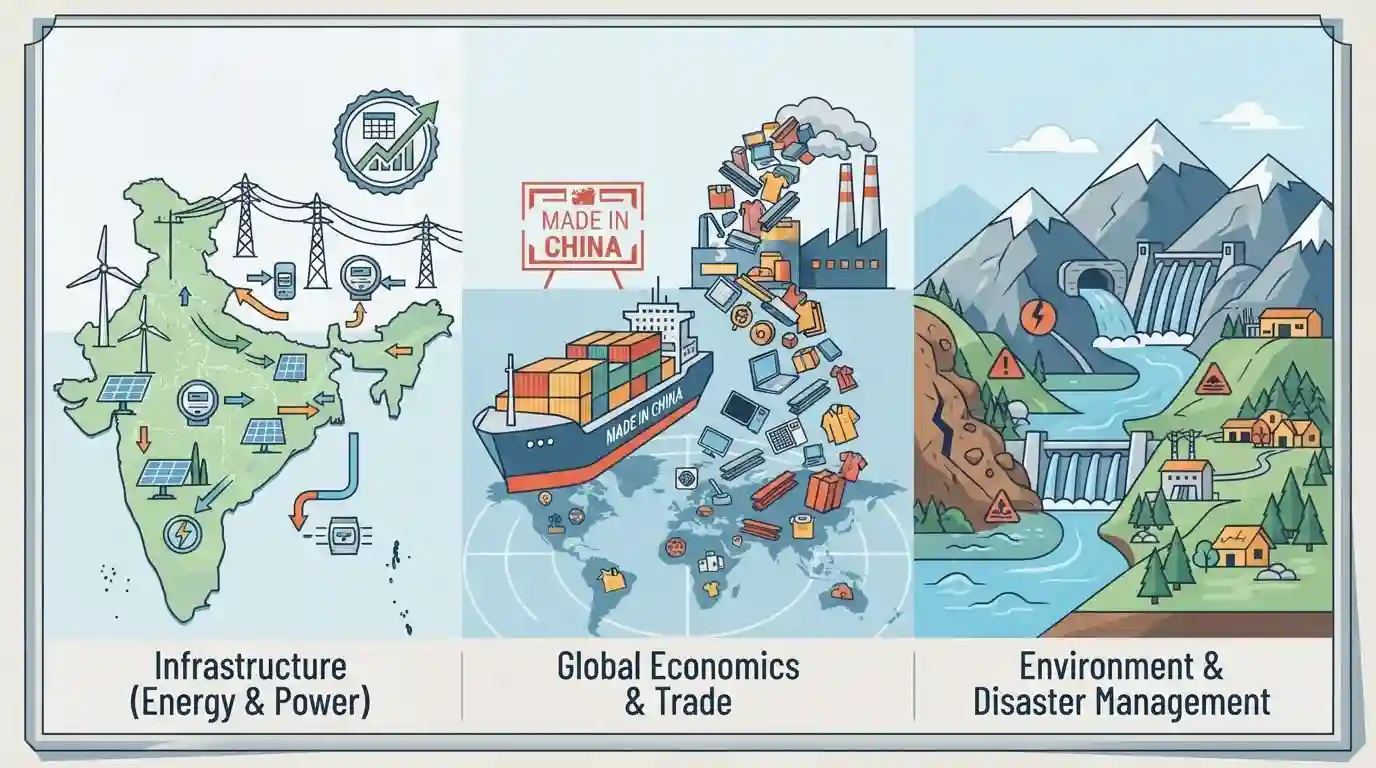
These topics directly tie into GS Paper 3 syllabus areas covering infrastructure development, energy security, effects of liberalization and global trade on Indian industry, and environmental impact assessment/disaster management in fragile ecosystems like the Himalayas.
সারসংক্ষেপ
The article covers key current affairs topics relevant for UPSC preparation, including the new Inter-State Transmission System (IST) rules impacting India's power and renewable sector, the economic challenges of Chinese industrial overcapacity on global trade and domestic manufacturing, and the environmental and disaster risks associated with hydropower projects in the Himalayas.
মূল বিষয়
- New Inter-State Transmission System (IST) rules aim to streamline power transmission, lower grid costs, and facilitate renewable energy integration in India.
- Chinese industrial overcapacity poses threats to global trade, driving cheap exports, anti-dumping duties, and protectionist measures by economies like India and the US.
- Himalayan dams and large-scale hydropower projects raise critical environmental, ecological, and disaster-management concerns regarding landslides, seismic activity, and downstream vulnerabilities.
গুরুত্বপূর্ণ শব্দ
Inter-State Transmission System (IST) Rules

India's centrally coordinated high-voltage network that facilitates the bulk transfer of electricity across state boundaries, crucial for integrating renewable energy and managing grid connectivity under CERC regulations.
UPSC context
UPSC Paper III (Infrastructure - Energy & Power): Tests understanding of power grid reforms, renewable energy evacuation, and transmission economics.
Chinese Industrial Overcapacity
An economic condition where industrial production capacity significantly exceeds domestic and global market demand, often driven by state-backed subsidies, triggering international trade disputes and protectionism.
UPSC context
UPSC Paper III (Global Economics & Trade): Important for analyzing global supply chains, dumping, anti-dumping duties, and India's manufacturing competitiveness.
Central Electricity Regulatory Commission
The apex statutory quasi-judicial regulator of the Indian electricity sector responsible for determining tariffs, regulating inter-state transmission systems, and fostering competitive power markets.
UPSC context
UPSC Paper II / III (Polity/Governance & Infrastructure): Tests knowledge of statutory regulatory bodies, institutional frameworks, and energy governance in India.
World Trade Organization
An international organization established to deal with global rules of trade between nations, providing a framework for negotiating trade agreements and resolving trade disputes.
UPSC context
UPSC Paper III (International Relations & Global Economics): Essential for questions on multilateral trade frameworks, dispute settlement, and subsidy rules.
সংযুক্ত স্থির ধারণা
What are the institutional mechanisms and trade defense instruments used against unfair foreign market dumping?
- Countervailing Duties: Tariffs imposed to offset state subsidies in exporting countries, leveling the playing field for domestic industries under WTO rules.
- Anti-Dumping Duties: Levies applied by importing countries to counter below-cost exports that cause material injury to domestic manufacturing.
- Safeguard Measures: Temporary trade restrictions invoked under WTO Safeguards Agreement to protect a domestic industry from a sudden, unforeseen surge in imports.
What are the key governance frameworks for Inter-State Transmission Systems (ISTS) and power sector open access in India?
- CERC Mandate: Statutory body under the Electricity Act 2003 responsible for regulating inter-state transmission tariffs and issuing grid regulations.
- Green Open Access: Regulatory mechanism allowing consumers with specified loads to buy electricity directly from generators or open markets, bypassing discoms.
- ISTS Charges Waiver: National framework facilitating seamless evacuation and wheeling of bulk power across state boundaries with rationalized transmission charges.
আন্তঃবিষয় প্যাটার্ন
Chinese Overcapacity & WTO Trade Remedies
Chinese industrial overcapacity in clean tech feeds directly into trade defense cases, testing India's WTO compliance and domestic safeguard mechanisms.
Himalayan Dams & NDMA Disaster Guidelines
Himalayan dam vulnerabilities intersect with disaster management policy, testing the efficacy of the National Disaster Management Authority's (NDMA) infrastructure guidelines in fragile terrains.

Chinese overcapacity + Himalayan ecology + IST grid rules will likely appear as linked statements in Economy & Environment prelims.
সংযুক্ত PYQ · 3
সংযুক্ত PYQ · 3
- 2025MainsGS3
The fusion energy programme in India has steadily evolved over the past few decades. Mention India's contributions to the international fusion energy project International Thermonuclear Experimental Reactor (ITER). What will be the implications of the success of this project for the future of global energy?
- 2017MainsGS3
Account for the failure of manufacturing sector in achieving the goal of labour-intensive exports. Suggest measures for more labour-intensive rather than capital-intensive exports.
- 2025MainsGS3
Mineral resources are fundamental to the country's economy and these are exploited by mining. Why is mining considered an environmental hazard? Explain the remedial measures required to reduce the environmental hazard due to mining.
